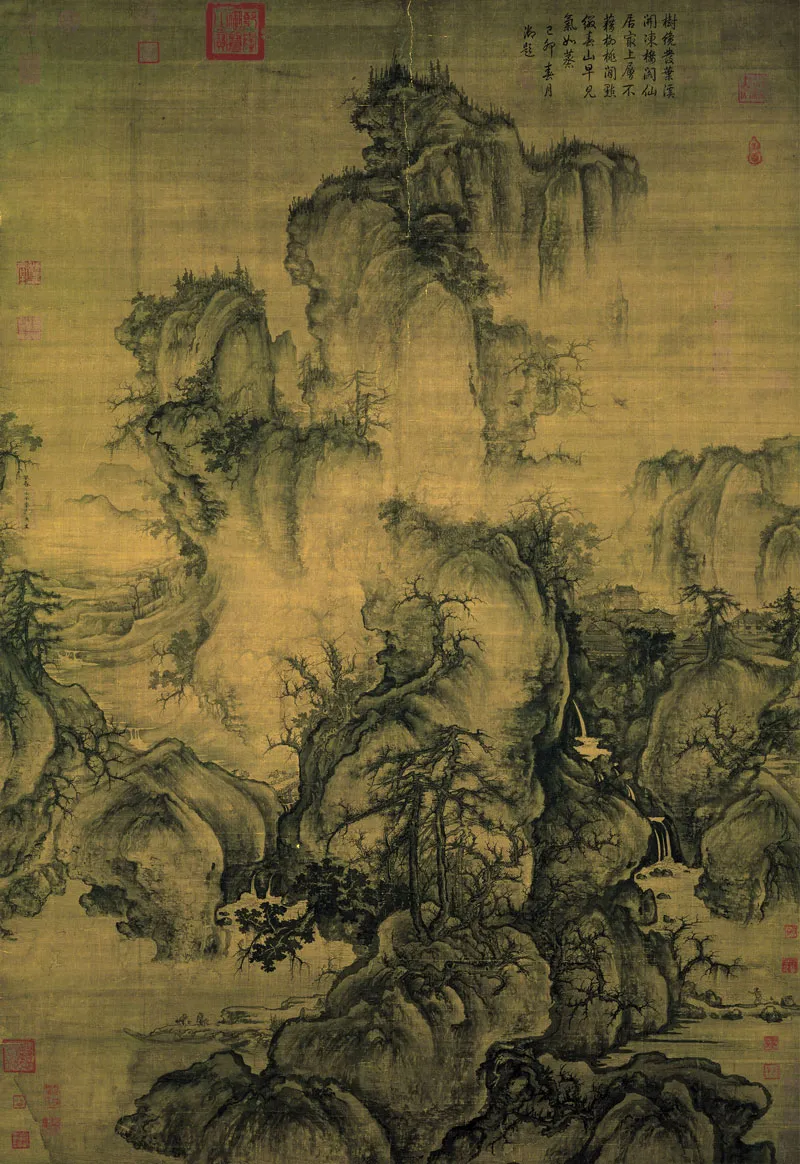
In the silence of an ancient Chinese scroll, the world is often rendered not by what is present, but by what is absent. The vast, mist-filled voids—known as liubai or “leaving white”—are not empty spaces; they are the breath of the painting, a spiritual expanse that allows the viewer to step out of the mundane and into the ethereal.
For artist Xiu Yitang, this emptiness is a functional necessity of beauty. “The function of this emptiness is to accentuate the main colour,” he observes. His practice is a delicate negotiation between the serenity of Taoist philosophy and a bold, resplendent aesthetic that recalls the grandeur of temple murals rather than the faded ink of later dynasties. Through his brush, the idyllic landscape becomes a stage for a higher reality, where the “oneness of heaven and man” is not just a concept, but a visual experience.
The Melody of Empty Space
To understand Xiu’s work, one must first understand the relationship between sound and silence. He likens painting to a musical composition, where the dominant color serves as the melody and the secondary hues provide the harmony. But without the pause—the white space—the music cannot resonate.
In Heavenly Music, this principle is vividly illustrated. The composition does not clutter the eye; instead, it uses the unpainted silk to represent the sky and the rolling mist beneath the mountains. These voids are the highlights, the light sources that define the form.
Heavenly Music by Xiu Yitang
Against this pristine backdrop, the contours of rocks, trees, and blue-green mountains emerge with crystalline clarity. “Although the colours I use are bright and bold, when placed strategically against the white space they look clean and transparent,” Xiu notes. The visual effect is one of reverberation—the colors echo through the valleys like the celestial music suggested by the title, distinct and unhurried.
A Return to Resplendence
While the Song and Yuan dynasties eventually drifted toward monochromatic ink and lighter washes, Xiu looks further back, or perhaps higher up, for his palette. He posits that the heavenly realms should not be depicted as dull or faded, but as “resplendent and glorious.” To capture this divinity, he returns to the “rich yet pure” colours found in nature—mineral blues, greens, and vermilions—adhering to the Taoist maxim that “the Tao follows nature.”
Gazing Towards Reunion by Xiu Yitang
In Gazing Towards Reunion, the artist employs a mineral-heavy scheme to differentiate the celestial from the mortal. The work depicts a divine being in a layered landscape, where the saturation of the pigment serves a symbolic function: to accentuate elegance and otherworldliness. Here, clarity is paramount. Just as a speaker must enunciate words clearly to be understood, a painter must define contours and highlights to prevent the image from becoming “dull.” The result is a vibrancy that feels illuminated from within, offering the viewer a momentary escape into a more lucid reality.
The Geometry of Enlightenment
Xiu’s reverence for tradition does not preclude technical evolution. In his exploration of the divine, he introduces elements of light manipulation and three-dimensional realism—techniques seldom utilized in ancient literati paintings.
The work Zhang Guolao demonstrates this subtle modernization. By adjusting light effects and heightening the contrast between radiance and shadow, Xiu emphasizes the “boundless radiance of the heavens.” The light is not merely physical; it is a manifestation of spiritual energy.
Zhang Guolao by Xiu Yitang
This duality is further explored in Laozi Writes the Tao Te Ching. The composition splits a single space into two dimensions: the tangible realm where the sage physically writes, and the higher, divine world his mind inhabits. To visualize this invisible connection—the flow of energy—Xiu utilizes a golden yellow hue and three-dimensional rendering. It is a visual translation of the “oneness of heaven and man,” where the sage exists simultaneously in form and spirit.
Laozi Writes the Tao Te Ching by Xiu Yitang
Symbolism and the Balance of Forces
When approaching established icons like the Monkey King, Xiu navigates the fine line between heritage and innovation. The character’s traits are sacred in Chinese culture, yet the artist finds room to inject a “more realistic depiction” without violating the canon.
The color choices in Monkey King are strictly codified yet deeply philosophical. Red anchors the composition, symbolizing the character’s boldness and courage. White is introduced to represent wisdom and vastness, while green offers a counterpoint of tranquillity.
Monkey King by Xiu Yitang
This arrangement is not arbitrary; it is a study in Yin and Yang. The juxtaposition of the cool jade green against the warm red-yellow spectrum creates a dynamic equilibrium. It renders the image “coordinated and balanced,” much like the Buddhist cave paintings that inspire Xiu’s portrayal of loyalty and bravery.
For Xiu Yitang, innovation is not a rejection of the past but a deepening of it. “Creating something new doesn’t necessarily mean that you’re starting from nothing,” he asserts. By respecting the natural laws and the sacred principles of the medium, he constructs a visual language that is both ancient and vividly present, proving that even in the modern era, the brush can still open a window to the divine.

 Heavenly Music by Xiu Yitang
 Gazing Towards Reunion by Xiu Yitang
 Zhang Guolao by Xiu Yitang
 Laozi Writes the Tao Te Ching by Xiu Yitang
 Monkey King by Xiu Yitang