In the cacophony of the 21st century, where the digital pulse dictates the rhythm of life for the generation born in the 1990s, Chen Shih-Hang stands as a deliberate anomaly. He does not seek the immediate gratification of the pixel, but rather the slow, permeating spread of ink on Xuan paper.
At the 2020 Chung-Shan Youth Art Awards—Taiwan’s premier platform for emerging talent—it was this quiet dedication that roared the loudest. Chen’s ink-wash magnum opus, Mountain of Immortals, claimed the top honor in its category. The judges noted a delicate high-wire act in his work: a profound respect for the ancestral roots of shanshui (mountain-water) painting, balanced by a willingness to push the medium’s physical boundaries.
Chen’s piece of Chinese ink painting Mountain of Immortals received the Zhongshan Award in the ink category as part of the 2020 Zhongshan Youth Art Awards.
The Sanctuary of Black Ink
For Chen, painting is less a career and more a monastic calling. A graduate of the National Taiwan University of the Arts, he has spent his youth anchoring himself against the rapid currents of modern life. His fascination lies in the elemental alchemy of the medium—watching ink bleed into water, a chaotic swirl that settles into a “celestial event.”
To the uninitiated, ink wash might appear monochromatic, a study in limitation. To Chen, it is a universe of infinite potential. “When you blend all the colours, you get black, an all-encompassing hue,” he observes. Through his lens, black is not the absence of light, but a vessel for it. In his hands, the ink becomes a living entity, textured with mystery, capable of mirroring the complex, breathing layers of the natural world.
Chen Shih-Hang’s painting Oil Pit Excursion uses layers of deep ink to create varying shades of vast mountains shrouded in mist.
A Dialogue with the Void
Chen’s artistic identity is forged in silence. As an introvert, he initially viewed his quiet nature as a melancholic reserve. Yet, through the meditative process of painting, his understanding evolved. Silence became a form of strength, a space for self-assurance rather than emptiness.
He draws philosophical sustenance from the ancient text Zhuangzi: “Heaven and Earth possess profound beauty yet remain silent.” This sentiment permeates his Silent Landscapes series. It is an acknowledgment that true grandeur—whether in the towering peaks of a mountain range or the depths of the human psyche—does not require words to validate its existence.
“Whenever I find myself in the presence of mountains and rivers, I experience a deep sense of contentment,” Chen reflects. For him, the speechlessness induced by nature’s splendour is the purest form of communication.
This reverence for the unsaid led to a material evolution in his work. Embracing the adage “Silence is gold,” Chen began incorporating Japanese gold foil paper into his compositions. In works like Gentleness in the Desolate Land, the shimmering backdrop contrasts sharply with the deep, inky mountains. Unlike his earlier, brooding piece Daybreak, where light struggled to pierce the darkness, these newer works radiate a tangible self-confidence, a “joyous spirit” emerging from the void.
In Chen’s work Gentleness in the Desolate Land—Gateway to the Sky, distinct gold textures contrast with the dark ink mountains.
The Micro-Architecture of Mist
The most striking aspect of Chen’s work lies in his technical rebellion against the constraints of traditional materials. Standard Xuan paper is notoriously unforgiving of excessive layering; it dissolves under the weight of too much moisture. Yet, Chen seeks a density that rivals oil painting—a palpable weight of silence.
To achieve this, he evolved the traditional dianran technique. Classically, dianran involves using the brush tip to create dots that merge into forms. Chen pushes this to an obsessive, microscopic extreme. He reduces the dots to the finest possible point, layering millions upon millions of them to construct his mountains.
This is not merely painting; it is an act of accumulation. By meticulously stacking these micro-dots, he engineers a unique chiaroscuro—an interplay of light and shadow that feels substantial yet breathable. The result is a paradox: mountains that look heavy enough to crush the earth, yet light enough to float in the mist.
In Chen’s painting Observing the Mist, varying shades of ink are layered to create a majestic mountain scene amid ethereal mist with birds in the sky.
Immortalizing Time
This labor-intensive technique fundamentally alters the artist’s relationship with time. In the studio, the clock dissolves. “Emotionally, time can seem to speed up considerably, even though in reality it follows its unchanging rhythm,” Chen notes. The millions of dots represent hours of repetitive, meditative action—a physical manifest of patience.
Chen views his Silent Landscapes as vessels that exist outside the human dimension of calendars and deadlines. They are attempts to capture the fleeting spark of inspiration and calcify it into something eternal. When a viewer stands before Observing the Mist or Mountain of Immortals, they are not just looking at a depiction of a landscape; they are witnessing the crystallization of the artist’s time.
Ultimately, these landscapes are internal. “While it may appear that I’m painting landscapes, at a deeper level each brushstroke is also a fragment of a self-portrait,” Chen admits. In the silence of the mountains, amidst the gold foil and the sea of black ink, Chen Shih-Hang is not just mapping the terrain of the earth, but the topography of his own evolving soul.

 Chen’s piece of Chinese ink painting Mountain of Immortals received the Zhongshan Award in the ink category as part of the 2020 Zhongshan Youth Art Awards.
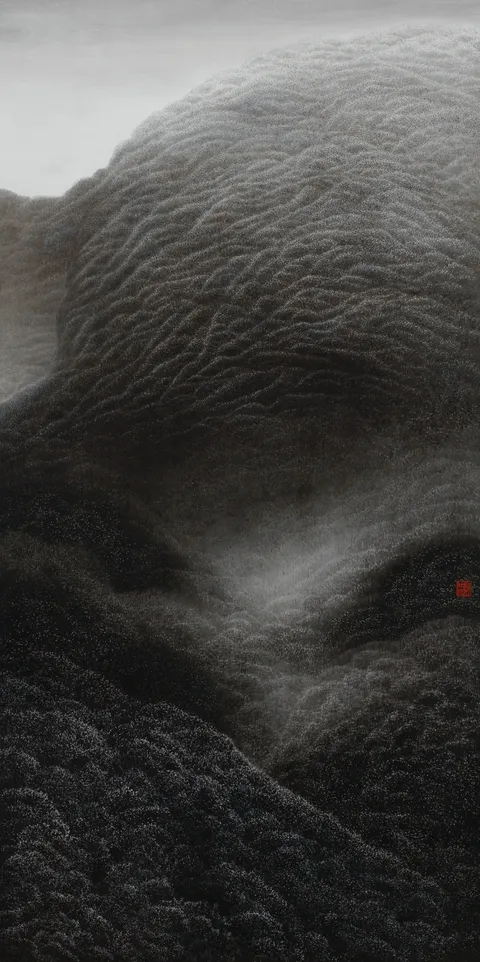 Chen Shih-Hang’s painting Oil Pit Excursion uses layers of deep ink to create varying shades of vast mountains shrouded in mist.
 In Chen’s work Gentleness in the Desolate Land—Gateway to the Sky, distinct gold textures contrast with the dark ink mountains.
 In Chen’s painting Observing the Mist, varying shades of ink are layered to create a majestic mountain scene amid ethereal mist with birds in the sky.