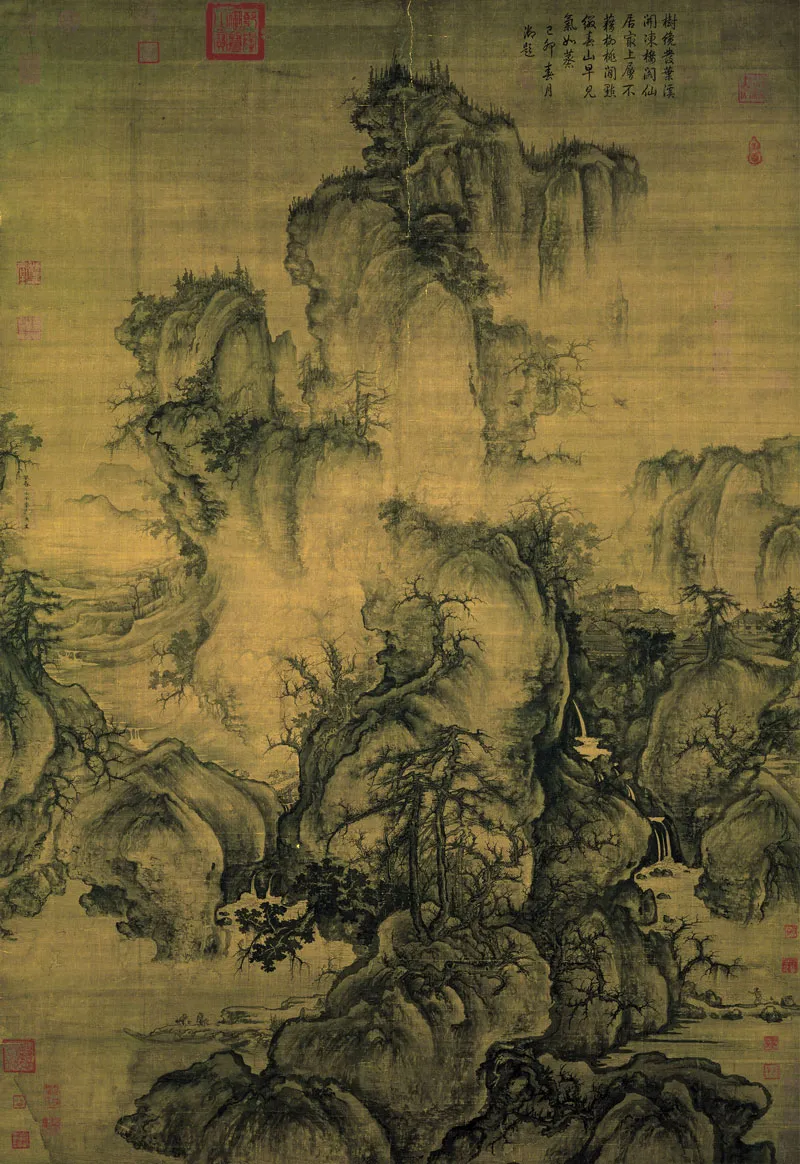
To view a painting in the classical Chinese tradition is rarely a passive act of sight. It is a process known as du hua—”reading a painting.” This concept elevates the viewer from a spectator to an interlocutor, engaging in a silent intellectual and emotional exchange with the creator. It implies that a scroll or a canvas is not merely a surface of pigment, but a conduit to the artist’s inner landscape, where every brushstroke carries the weight of a thought and every void suggests a breath.
Standing before the works of Taiwanese painter Chiu Su-mei, one instinctively understands this necessity of “reading.” Her works are less like static images and more like visual poems—delicate, mysterious, and rhythmic. As the Honorary Chairwoman of the Gongbi Painting Society of the Republic of China, Chiu’s practice is a testament to a philosophy that bridges millennia: drawing from the lineage of the past, learning from the truth of nature, and flourishing within the quietude of the heart.
In Chiu’s painting Oncorhynchus masou formosanus, silver foil on silver paper creates a shimmering aquatic effect for the swimming fish
The Discipline of Lineage
For over three decades, Chiu has devoted herself to Gongbi—the meticulous realist technique defined by its precise brushwork and vibrant detail. Yet, in an era obsessed with novelty, she maintains a practice that many modern contemporaries have abandoned: the rigorous copying of ancient masterpieces.
Chiu frequently exhibits these replicas alongside her original compositions. This is not a lack of invention, but a profound act of reverence. In the Chinese canon, imitation is the most direct vessel for transmitting the Qi (energy) of the masters. From the flourishing lines of the Han Dynasty to the aesthetic apex of the Song Dynasty (960–1279), the history of Chinese painting is a accumulated system of wisdom.
By tracing the strokes of the ancients, Chiu does not merely replicate an image; she internalizes the muscle memory of centuries. She studies how a Song master would wield the brush to structure a branch or dilute ink to suggest a misty void. It is a dialogue with ghosts, where the artist dissects the foundational principles of mood, composition, and color established by theorists like Xie He in the 5th century.
In Intoxicating Fragrance, white plum blossoms and three playful birds create a scene of elegant excitement
The Song Dynasty Aesthetic
Chiu’s spiritual home lies specifically within the Song Dynasty, a period celebrated for its “prosaic and tranquil” quality. The art of this era was characterized by a minimalist elegance—a desire to capture the essence of the subject rather than its superficial flashiness.
“Song Dynasty Gongbi paintings exhibit an unconventional approach to composition,” Chiu observes. Through her studies, she has cultivated an ability to render the atmosphere of a scene, not just its objects. The practice of imitation, therefore, becomes a form of meditation. It refines her color application and sensitizes her aesthetic intuition, allowing her to understand how silence can be painted and how emptiness can hold weight.
However, as the Qing Dynasty treatise Jiezhou’s Studies on Paintings notes, true imitation is about capturing the “mood,” not just the form. Chiu likens this to rereading a literary classic at different stages of life; the text remains the same, but the reader’s internal landscape shifts, revealing new layers of meaning with every encounter.
Sketch of Butterflies by Northern Song Dynasty painter Zhao Chang depicting a melancholic autumn scene
From the Museum to the Meadow
If history provides the skeleton of Chiu’s art, nature provides the flesh and blood. The masters of the Song Dynasty were ardent observers of the natural world, often venturing into the wild to sketch xiesheng (painting from life). They believed that to paint a flower, one must understand its growth; to paint a bird, one must witness its flight.
Chiu adheres to this naturalist tradition. She recognizes that the vitality of a painting stems from the artist’s direct contact with the living world. Consider the work of Northern Song painter Zhao Chang in Sketch of Butterflies. The brambles and frost-covered leaves do not just depict autumn; they evoke the melancholy of decline, contrasting with the fleeting vitality of the insects.
In her own celebrated work, Harvest, Chiu channels this observational prowess. The painting is a complex interplay of order and chaos—green bean pods and rebellious vines intertwine with pink blossoms, while yellow sparrows add a kinetic energy to the stillness. It is a microcosm of the world itself: a delicate balance where distinct forms coexist in harmony. Through her lens, the tangled vines are not messy; they are a script written by nature, legible only to those who take the time to read it.
Chiu’s painting Harvest features green bean pods, lush vines, and lively yellow sparrows
The Alchemy of Layering
The technical demands of Gongbi are unforgiving. Rooted in calligraphy, the technique relies on the “bone method” of outlining, where the pressure and rhythm of the brush dictate the character of the line. But the magic lies in the layering.
To achieve the luminous depth seen in Chiu’s petals and feathers, she applies ink and color in thin washes, often requiring six or seven layers to bring a single leaf to life. This process cannot be rushed; it is a test of patience that filters the artist’s intent through time.
Chiu has pushed these techniques into modern territory. In works like The Melody of Withered Lotus II, she experiments with materials, utilizing silver paper sprinkled with silver foil to mimic the glistening ripple of water. Against this shimmering, monochromatic backdrop, a bird of vibrant azure and vermilion stands in stark contrast. This interplay between the muted background and the saturated subject is Chiu’s signature—a visual rhythm that mirrors a musical composition.
The Melody of Withered Lotus II depicts a vibrant blue and vermilion bird on a lotus pod against a silver, rippling background
“I typically avoid overly bright colours in the background,” she explains. By allowing the environment to recede into a tranquil haze, she grants the focal point—the life force of the bird or flower—the stage it deserves.
The result is an art form that tastes like fine wine. Just as a vintner relies on time and subtle shifts in flavor to craft a vintage, Chiu relies on the accumulation of brushstrokes and the maturation of her own spirit. Her paintings are not merely depictions of flora and fauna; they are lingering impressions of a mind at peace, inviting the viewer to pause, read, and listen to the silence.

 In Chiu’s painting Oncorhynchus masou formosanus, silver foil on silver paper creates a shimmering aquatic effect for the swimming fish
 In Intoxicating Fragrance, white plum blossoms and three playful birds create a scene of elegant excitement
 Sketch of Butterflies by Northern Song Dynasty painter Zhao Chang depicting a melancholic autumn scene
 Chiu’s painting Harvest features green bean pods, lush vines, and lively yellow sparrows
 The Melody of Withered Lotus II depicts a vibrant blue and vermilion bird on a lotus pod against a silver, rippling background