In the Western tradition, floral arrangement often speaks the language of abundance—a chorus of color, mass, and volume designed to fill a space. Yet, turning toward the East, the conversation shifts from fullness to emptiness, from decoration to discipline. This is the realm of Ikebana, the Japanese art of “living flowers,” where the silence between the stems is as vital as the blooms themselves.
It is a practice where minimalism is not merely an aesthetic choice, but a spiritual necessity. The beauty of Ikebana lies not in what is added, but in what is stripped away to reveal the essential architecture of nature.
Ikebana-Toshiro-Kawase
The Lineage of Silence
The roots of Ikebana are deeply intertwined with the arrival of Buddhism in Japan from China. Initially, these floral offerings were ritualistic, placed on altars alongside incense and fruit. However, the formalization of the art began in the early 7th century with Ono no Imoko, a former envoy to China who retreated to the Rokkaku-dō temple. Here, the Ikenobo school—the oldest and largest school of Ikebana—was established, creating a lineage that continues to operate within those same temple walls today.
By the Kamakura period (1192–1333), the practice had transcended the altar to permeate the lives of the samurai class. It presents a profound paradox: warriors, trained in the art of death, would engage in flower arranging to center their minds before combat. In the delicate handling of a stem, they found a heightened state of concentration, a fleeting moment of peace amidst a life defined by the sword.
This evolution culminated in the late 15th century under Shōgun Ashikaga Yoshimasa, who codified the principles of the art. He understood that the arrangement was not static decor, but a conduit for spiritual attention—a bridge between the human spirit and the divine.
Ikebana-Toshiro-Kawase
The Geometry of Heaven and Earth
At the heart of Ikebana lies a structural philosophy that defies simple symmetry. Traditional compositions are anchored by three main lines of differing heights, forming a scalene triangle. These lines represent a cosmic triad: the tallest line reaches for Heaven, the lowest grounds the piece in Earth, and the middle line represents Man, the mediator suspended between the two.
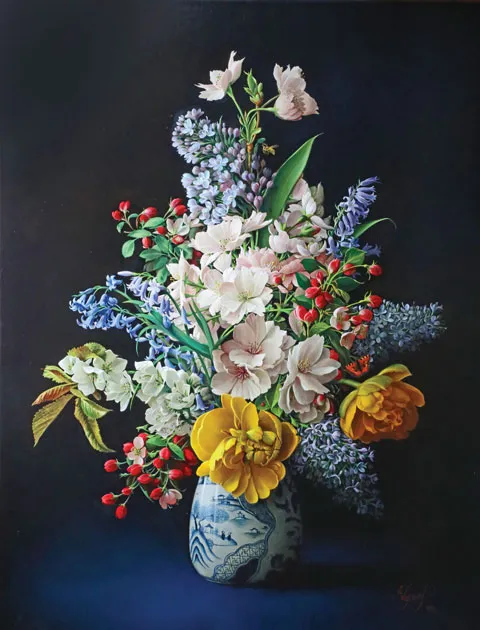
This triad also serves as a temporal metaphor, weaving together the past, present, and future within a single vessel. The master requires a discerning eye to achieve this balance; one must cut away the extraneous to let the energy—or qi—flow through the lines unhindered. As illustrated in the works of master Toshiro Kawase, the vessel itself plays an elemental role. It is not merely a container but the soil from which the composition springs, providing weight and context to the ethereal forms above.
A Prayer in Petals
“The whole universe is contained within a single flower,” notes Toshiro Kawase, one of the most significant figures in modern Ikebana. His approach transcends technique, moving into the realm of active meditation. This philosophy became poignantly visible following the devastation of Japan’s 2011 earthquake and tsunami.
Ikebana Toshiro Kawase
In the wake of the tragedy, Kawase initiated “One Day, One Flower,” a project where he published a photograph of a new arrangement daily. It was a form of collective prayer, a ritual of resilience using the fragility of flowers to confront the impermanence of life. In his hands, a single bud or a cascading maple branch becomes a testament to the eternal cycle of destruction and renewal.
The Art of Observation
To practice Ikebana is to enter a dialogue with nature. It demands that the artist observe the specific curve of a branch or the hue of a leaf, respecting the innate character of the material.
Ikenaba-Nishiyama
Contemporary masters like Hayato Nishiyama and Hirama Mario continue to interpret these ancient principles. Nishiyama’s work often leans into the profound quiet of the art. An arrangement might consist of a solitary wild Chrysanthemum japonense, accented by a few restrained leaves. The simplicity is deceptive; it forces the viewer to confront the singular power of the life force before them.
Conversely, the works of Hirama Mario may present a fuller appearance, yet they adhere to the same rigorous logic of space and line. Whether minimal or complex, the goal remains the same: to remove the habitual clutter of the mind and reflect a refined state of consciousness.
Ikenaba-Nishiyama
In a world that often equates value with accumulation, Ikebana offers a different wisdom. It teaches us that beauty is found in the fleeting moment, and that true balance is achieved not by adding more, but by understanding the profound weight of what remains.

 Ikebana-Toshiro-Kawase
 Ikenaba-Nishiyama
 Ikenaba-Himara-Mario