In the grand narrative of decorative arts, few chapters are as evocative as the dialogue between the East and the West—a conversation conducted not in words, but in silk, pigment, and paper. It is a dialogue that de Gournay, the British house founded in 1986, has not only preserved but revitalized, turning the walls of modern interiors into breathing canvases of history.
The story begins long before the brand’s inception, tracing back to a 17th-century Europe that had just awoken to the aesthetic mysteries of the Orient. When the first porcelain and painted silks arrived from the Far East, the continent was swept by a fever for this new, exotic beauty. Yet, what emerged was not a pure replication of Chinese art, but Chinoiserie: a European dreamscape of China, a fantasy of pagodas and flowering boughs tailored to Western sensibilities.
Hand-painted Jardinieres Citrus Trees on Custom Silver Metallic Xuan Paper
It is within this historical intersection that Claud Cecil Gurney and his nephew, Dominic Evans-Freke, found their calling. What began as a personal quest—Claud’s desire to restore antique wallpaper in his London family home—unraveled into a realization that the craft had all but vanished. The grand tradition of hand-painted wallpaper, once the pride of export trade, had withered away.
The Quest for the Single Masterpiece
In the mid-1980s, when Gurney and Evans-Freke traveled to mainland China, they found a landscape altered by decades of upheaval. The ruling elite of the past had discouraged “frivolously artistic” enterprises, and the stability required for fine art had been fractured by revolution. The artisans they encountered were skilled, yet their talents were channeled into mass production: thousands of identical kites, legions of repetitive scroll paintings.
Dominic recalls the initial bewilderment of the local workshops in Shanghai. “We landed in Shanghai and the frequent question that came up was ‘How many thousands of these pieces do you want?'” he reflects. The concept of spending hundreds of hours on a single, bespoke creation was anathema to a system built on volume.
Dominic Evans-Freke, nephew of Claud Cecil Gurney
Their proposition was radical in its simplicity: “Hold your thousand,” they told the craftsmen. “Take all the effort you’d put into making that thousand, make us one in the same amount of time.”
It was a process of re-education, not of skill, but of intent. The Chinese artisans possessed the dexterity, but the cultural memory of wallpaper—a product historically made solely for export to the West—did not exist domestically. Gurney and Evans-Freke had to act as bridges across time, using research from the UK to guide the hands of artisans in Southern China, helping them rediscover a heritage they didn’t know they possessed. It was, as Dominic describes, like teaching a master carpenter to build a boat when he had only ever built houses; the skill was there, waiting for a new blueprint.
The Soul of the Brush
The allure of de Gournay lies not merely in its visual opulence but in the “imperfections” that signal humanity. In an era dominated by digital precision and machine printing, the hand-painted nature of these wallpapers offers a profound counter-narrative.
Hand-painted Askew on Apple Green Williamsburg designed by Alison Henry
A machine creates uniformity; an artist creates life. Dominic articulates this distinction with the eye of a curator. The life of a de Gournay panel is dictated by the subtle variables of the human condition: the changing pressure of the artist’s hand as they tire, the saturation of the brush as it empties of pigment, even the shifting light in the studio or the painter’s mood on a rainy Tuesday.
This results in a depth that invites prolonged observation. A homeowner might live with a room for years before noticing that two seemingly identical birds are, in fact, distinct individuals. “The artist, painting one afternoon, was in a particular mood and his flying sparrow has got his tail up in the air and is coming out with a slight kick to its feet,” Dominic notes. These are the secrets hidden in the leaves—details that do not shout for attention but wait patiently to be discovered.
Detail of Hand-painted Jardinieres Citrus Trees pattern
A Cultural Mirror
The revival of this craft has led to a fascinating cultural inversion. When de Gournay opened a showroom in Shanghai, the local clientele viewed the intricate wallpapers not as a return of Chinese heritage, but as the height of “English” taste. “My gosh, I love all this stuff. This is so English!” they would exclaim, admiring the European layouts and color palettes.
It is a testament to the hybrid nature of Chinoiserie. While the techniques—the brushes, the Xuan paper, the silk—are deeply rooted in Chinese tradition, the aesthetic application is a European invention. The modern Chinese client recognizes the method but perceives the function as Western. This layering of perception adds a rich complexity to the brand: it is neither fully East nor fully West, but a beautiful artifact of their historical collision.
Hand-painted Earlham on Sung Blue Williamsburg
The Living Wall
Today, de Gournay stands as a guardian of this slow art. From the Duchess of Cambridge wearing their hand-painted silk to the quietest corners of private residences, the brand continues to expand the vocabulary of Chinoiserie. They have moved beyond simple restoration into the realm of modern interpretation, allowing clients to dictate the “pantone shade of blue” or the specific temperament of the birds on their walls.
Hand-painted Hampton Court on Vivid Olive India Tea Paper at Kimberley Hall
Yet, the core remains unchanged. It is about the suspension of time. To enter a room lined with de Gournay is to step into a painting that has no frame. It is to be surrounded by the labor of hands that worked with the patience of a bygone era, creating a beauty that breathes, shifts, and endures.
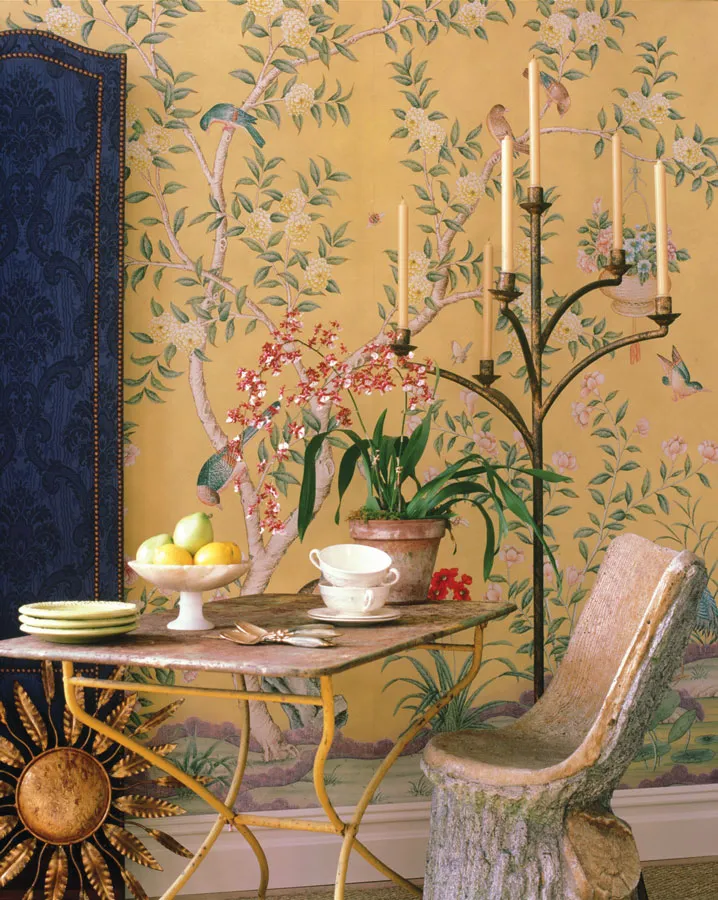
Hand-painted Temple Newsam on Custom Yellow Painted Silk

 Hand-painted Jardinieres Citrus Trees on Custom Silver Metallic Xuan Paper
 Dominic Evans-Freke, nephew of Claud Cecil Gurney
 Hand-painted Askew on Apple Green Williamsburg designed by Alison Henry
 Detail of Hand-painted Jardinieres Citrus Trees pattern
 Hand-painted Earlham on Sung Blue Williamsburg
 Hand-painted Hampton Court on Vivid Olive India Tea Paper at Kimberley Hall
 Hand-painted Temple Newsam on Custom Yellow Painted Silk