There is a fairy-tale quality to the work of Lison de Caunes, reminiscent of the folklore where straw is spun into gold. Yet, in her Parisian atelier, there is no magic spell-only the patient, rhythmic movement of the human hand transforming the humblest of agricultural materials into surfaces of vibrating luxury.
De Caunes works with rye straw harvested in Burgundy, a raw, durable material that arrives in bushels. To the untrained eye, it is merely dried grass. To de Caunes, it is a medium of infinite potential, possessing a natural silica varnish that no synthetic lacquer can replicate. Her art is the resurrection of la marqueterie de paille-straw marquetry-a meticulous craft she has single-handedly dragged from the precipice of extinction back into the spotlight of high design.
Straw-Marquetry-Lison-de-Caunes
A Legacy of Art Deco
The lineage of de Caunes’ craft is deeply personal. She is the granddaughter of Andre Groult, the renowned Art Deco designer who utilized straw marquetry in the early 20th century to create furniture of distinct elegance. While the technique is thought to have originated in the East and flourished in 17th-century Europe, it had largely faded into obscurity by the time Groult adopted it. Following his death, the silence returned.
“When I began this work, I was the only one. There was no school teaching this technique,” de Caunes reflects. She did not inherit a bustling workshop but rather a memory and a curiosity. Initially, she learned by observing her grandfather during her childhood, and later, by restoring antique pieces, dissecting the logic of the straw laid down centuries prior.
Today, she has achieved what once seemed impossible: the revival of a lost language. Her daughter, Pauline Goldszal, notes that the current vogue for straw marquetry in interior design is directly traceable to de Caunes’ persistence. “She feels like she has achieved her goal in perpetuating the work… It has become very fashionable again, and it’s really because of her.”
Straw-Marquetry-Lison-de-Caunes
The Vibration of Material
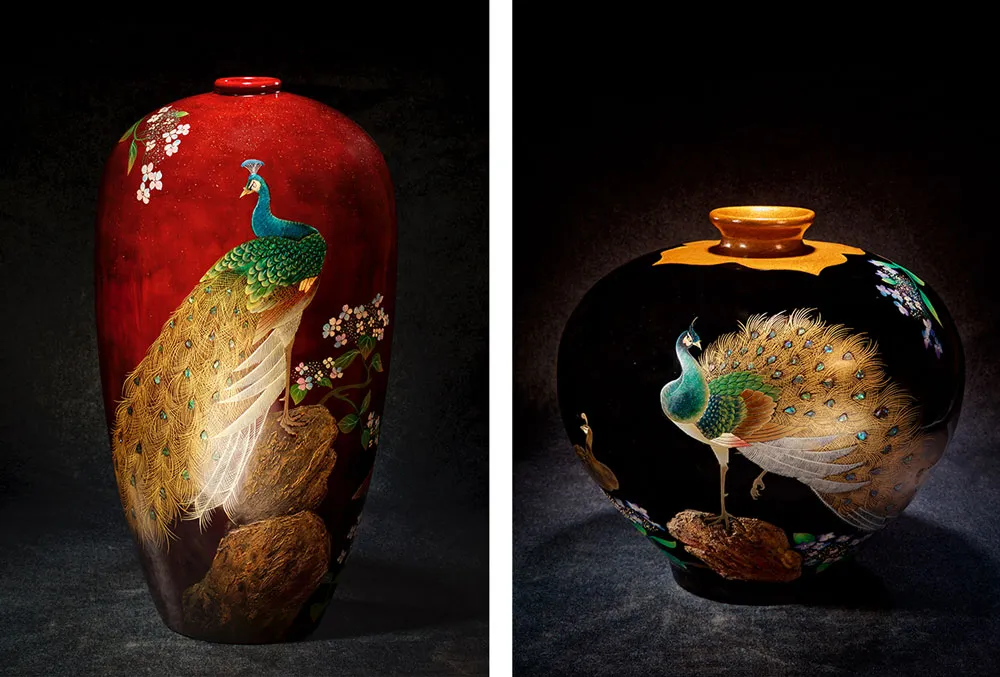
The aesthetic of straw marquetry is defined by a paradox: it is strictly geometric yet entirely organic. Unlike wood grain, which meanders and curves, a stalk of straw offers a dead-straight line. When arranged in de Caunes’ signature sunbursts or linear patterns, these lines create a mesmerizing optical effect.
The material interacts with light in a way that is almost kinetic. “Everybody thinks it’s varnish, but it’s not,” de Caunes explains. The shimmer is inherent to the plant itself. As the light shifts in a room, the straw surfaces “vibrate,” changing tone and depth throughout the day. A wall covered in gold-hued straw does not merely reflect light; it seems to hold it, offering a warmth that Goldszal describes as comforting, distinct from the cold brilliance of “bling-bling” luxury.
This interplay with light adds a layer of complexity to the creation process. De Caunes must anticipate how the direction of the straw will catch the sun. It is an intuition honed over decades. Occasionally, the result defies expectation, necessitating the dismantling and reconstruction of the piece to achieve the perfect luminescence.
Straw-Marquetry-Lison-de-Caunes
The Silence of the Atelier
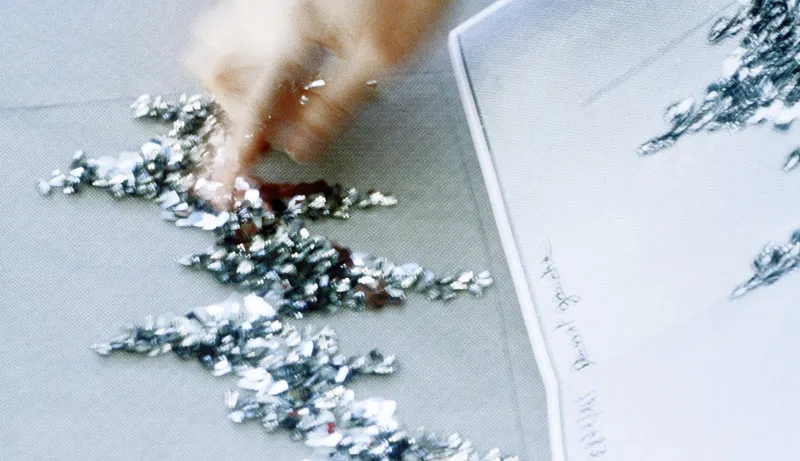
In an era defined by the noise of industrial production, Lison de Caunes’ workshop is a sanctuary of silence. Straw marquetry rejects mechanization. There are no power tools, no hum of engines, no sawdust. The process remains exactly as it was centuries ago: the straw is dried, tinted, split, opened, and flattened by hand. The matte side is glued down, leaving the glossy outer cuticle to face the world.
“It’s zen,” de Caunes says of the work.
The atmosphere is meditative, requiring a rhythm of breath and hand that allows the artisan to enter a flow state. For fifteen years, de Caunes worked entirely alone in this quietude. Today, she leads a team of fifteen artisans, including her sister, Marie de Caunes, yet the ethos of the solitary, painstaking craft remains. A single square meter of marquetry requires approximately four days of labor, though intricate patterns can demand far more.
Straw-Marquetry-Lison-de-Caunes_
Redefining Luxury
De Caunes has elevated straw from a rustic craft to the heights of the luxury market, creating commissions for Van Cleef & Arpels, Louis Vuitton, and private collectors. A chest of drawers she covered recently commanded a price of nearly $90,000. Yet, for de Caunes, the monetary value is secondary to the philosophical definition of luxury: the time, the uniqueness, and the human touch.
“I am not a factory,” she asserts. “We refuse huge work.”
This scarcity is vital. Luxury, in her view, is the transformation of the “poor” into the precious through sheer mastery. It is the ability to take a stalk of rye and render it more captivating than gold.
Straw-Marquetry-Lison-de-Caunes
The Master’s Duty
In 1998, France’s Ministry of Culture bestowed upon Lison de Caunes the title of Maître d’Art (Master of Art). It is a rare honor that recognizes not just exceptional skill, but a commitment to the preservation of French heritage. With the title comes the obligation to transmit knowledge-a duty de Caunes takes seriously.
Having revived the craft from the brink of disappearance, she is now ensuring it survives her. Her workshop is not merely a production studio; it is a school of patience and precision. By training a new generation of artisans, she ensures that the dialogue between the straw, the light, and the human hand continues long into the future.

 Straw-Marquetry-Lison-de-Caunes