There is a distinct fairy-tale quality to the work of Lison de Caunes, a resonance with the mythical notion of spinning straw into gold. Yet, in her Parisian atelier, this transformation is not magic, but the result of rigorous patience and an unwavering dedication to a humble material. De Caunes takes rye straw—a rustic byproduct of the harvest—and elevates it into surfaces that possess the depth, brilliance, and value of precious gems.
For de Caunes, the wonder of this metamorphosis never fades. It is a process of reclaiming the overlooked and refining it until it sings.
The Solitude of the Craft
Straw marquetry, an art form with origins tracing back to the East before finding favor in 17th-century Europe, had all but vanished from the decorative arts landscape by the time de Caunes began her journey. It was a technique relegated to history, overshadowed by more industrial finishes.
“When I began this work, I was the only one,” de Caunes reflects, emphasizing the isolation of her early years. “There was no school teaching this technique. I was really the only one.”
For years, she acted as the sole custodian of this knowledge, preserving the gestures and secrets of the trade in a vacuum. Her perseverance was not merely about maintaining a career but about safeguarding a piece of cultural heritage that was on the brink of extinction.
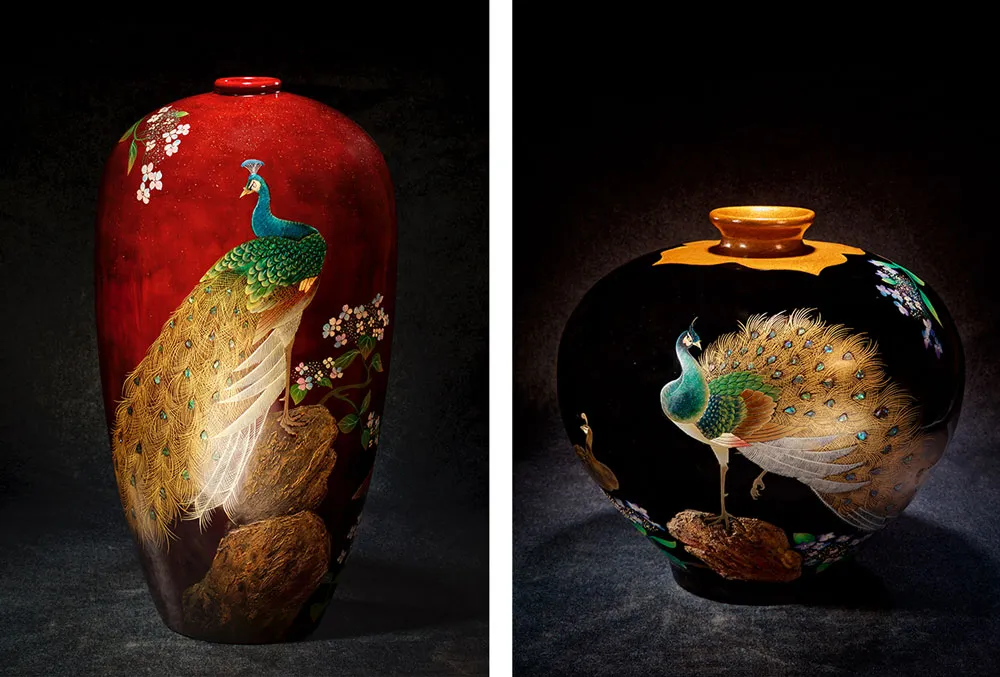
De Caunes uses the art of straw marquetry to create various objets d’art. Photos by Gilles Trillard
The Materiality of Light
The foundation of de Caunes’s work lies in the raw material itself: bushels of rye straw harvested in Burgundy, France. Chosen for its strength and heartiness, this specific straw offers the resilience required for the artist’s demands.
The process is intensely physical and repetitive. Each stalk must be dyed, split, flattened, and cut before it can be applied. Unlike wood, which carries the meandering, unpredictable grain of growth rings, straw presents a grain that is dead-straight. When arranged in rows, sunbursts, or intricate geometric patterns, this linearity creates a mesmerizing optical effect. The surface becomes a topography of light, linear yet organic.
A common misconception regarding straw marquetry is the source of its gloss. “Everybody thinks it’s varnish, but it’s not,” de Caunes explains. The shimmer is intrinsic to the material itself—a natural silica coating that protects the stalk and refracts illumination. “With light, it changes and vibrates.”
This vibration gives the work a living quality. A wall or object covered in straw does not remain static; it shifts with the time of day and the angle of the viewer, flashing from matte to high-gloss, gold to amber.
Having trained artisans in this lost art, de Caunes now trusts much of the work to them while she focuses on the fine details and flourishes of her workshop’s creations.
A Renaissance of Texture
Today, the silence of the workshop has been replaced by a collective energy. De Caunes has succeeded in her mission to revive the craft, moving it from the periphery of forgotten arts to the center of contemporary interior design.
Her daughter, Pauline Goldszal, notes the magnitude of this achievement. “She feels like she has achieved her goal of perpetuating the work and making it alive again,” Goldszal says. The technique has found new relevance in modern aesthetics, where the demand for natural materials and artisanal integrity is high. “Today, a lot of people want to work with straw marquetry. It has become very fashionable again, and it’s really because of her.”
De Caunes no longer works in isolation. Having trained a new generation of artisans, she now oversees a bustling studio, trusting her team with the labor-intensive execution while she focuses on the fine details and the creative flourishes that define her signature style. The “gold” she has spun is not just in the shimmering artworks produced, but in the vitality of a tradition restored.

 De Caunes uses the art of straw marquetry to create various objets d’art. Photos by Gilles Trillard
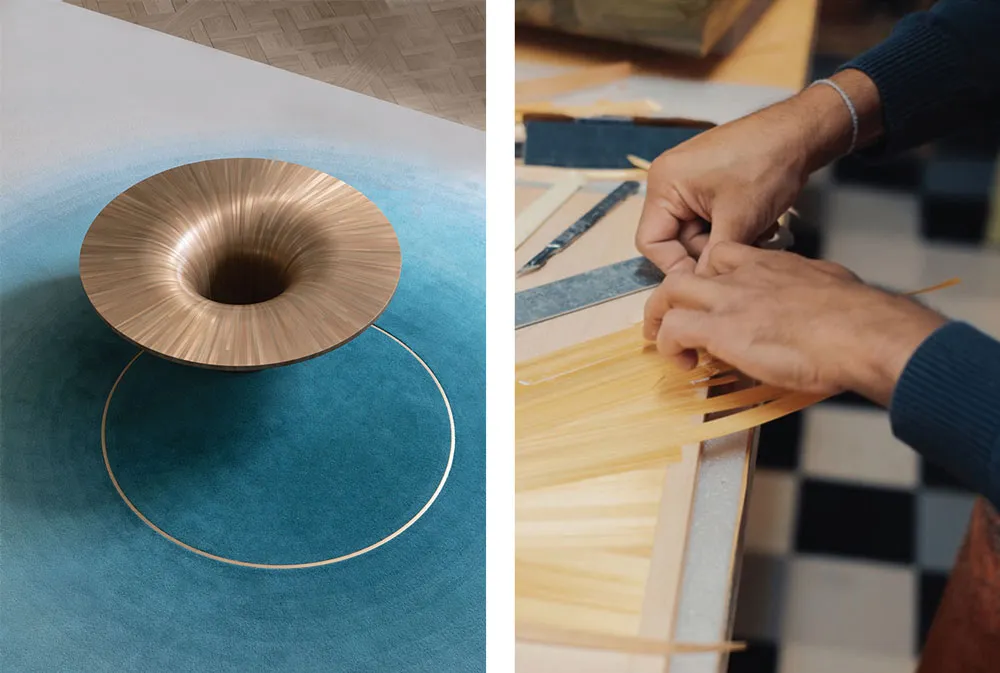 Having trained artisans in this lost art, de Caunes now trusts much of the work to them while she focuses on the fine details and flourishes of her workshop’s creations.