Lacquer possesses a paradox at its heart: it is a material that demands moisture to dry. Unlike inks that require the evaporation of water, the sap of the urushi tree cures only when embraced by humidity. This distinctive chemical alchemy—hardening through hydration—perhaps explains the medium’s enigmatic, reserved allure. It is an art form that does not simply age; it deepens, its distinct gleam illustrating a sophistication that balances the utilitarian with the sublime.
For over 9,000 years, from the rudimentary forms of the Jomon Period to the sophisticated vessels of the Shang and Zhou dynasties, lacquer has been a testament to human patience. It is a craft of layers—often thirty or more—applied, cured, and polished in a cycle that can span months or years.
In Taiwan, this timeline of heritage is currently upheld by the hands of Wang Ching-Shuang. Hailed as a “Living National Treasure,” Wang, alongside his sons Hsien-zhi and Hsien-min, and grandson Chun-wei, represents a rare lineage. They are not merely preserving a technique; they are interpreting the passage of time through the medium of sap, infusing a contemporary pulse into an ancient vascular system.
Lacquer-art-1
The Weight of Absence: Ramee Lacquer
The physical defying nature of lacquer is best exemplified in the bodiless technique, known as Ramee lacquer. Originating in the Warring States period, this method allows for the creation of monumental forms that possess an uncanny lightness. By applying lacquer over a clay core reinforced with hemp cloth, and subsequently removing the core, the object remains as a hollow, resonant shell—pure surface and spirit.
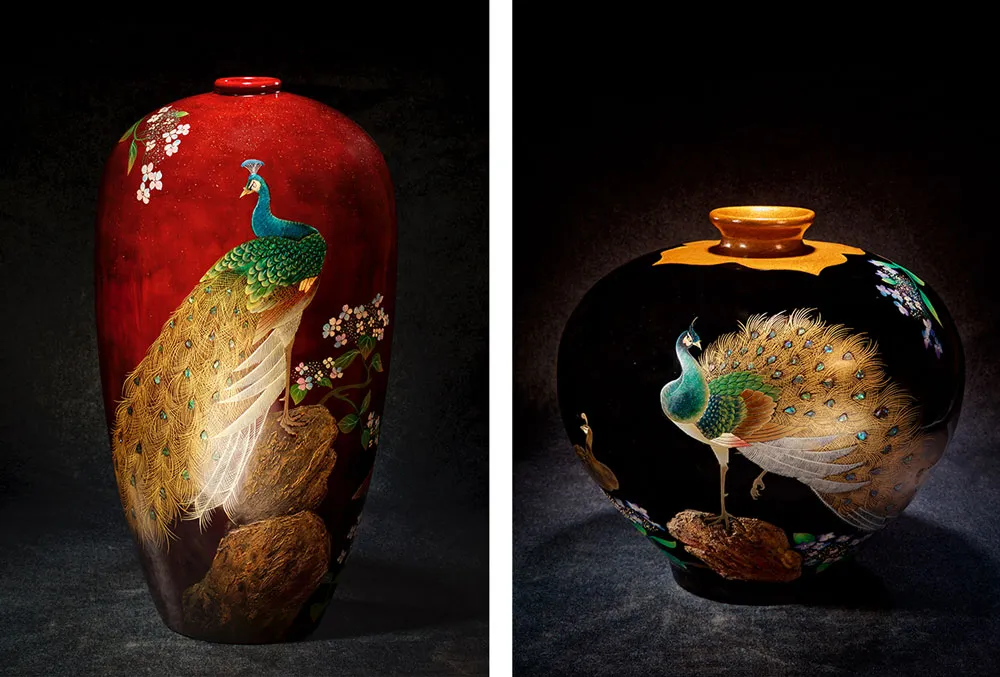
In Majestic Grace 1 (2018) and Majestic Grace 2 (2019), Wang Hsien-zhi utilizes this technique to sculpt vases that feel less like solid objects and more like solidified silhouettes. The creation of such forms requires a dedicated six-month cycle, where the absence of the interior is as significant as the exterior finish. The result is a vessel that carries the visual weight of history but lifts with the lightness of a breath.
Lacquer-art-2
Frozen Sound: Raden and the Play of Light
If black lacquer represents the void, Raden (seashell inlay) represents the stars within it. This ancient decorative technique employs the iridescent laminations of abalone or mother-of-pearl, cut into razor-thin fragments and embedded into the dark surface.
In Wang Chun-wei’s Nocturne (2023), the technique transcends mere decoration to become atmospheric narrative. Against a midnight-black void, frosty blue lilies bloom, intersected by rhythmic streaks of shell.
Lacquer-art-3
The artist treats the material not as solid shell, but as captured light. The iridescent shimmer mimics the visual quality of cascading water or a musical score made visible. The flecks at the summit and base suggest the spray of a waterfall or the staccato notes of a night song, portraying pristine lilies blossoming amidst a sparkling, silent rainfall.
The Geography of Cracks: Eggshell Inlay
Lacquer is a binder of exceptional strength, capable of turning the fragile into the eternal. In the hands of the Wang family, the humble eggshell becomes a mosaic of porcelain-like complexity.
Lacquer-art-4
For Balletic Symphony (2017), Wang Hsien-min employs crushed eggshells to render ivy-toned peonies and peacocks. The process is one of surgical precision: the membrane is removed, and the shell is fractured. The artistry lies in the manipulation of these fractures. Larger fragments are selected for the periphery of petals to catch the light, creating radiance, while the flower’s core demands a fine dust of shell, where amber-hued lacquer seeps into the seams to create a texture akin to aging crackle-glaze pottery. It is a deliberate reconstruction of fragility, creating a harmonious, organic mesh that mimics nature’s own geometry.
Lacquer-art-5
Maki-e: The Art of Sprinkling
While inlay embeds material into the lacquer, Maki-e sprinkles metallic powder onto it. Translating to “sprinkled picture,” this Japanese technique requires a control of breath and hand that takes decades to master. It is not painting with a brush, but painting with gravity and dust.
In Majestic Grace 2, Wang Hsien-zhi layers metallic and shell powders to replicate the iridescent gradient of peacock feathers. The technique allows for a depth that flat pigment cannot achieve. By varying the density of the sprinkle—layering powders to build texture or scattering them sparsely to create phantom fades—the artist mimics the shadowing and highlighting of a three-dimensional object.
Lacquer-art-6
Each feather on the vessel is a result of dozens of steps: painting, sprinkling, curing, and grinding. The result is a surface that feels alive, shifting in tone as the viewer moves, much like the plumage of the bird itself.
Lacquer-art-7
The Reveal: Cover and Grind
There is a philosophical dimension to the “Cover and Grind” technique (Zhaoqi). It is an art of concealment and revelation. A pattern is painted, then completely obliterated by a layer of black lacquer. The artist then grinds the surface down, sanding away the darkness to locate the image buried beneath.
The result is a hazy, dreamlike aesthetic, where the image appears to emerge from a fog. In Plum Poetry (2017), Wang Hsien-zhi uses this to create fluid calligraphy that feels recessed into the void—a secret unveiled only to the observant.
Lacquer-art-8
Similarly, in Wang Ching-shuang’s Songbirds and Kapok Blossoms (2001), dark crimson flowers seem engulfed by the background. The technique creates a depth that differs entirely from optical perspective; it is physical depth, a geological layering of color where the image is trapped within the amber of the lacquer itself.
Lacquer-art-9Lacquer-art-10
Precision in Gold
Contrasting the hazy depth of the grind is the sharpness of Inlaid Gold. Dating back to the Warring States period, this method involves carving hair-thin grooves into the semi-wet lacquer and filling them with gold powder.
Lacquer-art-11
In Whispers of Lotus (2017), Wang Chun-wei utilizes this high-contrast technique to outline the swaying lotus. The gold lines vibrate against the glossy black lacquer, lending the vase a regal sophistication. It captures the essence of the lotus—noble and unsullied—rising from the dark waters. The precision required here is absolute; once the groove is cut, the line is permanent.
Lacquer-art-12
Kawari-nuri: The Organic Surface
Finally, the Kawari-nuri technique celebrates the unpredictable. By applying multiple layers of colored lacquer and polishing them unevenly, unique, organic patterns emerge, often resembling leather or stone.
Lacquer-art-13
On the neck of the Plum Poetry vase, Wang Hsien-zhi employs a specific variation known as rhinoceros leather lacquer. The pattern flows with a natural chaos, contrasting the deliberate calligraphy below. It highlights the innate beauty of the resin itself, proving that even after thousands of years of refinement, the most compelling element of lacquer art remains the mysterious, living nature of the sap.

 Lacquer-art-1
 Lacquer-art-2
 Lacquer-art-3
 Lacquer-art-4
 Lacquer-art-5
 Lacquer-art-6
 Lacquer-art-7
 Lacquer-art-8
 Lacquer-art-9
 Lacquer-art-10
 Lacquer-art-11
 Lacquer-art-12
 Lacquer-art-13
 Lacquer-art-14


