The revolution of the feminine silhouette often begins not with a radical addition, but with a subtraction. For Gabrielle Chanel, the dismantling of the ornamental constraints of the early 20th century was achieved by looking elsewhere—specifically, at the utilitarian wardrobes of men. Her genius lay in perceiving the inherent grace in function, transforming the “poor” materials of jersey and knitwear into symbols of liberated movement.
Before Chanel, knits were the domain of undergarments or the rough, chunky sweaters of fishermen—garments of necessity rather than desire. Her subversion began intimately, borrowing the comfortable cardigans of her partner, Arthur “Boy” Capel. In the drape of his knitwear, she found a fluidity that rigid corsetry denied, tossing these pieces over her shoulders with a nonchalance that would become her signature. This was not merely a styling choice; it was a proposal for a new way of living.
Gabrielle “Coco” Chanel and her partner, Arthur “Boy” Capel (fourth left) by the storefront of the Deauville CHANEL boutique in 1913. Bottom, left to right: Dancers from the Le Train Bleu ballet donning knitted sportswear costumes designed for them by Chanel; Chanel with her frequent sailing companion, the Duke of Westminster, on his yacht “The Flying Cloud” in 1928; Chanel at the entrance to her boutique in Deauville, 1913; Chanel with her aunt Audrienne in front of the Deauville boutique.
The Scottish Provenance
The narrative of Chanel knitwear is inextricably linked to the geography of Scotland. Through her relationship with the Duke of Westminster, Chanel immersed herself in a world of sailing, hunting, and golfing—activities that demanded warmth without weight. The misty landscapes and sporting lifestyle inspired her 1920s and 30s collections, where she reinterpreted the finest Scottish Fair Isle cashmere.
Here, the technical mastery of the material became paramount. The “twin set”—a matching cashmere shell and cardigan introduced in the 1930s—cemented knitwear as a pillar of the modern woman’s wardrobe. It was a uniform of elegance that allowed for an active life, bridging the gap between the aristocracy of the material and the democracy of the cut.
Left: Métiers d’art 2013/14 collection. The traditional Chanel tweed took on Americana flavor in a boxy chain-trimmed cardigan. Right: Métiers d’art 2016/17 Paris Cosmopolite collection. The sophisticated luxe of gold embroidery upon a black wool pullover pays homage to the show’s theme of the Ritz Paris and the elegance of vintage evening wear.
The Artisan of Hawick
Central to this tactile history is Barrie, a manufacturer based in the Scottish Borders since 1903. Originally a factory producing stockings and later WWI military garments, Barrie’s collaboration with Chanel began in the 1920s, forming a symbiotic relationship between French design and Scottish craft.
The production of a single piece at Barrie is less a manufacturing process and more a ritual of patience, involving over 40 distinct steps. It begins with the fiber itself—the world’s finest cashmere, spun and dyed by local experts. The chromatic precision is obsessive; skeins are cataloged with library-like strictness to ensure absolute color consistency, preventing the mixing of batches.
Left: Cruise 2017/18 collection. Set against a backdrop of ancient Greek ruins, the show’s flowing, draped silhouettes, such as this one in a porcelain-white fluid ribbed jersey, recalled the togas of goddesses and the pleats of statuesque columns. Middle: Fall/ Winter 2019/20 Ready-to-Wear collection. A palette of nuanced tones including winter white, beige, and navy blue sets a wintry yet warm backdrop to the collection’s knits and leathers. Right: Fall/ Winter 2019/20 Ready-to-Wear collection. The yak wool dress and chunky cardigan bring forth a wintry mountain feel, with geometric patterns resembling snowflakes.
The alchemy of the material occurs quite literally in the water. The factory sits in the Scottish Borders, where the local water possesses specific chemical properties that, when used to wash the knitwear, unlock the fiber’s signature softness. This stage transforms the textile from a raw, tightly spun thread into the cloud-like texture synonymous with the House.
Even in an era of automation, the human hand remains the ultimate tool. Braiding involves “bar filling,” where threads are manually placed onto machine bars. Collars and details are not merely attached but grafted with a precision that can take months to perfect. Acquired by Chanel in 2012, Barrie operates with a workforce of nearly 300, yet the ethos remains that of an artisan studio.
The making of Chanel’s signature two-tone cardigan begins with spools of fine cashmere thread, made from dyed and spun fiber strands, at the Barrie Knitwear factory in Hawick, Scotland. In the first step of cardigan making, the pockets and trim are knitted on a special machine, then threaded onto a metal bar made up of pins; a stage known as ‘bar filling’.From top to bottom and left to right: The cardigan’s back, two sleeves and the front are all stitched separately and then assembled. After getting washed in the region’s waters for softness, the garment is steamed back into its original shape. In one of the finishing touches, the black Barrie label is sewn in. Upon completion, the finished product is carefully examined for quality, verifying all proportions.Barrie Knitwear factory in Hawick
A Continuing Dialogue
The conversation between the atelier and the factory evolves with each season. Under the recent direction of Virginie Viard, the knitwear codes established by Gabrielle were revisited with a contemporary vibrancy. The Fall-Winter 2020/21 Ready-to-Wear collection saw cardigans in striking fuchsia, camel, and blue, serving as canvases for symbolic embellishments.
There is a subtle interplay of hardness and softness in these modern iterations: fine gold brass chains woven directly into wool sweaters add a metallic sheen to the matte cashmere, a nod to the heavy jewelry Gabrielle often paired with her simple jersey suits. Whether it is a dramatic shawl collar on a black cardigan or the geometric precision of a two-tone pullover, the work honors the paradox of knitwear—that something so soft can possess such structural integrity.
From top to bottom and left to right: Métiers d’art 2019/20 Paris 31 rue Cambon collection. Geometric motifs in Chanel’s classic two-tone styling highlights an alpaca pullover and skirt duo. Métiers d’art 2019/20 Paris 31 rue Cambon collection. An alpaca and silk jacket tops a wool and cashmere pencil skirt, featuring the chain detail, one of Gabrielle Chanel’s codes honored by the collection. Métiers d’art 2019/20 Paris 31 rue Cambon collection. A matching set of a button-down cashmere skirt and cardigan lightens up for warmer days with short sleeves and a fresh peach shade. Spring/ Summer 2020/21 Ready to Wear collection. A matching viscose cardigan and shorts lighten up knits for the spring season with dynamic white trim and statement jewelry.
The partnership between Chanel and Barrie is less about preservation and more about propulsion. It is a century-long study in how a single thread, when treated with reverence and rigor, can define the posture of an era.

 Gabrielle “Coco” Chanel and her partner, Arthur “Boy” Capel (fourth left) by the storefront of the Deauville CHANEL boutique in 1913. Bottom, left to right: Dancers from the Le Train Bleu ballet donning knitted sportswear costumes designed for them by Chanel; Chanel with her frequent sailing companion, the Duke of Westminster, on his yacht “The Flying Cloud” in 1928; Chanel at the entrance to her boutique in Deauville, 1913; Chanel with her aunt Audrienne in front of the Deauville boutique.
 Left: Métiers d’art 2013/14 collection. The traditional Chanel tweed took on Americana flavor in a boxy chain-trimmed cardigan. Right: Métiers d’art 2016/17 Paris Cosmopolite collection. The sophisticated luxe of gold embroidery upon a black wool pullover pays homage to the show’s theme of the Ritz Paris and the elegance of vintage evening wear.
 Left: Cruise 2017/18 collection. Set against a backdrop of ancient Greek ruins, the show’s flowing, draped silhouettes, such as this one in a porcelain-white fluid ribbed jersey, recalled the togas of goddesses and the pleats of statuesque columns. Middle: Fall/ Winter 2019/20 Ready-to-Wear collection. A palette of nuanced tones including winter white, beige, and navy blue sets a wintry yet warm backdrop to the collection’s knits and leathers. Right: Fall/ Winter 2019/20 Ready-to-Wear collection. The yak wool dress and chunky cardigan bring forth a wintry mountain feel, with geometric patterns resembling snowflakes.
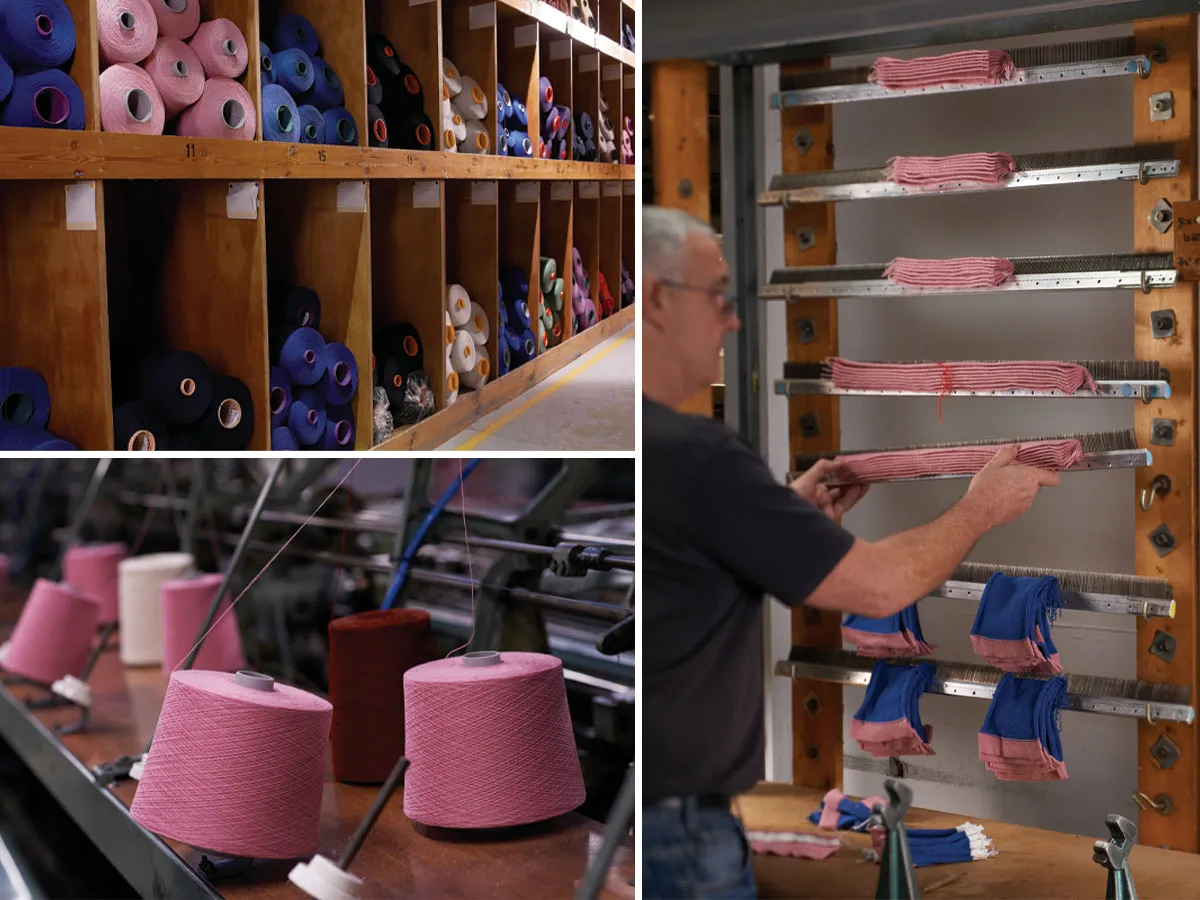 The making of Chanel’s signature two-tone cardigan begins with spools of fine cashmere thread, made from dyed and spun fiber strands, at the Barrie Knitwear factory in Hawick, Scotland. In the first step of cardigan making, the pockets and trim are knitted on a special machine, then threaded onto a metal bar made up of pins; a stage known as ‘bar filling’.
 From top to bottom and left to right: The cardigan’s back, two sleeves and the front are all stitched separately and then assembled. After getting washed in the region’s waters for softness, the garment is steamed back into its original shape. In one of the finishing touches, the black Barrie label is sewn in. Upon completion, the finished product is carefully examined for quality, verifying all proportions.
 Barrie Knitwear factory in Hawick
 From top to bottom and left to right: Métiers d’art 2019/20 Paris 31 rue Cambon collection. Geometric motifs in Chanel’s classic two-tone styling highlights an alpaca pullover and skirt duo. Métiers d’art 2019/20 Paris 31 rue Cambon collection. An alpaca and silk jacket tops a wool and cashmere pencil skirt, featuring the chain detail, one of Gabrielle Chanel’s codes honored by the collection. Métiers d’art 2019/20 Paris 31 rue Cambon collection. A matching set of a button-down cashmere skirt and cardigan lightens up for warmer days with short sleeves and a fresh peach shade. Spring/ Summer 2020/21 Ready to Wear collection. A matching viscose cardigan and shorts lighten up knits for the spring season with dynamic white trim and statement jewelry.