In the lexicon of the West, to be “drunk” is a physiological state, often associated with excess and loss of control. Yet, within the poetic tapestry of Chinese culture, the word carries a far more romantic weight. To be drunk is to be utterly surrendered to beauty—to be intoxicated by the glow of starlight, the intense hues of a sunset over a mountain range, or the lingering gaze of a lover.
It is from this lyrical definition that Shunan Teng draws the ethos for her sanctuary, Tea Drunk. A tea house in New York City, it serves not merely as a purveyor of leaves, but as a bridge to a forgotten heritage of sensory indulgence. Teng’s mission is one of preservation and education, treating tea not as a morning utility, but as an art form comparable to the finest pursuits of the human spirit.
Shunan Teng, founder of Tea Drunk, seated in a contemplative setting
The Architecture of Taste
For the uninitiated in the West, tea is frequently cast in the shadow of coffee—a hot, caffeinated liquid consumed for function. Teng dismantles this comparison, positing that while coffee is a stimulant, authentic Chinese tea shares its soul with fine wine. Both are products of terroir, defined by the polyphenols in the vine or the tannins in the leaf, and both demand a sophisticated hierarchy of appreciation.
The experience of tea, Teng observes, is a structural ascent. It begins at the base with aroma—captivating yet ephemeral. It rises to the “notes,” the specific quality of sensation upon the tongue. Higher still is the body, the texture and weight of the liquid. Finally, there is the aftertaste, the ghostly resonance that lingers long after the cup is drained.
This complexity is often lost in the commodified tea market, where low-grade leaves—comparable to “table wine”—are masked by milk and sugar. True appreciation requires a stripping away of these additives to encounter the leaf in its naked, honest form.
Red tea leaves wilting under the sun in the Wu Liang Shan mountain range
Authenticity and Origin
Precision is paramount in the definition of tea. From a classical Chinese perspective, the title is reserved exclusively for the leaves of the Camellia sinensis. What the West categorizes broadly—chamomile, rosebud, lavender—are more accurately described as tisanes.
Furthermore, the integrity of the leaf rejects artificial adornment. Teng draws a sharp analogy: just as one would not degrade a vintage Bordeaux by turning it into sangria, one does not scent high-quality tea with jasmine or bergamot. The art lies in the purity of the source, unadulterated and exposed.
A Philosophy of Balance
Beyond aesthetics, tea serves as a medium for energetic equilibrium. In the realm of traditional Chinese medicine, the beverage is a gentle harmonizer, interacting with the body’s innate constitution.
The philosophy dictates a balance of Yin and Yang. Men, often possessing warmer constitutions or “yang” energy, find their counterpoint in the cooling nature of lighter teas—green, white, and raw pu-erh. This is particularly potent for those whose lifestyles involve the “heat” of red meat or alcohol. Conversely, women, often aligned with “yin” or cooler energy, are nurtured by the warming embrace of darker varietals—black, red, and roasted oolong. It is a consumption guided not just by flavor, but by an awareness of the self.
A traditional tea set arranged for the Tea Crash Course experience
The Virtue of Jian
Perhaps the most profound offering of tea culture is its inherent morality. While the West may associate tea with the delicate, feminine sphere of afternoon socialising, history paints a different portrait. In ancient China, tea was the domain of the virtuous man—the scholar, the artist, the aristocrat. It was a companion to high thought and a conduit to nature.
Unlike alcohol, which can lead to chaos, tea induces a state of clarity and quietude. It anchors the central virtue of Jian (儉)—simplicity and non-extravagance. To drink tea is to practice a form of restraint, a refusal to compete for worldly desires, focusing instead on the essential.
Today, this heritage is not gated by ethnicity or deep historical knowledge. It is universal. As Teng suggests, the only requirement for entry is the possession of taste buds and a willingness to pause. In the cup, one finds not just a beverage, but a momentary suspension of time—a chance to be, briefly and beautifully, drunk on the experience of living.

 Shunan Teng, founder of Tea Drunk, seated in a contemplative setting
 Red tea leaves wilting under the sun in the Wu Liang Shan mountain range
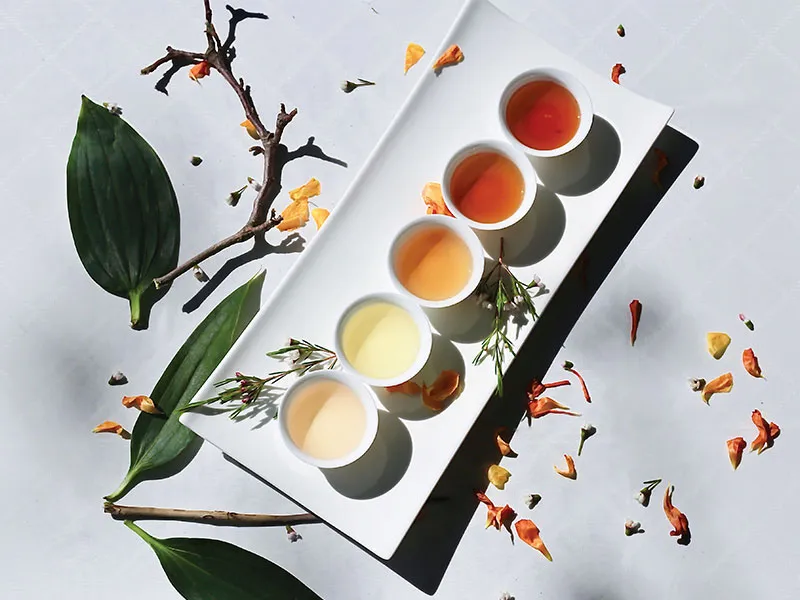 A traditional tea set arranged for the Tea Crash Course experience