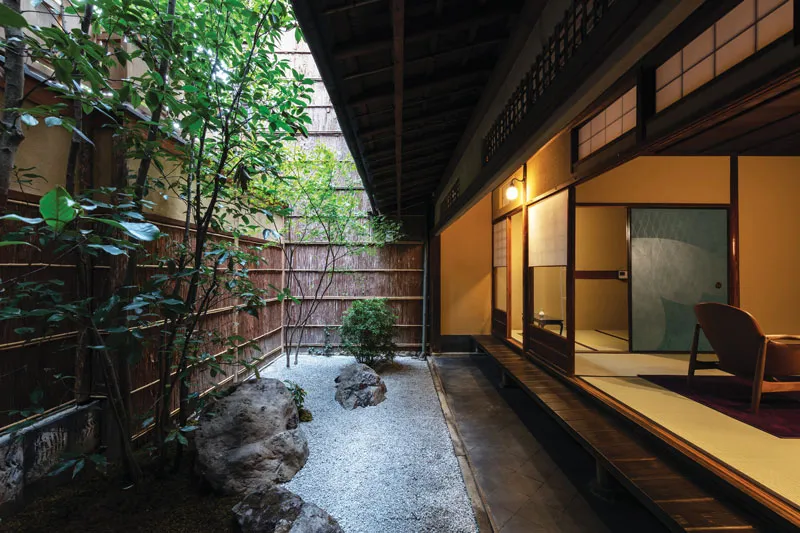
Ancient Chinese architecture is rarely just about shelter. Across a civilization spanning five millennia, builders and craftsmen have treated wood, stone, and tile as distinct verses in a three-dimensional poem. From the imperial majesty of the Forbidden City to the quiet dignity of a country residence, these structures serve as physical manifestations of Confucianism, Buddhism, and Taoism—a dialogue between the human realm and the vastness of nature.
In traditional Chinese architecture, doors and windows are picture frames for the changing seasons
In this architectural language, a window is never merely an opening for light; it is a frame for the changing seasons, curating the view of apricot blossoms against red walls as if they were a painting in motion. The aesthetic is one of profound equilibrium, where ingenuity and majesty coalesce to reflect a cosmic order.
The Weightless Roof
One of the most defining silhouettes of the Eastern skyline is the “flying eave.” While Western architecture often emphasizes verticality and mass, the Chinese roof prioritizes buoyancy. The uplifted corners, sweeping upwards like the wings of a bird, create an optical illusion: the heavy timber structure appears to float, lifted by its own edges.
The exquisitely painted flying eaves and bucket arches of a traditional ornamental roof in the Forbidden City
This design choice is a masterclass in marrying function with philosophy. Practically, these swooping lines drive rainwater away from the wooden foundations and help deflect lightning. Aesthetically, they embody the Taoist principle of flexibility—strength found in softness. The complex system of dougong (bucket arches) supports these eaves without nails, distributing weight through an interlocking geometry that has withstood centuries of earthquakes.
The Elemental Palette
Color in ancient Chinese architecture functions as a cosmological code rather than mere decoration. The visual experience is dictated by the Theory of the Five Elements, where every hue corresponds to a fundamental force of the universe.
Yellow glazed tiles on the palace roofs represent the supreme power of the imperial family
Yellow, representing the element of Soil (Earth), is considered the sacred center and the foundation of all things. It is the color of supreme power, reserved for the imperial family; thus, the rooftops of the Forbidden City are a sea of golden glazed tiles. This choice anchors the emperor as the earthly center of the cosmos.
Beneath these golden roofs, the walls blaze in red. In the generative cycle of the elements, Fire is red, and Fire creates Soil. Furthermore, Soil generates life. The ubiquitous red on palace doors, windows, and walls is therefore an active prayer—a chromatic wish to nourish the families and lands within.
An alley in the Forbidden City showing the interplay of red walls and the symmetry of the complex
The Geometry of Heaven and Earth
The spatial arrangement of Chinese architecture is governed by the ancient belief that “Heaven is round, and Earth is square.” This cosmology dictates the very footprint of the buildings. The main body of a structure is typically square or rectangular, grounding it firmly to the Earth, while the round details—arched doorways, circular windows, and the swooping curves of the roof—connect it to Heaven.
A traditional Chinese garden in Singapore demonstrating the harmony between architecture and nature
This pursuit of balance extends to the “Golden Mean” of Confucius, which emphasizes impartiality and moderation. In architecture, this manifests as rigorous symmetry. Large complexes like the Forbidden City are organized along a distinct north-south central axis. This invisible line acts as the central nerve of the city, bringing order to the layout and reflecting the hierarchical stability of society.
While the north is characterized by this imperial rigidity and the warm tones of red and yellow, the architecture south of the Yangtze River offers a different temperament. Here, the aesthetic shifts to cool, monochromatic tranquility: white walls, black columns, and blue-gray tiles.
Buildings south of the Yangtze River feature blue-gray tiles and white walls, appearing light and agile
Rhythms of the Wall and Garden
In the Huizhou style, the architecture takes on a lyrical quality through the “Horse Head Wall” (or Wall of Fire). These walls rise higher than the rooflines, descending in stepped levels that mimic the silhouette of a horse’s head. While their primary function is to prevent the spread of fire and block strong winds, visually, they create a stylized, rhythmic horizon that seems to dance against the sky.
The colourful bucket arches with patterns of clouds, dragons, and flowers
The ornamentation upon these structures is equally symbolic. The intricate paintings on beams and the colorful dougong brackets often feature clouds, dragons, and flowers. These are not random motifs but talismans of honor and auspiciousness, harmonizing the five primary colors: Green (East/Wood), Red (South/Fire), White (West/Metal), Black (North/Water), and Yellow (Center/Earth).
The Horse Head Wall in Huizhou architecture rises above the roof in stepped levels
Unity with the Landscape
Ultimately, the goal of ancient Chinese architecture is to dissolve the boundary between the built environment and the natural world. Whether through the Mencian idea that “Heaven and Earth flow together harmoniously” or the Taoist concept of oneness, the building is treated as a component of the landscape, not an imposition upon it.
Houses with white walls and blue tiles in Huizhou set amid a field of golden rapeseed flowers
Architects sought natural forms that permitted humanity to dwell within the art of nature. In the great gardens, rocks are piled to mimic mountains, and ponds are dug to reflect the moon. The structures themselves—pavilions with thick, lofty foundations and intricate timber frames—are placed to command the best views, allowing the inhabitant to witness the passage of time.
The pavilions of the Summer Palace in Beijing display the foundation platform, timber frame, and decorative roof
This inseparable connection between people, nature, and the divine has left behind a heritage of structures that are as much about the space they enclose as the materials they are built from. They stand as enduring testaments to a civilization that sought to build not just for survival, but for spiritual and aesthetic harmony.

 In traditional Chinese architecture, doors and windows are picture frames for the changing seasons
 The exquisitely painted flying eaves and bucket arches of a traditional ornamental roof in the Forbidden City
 Yellow glazed tiles on the palace roofs represent the supreme power of the imperial family
 An alley in the Forbidden City showing the interplay of red walls and the symmetry of the complex
 A traditional Chinese garden in Singapore demonstrating the harmony between architecture and nature
 Buildings south of the Yangtze River feature blue-gray tiles and white walls, appearing light and agile
 The colourful bucket arches with patterns of clouds, dragons, and flowers
 The Horse Head Wall in Huizhou architecture rises above the roof in stepped levels
 Houses with white walls and blue tiles in Huizhou set amid a field of golden rapeseed flowers
 The pavilions of the Summer Palace in Beijing display the foundation platform, timber frame, and decorative roof