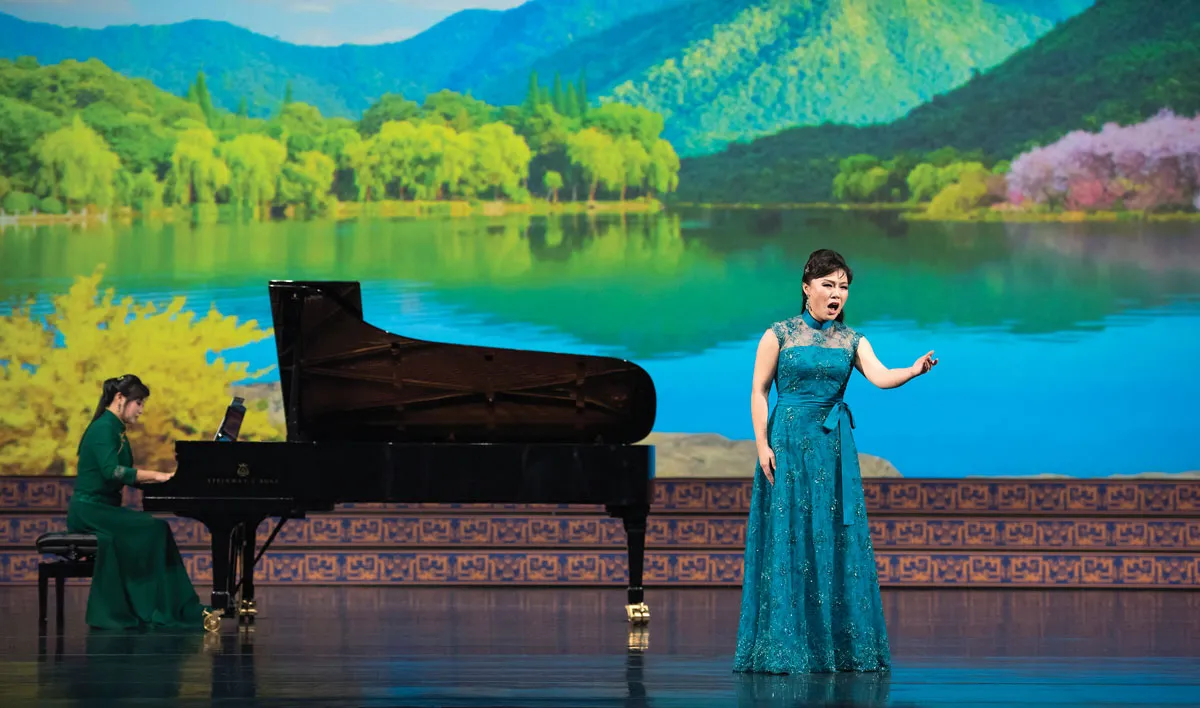
In the cacophony of the modern world, silence is often mistaken for absence. For Megan Li, however, silence is a reservoir. Offstage, the lead dancer for Shen Yun Performing Arts is admittedly reserved, a personality that naturally seeks the quiet corners rather than the center of the room. Yet, under the stage lights, this introversion undergoes a transmutation. The shyness evaporates, replaced by a commanding presence that speaks without uttering a single syllable.
“I don’t really like to express myself in words,” Li admits, reflecting on the dichotomy of her life. “After dancing for a while, I’ve realized I don’t have to talk — I can express the role that I have, the dance, and I feel like I’m talking to the audience through my dancing.”
Classical Chinese dance functions as a distinct linguistic system, one where the vocabulary is built from minute gestures and the syntax is governed by the dancer’s yun—their inner bearing. It is an art form where a lowered gaze or the curve of a finger is not merely aesthetic but a direct transmission of values rooted in 5,000 years of civilization.
Li has felt emboldened by the expressiveness of the gestures particular to classical Chinese dance. Despite her shyness, she can share her feelings with thousands of people in an audience through dance. Photography by Bill Xie
The Mirror of the Mind
The ethos of Shen Yun is built upon a revival of China’s semi-divine culture, drawing heavily from the spiritual wells of Buddhism, Taoism, and Confucianism. Unlike Western disciplines that often celebrate individual bravado, classical Chinese dance demands a harmonization of the self with the collective. It is suited to the humble spirit because it emphasizes synchronization over the spotlight.
For Li, the physical discipline is inextricably linked to spiritual cultivation. A central tenet of the art form is that the dancer’s internal state is transparent to the audience; one cannot perform benevolence while holding onto agitation.
“I have to always look inside to see if I have anything that’s blocking my feelings, preventing me from being happy,” Li explains. Her approach to her craft is investigative and introspective. When hardships arise, she turns inward to identify negative thought patterns. “After I realize it, I try to think more positive… When I act, I’m more in the mood, more into that character.”
This philosophy reframes the physical toll of elite performance. The soreness of training is not viewed as an injury, but as a tangible metric of growth—a signal that the necessary muscles are being forged.
It was difficult for Li to develop great flexibility during her training, but she has always tried to look at challenges in a positive light, as the means towards great ends. (c) Shen Yun Performing Arts
From Spectator to Protagonist
Li’s journey into this ancient world began in the modern setting of San Francisco. Moving to the United States from China at the age of two, she grew up identifying more with her American surroundings than her ancestral roots. Yet, a ritual persisted: every January, around her birthday, she would watch Shen Yun perform.
“It would be the best birthday present ever,” she recalls. While she was mesmerized by the spectacle, the shy, sports-loving girl never envisioned herself within the tableau.
That trajectory shifted in 2010. At twelve years old, seeking a deeper connection to her heritage, Li enrolled at the Shen Yun Academy of the Arts in California. The curriculum, rich in Chinese history, acted as a bridge to a past she had only glimpsed. Dance, initially just a component of her studies, quickly became her vocation. The transformation was rapid; the “American” teenager found herself mastering an ancient physical language and touring the world’s most prestigious venues.
Now a lead dancer with four years of touring experience, Li remains grounded, often deflecting praise. She views the rigors of travel—the jet lag, the exhaustion—through the lens of a missionary zeal. “We have to suffer to bring this beauty to others,” she notes, highlighting the company’s dedication to showcasing a China that existed before, and persists outside of, the current communist regime.
The ancient Chinese believed that human culture was bestowed by heavenly immortals, and among these gifts was celestial garb. Shen Yun’s costumes revive this heavenly dress. (c) Shen Yun Performing Arts
Truth and Resilience
The narrative scope of Shen Yun extends beyond mythology into contemporary human rights realities. Li and her mother are practitioners of Falun Dafa, a spiritual meditation practice persecuted in China since 1999. This personal connection imbues her performances with a visceral gravity.
One specific role resonates deeply with her: a dance depicting the persecution, where Li plays a practitioner who hands a banner to a baby girl before being killed by the regime. In the narrative, the child grows up to reconnect with Li’s character and the faith her mother died for.
The story carries a heavy, personal echo for Li. Her father, influenced by the pervasive propaganda against Falun Dafa in China, held a difficult relationship with the practice. He passed away two years ago, never having seen his daughter perform on the Shen Yun stage—a silence in her life that remains unbroken.
Yet, through dance, Li finds the courage to confront both historical and personal tragedies. She cites the legend of Mulan as a profound influence. The story of the young woman who disguises herself as a man to take her ailing father’s place in war offers Li a template for strength. It validates the idea that a gentle exterior can house a warrior’s resolve.
“It makes me feel I should help others more, and help myself become better, too,” Li says. On stage, the shy girl from San Francisco disappears, and in her place stands a figure capable of bridging the gap between the human and the divine, speaking a language that requires no words to be understood.

 Li has felt emboldened by the expressiveness of the gestures particular to classical Chinese dance. Despite her shyness, she can share her feelings with thousands of people in an audience through dance. Photography by Bill Xie
 It was difficult for Li to develop great flexibility during her training, but she has always tried to look at challenges in a positive light, as the means towards great ends. (c) Shen Yun Performing Arts
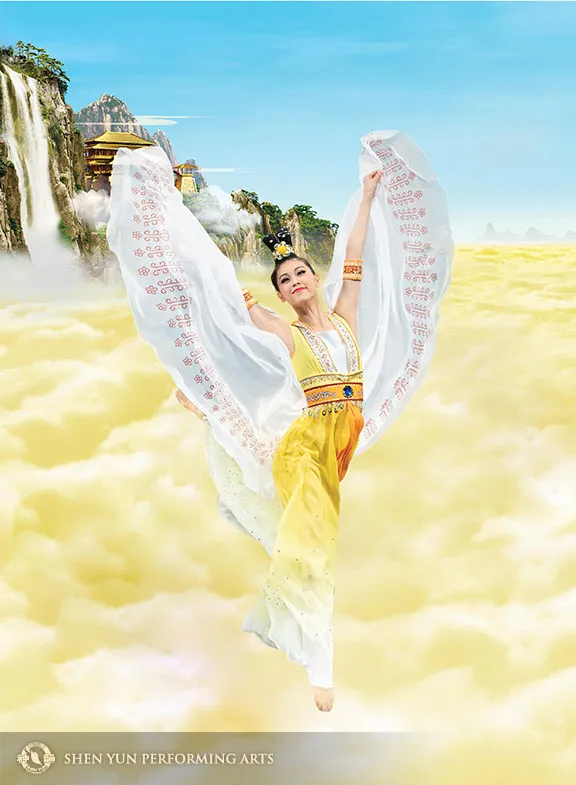 The ancient Chinese believed that human culture was bestowed by heavenly immortals, and among these gifts was celestial garb. Shen Yun’s costumes revive this heavenly dress. (c) Shen Yun Performing Arts