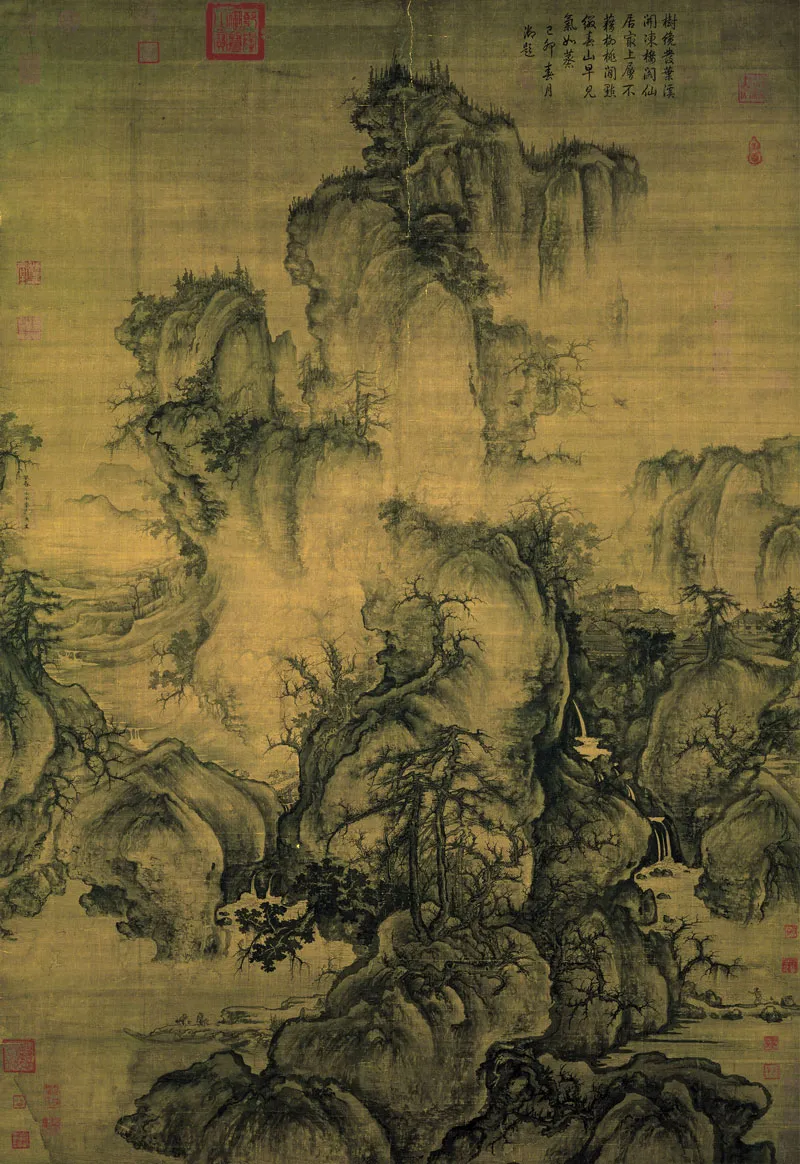
This season, the museum landscape opens a series of portals into the artistic soul of Asia. From the dust of ancient trade routes to the iridescent sheen of titanium sculptures, these exhibitions do not merely display objects; they map the contours of human thought, spiritual longing, and the quiet dignity of craftsmanship.
Here is a curated selection of exhibitions that bridge the divide between the ancient and the avant-garde, offering a contemplative journey through time, material, and memory.
1. The Veins of the World
The Silk Roads
Location: British Museum, London
Date: Through February 23, 2025
Asian–Art–Exhibitions-1
History is often taught as a series of isolated empires, but the British Museum proposes a different narrative: a vast, interconnected web. Focusing on the pivotal era between AD 500 and 1000, The Silk Roads moves beyond the commodity of silk to explore the transmission of ideas, faiths, and technologies.
The exhibition illuminates the “veins” that connected Asia, Europe, and Africa, showcasing rare artifacts from Uzbekistan and Tajikistan displayed in the UK for the first time. Viewers encounter intricate Sogdian murals and ivory chess pieces from Samarkand alongside a Buddhist mandala from the Mogao Caves. It is a study of movement—of a Chinese princess bringing sericulture to the West, and the complex, human stories of smugglers and diplomats who navigated the boundaries of the known world.
2. The Weight of Light
The Eternal Garden – Titanium Art by Aka Chen
Location: Bowers Museum, Santa Ana
Date: Through April 13, 2025
Asian–Art–Exhibitions-2.2
In a debut US solo exhibition, Taiwanese artist Aka Chen bridges the gap between the monumental and the miniature. Chen’s medium is titanium—a material known for its industrial strength—yet under his hand, it becomes fluid, ethereal, and iridescent.
Drawing deeply from Chinese philosophical traditions, Chen treats the concept of the “garden” not just as a physical space, but as a site for meditation and self-discovery. Through techniques like underwater carving and high-temperature shaping, he creates works ranging from delicate jewelry-like vases to soaring 30-foot installations. The centerpiece, a titanium sculpture encrusted with gemstones, exemplifies a harmony between opulence and Zen-like restraint, inviting the viewer into a world where heavy metal floats like a breath.
3. Preserving the Shadow
The Art of Ink Rubbings – Impressions of Chinese Culture
Location: Nelson-Atkins Museum of Art, Kansas
Date: Through February 2, 2025
Asian–Art–Exhibitions-3
Before the age of photography, there was the ink rubbing—a tactile method of memory. Dating back to the 6th century, this technique captured the inscriptions of stone and bronze steles, preserving history in stark, beautiful contrast.
The Nelson-Atkins Museum explores how this documentary practice evolved into a sophisticated art form by the 19th century. Featuring over 25 examples alongside the original objects, the exhibition reveals the interplay between the three-dimensional artifact and its two-dimensional “shadow.” It serves as a testament to the scholar’s obsession with the past, highlighting how these monochromatic impressions became a cultural bridge, introducing the aesthetics of Chinese calligraphy and carving to a global audience.
4. Sanctuaries of Ink
Mountains of the Mind – A Chinese Landscape Journey
Location: Asian Art Museum, San Francisco
Date: Through January 2025
Asian–Art–Exhibitions-4
In the frenetic rhythm of modern existence, the shanshui (landscape) painting offers a necessary retreat. This exhibition does not merely present depictions of nature; it offers “mountains of the mind”—idealized spaces constructed for spiritual wandering.
The curation highlights the literati ideal of withdrawal from chaos. We see Ni Zan’s austere brushwork, stripping away the superficial to reveal a world of solitude, contrasted with Wen Zhengming’s lush, harmonious groves. These are psychological landscapes as much as physical ones—symbolic sanctuaries where the scholar could escape the dust of the mundane world to find clarity in ink and paper.
5. Illumination and Renewal
The Lantern Festival and 2025 – The Year of the Snake
Location: Norton Museum of Art, West Palm Beach
Date: Through February 16, 2025
Asian–Art–Exhibitions-5
Marking the transition of the lunar calendar, this exhibition focuses on the interplay of light and folklore. Central to the display are rare 16th-century scrolls that capture the vibrancy of the Lantern Festival—the luminous conclusion to the Lunar New Year celebrations.
To honor the incoming Year of the Snake, the Norton Museum pairs these festive scenes with Japanese artworks featuring the serpentine motif, including woodblock prints and intricate ivory netsuke. It is a celebration of the cycle of time, blending the communal joy of the festival with the quiet, symbolic power of the zodiac in East Asian art.
6. The Language of Pigment
Kaleidoscope of Colors in Asian Art
Location: Harn Museum of Art, University of Florida
Date: Through April 26, 2026
Asian–Art–Exhibitions-6
Color in Asian art is rarely purely decorative; it is a code of status, cosmology, and element. Kaleidoscope of Colors deconstructs the visual spectrum, focusing on the specific cultural weights of green, blue, red, and gold across three millennia.
From the mineral depths of blue in Indian textiles to the imperial resonance of red in Chinese lacquerware, the exhibition examines how pigment functions as a language. It reveals the transregional dialogues facilitated by trade—where the pursuit of a specific hue could drive commerce and influence aesthetics across borders.
7. Beauty in Utility
Japan, Form & Function – The Montgomery Collection
Location: Crow Museum of Asian Art, The University of Texas
Date: Through April 13, 2025
Asian–Art–Exhibitions-7
Drawing from the celebrated collection of Jeffrey Montgomery, this exhibition is an ode to Mingei—the Japanese folk art movement that finds profound beauty in utilitarian objects. It challenges the hierarchy of “high art” by elevating the everyday: water jars, tea kettles, and textiles.
The curation traces the evolution of Japanese craftsmanship from the Ryūkyū Kingdom to the modern era, featuring works by pioneers like Kawai Kanjirō and Bernard Leach. It is a study in the balance of form and function, where the hand of the maker is visible in the humble, durable, and honest objects of daily life.
8. Nature as Mirror
Landscape, Mindscape – Portrayals of Nature and the World from Korea and Beyond
Location: Jordan Schnitzer Museum of Art, University of Oregon
Date: Through May 18, 2025
Asian–Art–Exhibitions-8
Spanning three centuries, Landscape, Mindscape juxtaposes the traditional with the contemporary to explore the Korean gaze upon nature. The exhibition places Joseon dynasty folding screens alongside modern video art and ceramics, creating a dialogue across time.
Notable works include Lee Lee-Nam’s digital reinterpretations of classical scenes and Seongmin Ahn’s surreal still lifes. The collection suggests that the landscape is never static; it is a “mindscape,” constantly reshaped by socio-political narratives and the shifting relationship between humanity and the environment.
9. The Unseen Realm
Good or Evil – Demons, Ghosts, and Goblins in Chinese Art
Location: Cleveland Museum of Art
Date: Through January 20, 2025
Asian–Art–Exhibitions-9
In the rich tapestry of Chinese folklore, the supernatural is not always malevolent; it is a complex bureaucracy of spirits, demons, and guardians. The Cleveland Museum of Art opens a window into this spectral world, examining the dual nature of these beings as both agents of chaos and protectors against evil.
Anchoring the exhibition is a rare 32-foot handscroll depicting a demon-hunting narrative, alongside monumental sculptures of guardians. The figure of Zhong Kui, the demon queller, stands central—a reminder of the thin veil between the mortal world and the spirit realm, and the art created to negotiate that boundary.
10. The Architecture of the Heavens
Mapping the Infinite – Cosmologies Across Cultures
Location: Los Angeles County Museum of Art (LACMA)
Date: Through March 2, 2025
Asian–Art–Exhibitions-10
Humanity has always looked up, seeking to impose order on the chaos of the stars. In collaboration with scientists, LACMA presents a profound exploration of how different civilizations have visualized the cosmos.
The exhibition traverses time and geography—from the Neolithic to the Islamic Middle East and East Asia—to reveal the sacred geometries and celestial deities that define our understanding of the universe. It is an intersection of science, spirituality, and art, mapping the infinite questions of origin and existence.
11. The Evolution of Story
From the Divine to the Mortal – Storytelling in Chinese Painting at Mia
Location: Minneapolis Institute of Art
Date: Through October 19, 2025
Asian–Art–Exhibitions-11
Narrative is the lifeblood of culture. This exhibition traces the arc of Chinese storytelling over 2,000 years, documenting a significant shift in focus: from the high drama of Buddhist and Taoist mythology to the intimate details of mortal life.
Through richly detailed scrolls and paintings, visitors witness the changing purpose of art—from moralizing tales and political satire to the celebration of earthly experiences. It is a journey from the divine clouds of legend down to the bustling, dusty streets of human reality.
 Asian–Art–Exhibitions-1
 Asian–Art–Exhibitions-2.2
 Asian–Art–Exhibitions-3
 Asian–Art–Exhibitions-4
 Asian–Art–Exhibitions-5
 Asian–Art–Exhibitions-6
 Asian–Art–Exhibitions-7
 Asian–Art–Exhibitions-8
 Asian–Art–Exhibitions-9
 Asian–Art–Exhibitions-10
 Asian–Art–Exhibitions-11