In the stillness of the stage, a figure clad in purple and white unfurls a folded fan. The movement is not merely a gesture but an invocation of an era long past. As the music rises, the dancer dissolves, replaced by the solitary silhouette of an ancient scholar lost in the moonlight.
This is the atmosphere of Moonlight Mist, the choreographic work that earned Bella Fan the gold award at the 10th NTD International Classical Chinese Dance Competition. For Fan, this performance was more than a display of technical prowess; it was an act of temporal translation, bringing the refined aesthetics of the Song Dynasty into the visceral reality of the present moment.
Bella Fan / Credit of Dress: Samuelle Couture
The Body as a Brush
The piece draws its narrative soul from Cave Fairy Song · Sizhou Mid-Autumn Festival, a poem by the Song Dynasty writer Chao Buzhi. The text speaks of a misty night, the beauty of the moon, and a deep, introspective reflection on the meaning of existence. To translate this literary heritage into movement, Fan approached the stage as a canvas, utilizing her body as the brush and the music as the ink.
The choreography navigates a complex emotional spectrum. It begins in a state of solitude and dejection—the scholar searching the heavens for answers to earthly troubles. Through the dance, this heaviness transmutes into a sudden, weightless epiphany. The transition from solemnity to lighthearted ease is not just a change in tempo, but a shift in the dancer’s internal state.
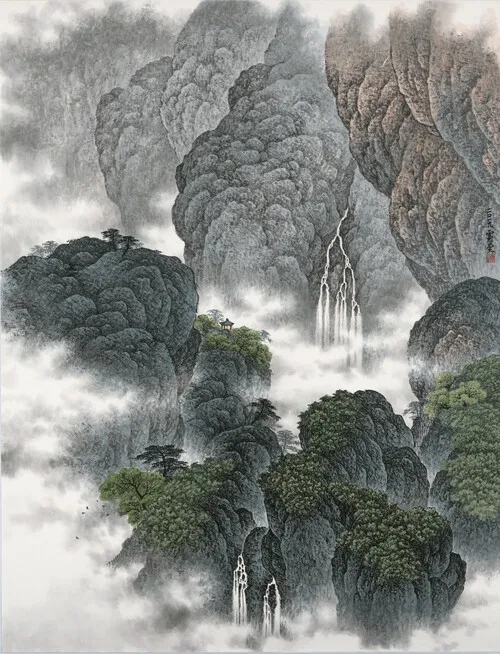
Fan’s affinity for the Song Dynasty (960–1279) informs the texture of the performance. It was an era defined by a “profound simplicity”—impeccable ink paintings, exquisite porcelain, and poetry that balanced Confucian values with deep human emotion. In Moonlight Mist, every flick of the sleeve and pause in movement attempts to capture this specific aesthetic: clean, elegant, yet laden with significant meaning.
Bella Fan performs Moonlight Mist in the 10th NTD International Classical Chinese Dance Competition.
The Architecture of Movement
To convey a psychological journey that moves from confusion to enlightenment, technique becomes a language rather than a feat. “The dancer must first align herself with the sentiments and values she wishes to communicate before she can use her body to convey the character’s inner emotions,” Fan observes.
This philosophy is physically realized through the method known as shen dai shou, kua dai tui—the body leads the hands, the hips lead the legs. It is a technique that Shen Yun Performing Arts has revived, representing a pinnacle of classical Chinese dance. By originating movement from the core, the dancer achieves a maximum extension of the limbs.
The result is a kinetic vocabulary that mirrors the range of a writer or a vocalist. Just as a rich vocabulary allows for nuanced storytelling, the physical extension provided by this technique creates room for emotional expression. In Fan’s performance, the point of a toe or the angle of a fingertip is not an isolated action but the final ripple of an impulse starting deep within the body.
Bella Fan / Credit of Dress: Samuelle Couture
Resilience Behind the Curtain
The seeming effortlessness of the “scholar” on stage belies the rigorous reality of the artist behind it. This gold award marked Fan’s fourth participation in the New York competition, a journey spanning a decade since she left her hometown in Taiwan to join Shen Yun.
The life of a principal dancer is one of relentless repetition—stretching, conditioning, and the constant refinement of form. Fan admits that the exhaustion and pain of touring and training have, at times, invited thoughts of quitting. Yet, the resolve to continue stems from a clarity of purpose. The choice is always between the comfort of avoidance and the satisfaction of overcoming the self.
“There are no shortcuts,” Fan notes. Improvement is a process of trial and error, of adjusting force and feeling until the error dissolves into art.
Bella Fan
A Spiritual Dialogue
Classical Chinese dance is inherently linked to a worldview where art serves as a bridge between the human and the divine. The name “Shen Yun” itself translates to “the beauty of divine beings dancing.” This connection requires the artist to cultivate an internal purity that matches their external technique.
Fan and her fellow performers are practitioners of Falun Dafa, a spiritual discipline centered on truthfulness, compassion, and tolerance. This cultivation of character is not separate from the dance; it is its foundation. The ancient Chinese belief that the heart is the locus of the self implies that only a refined heart can produce truly resonant art.
For Fan, the role of the scholar in Moonlight Mist—a figure who moves from being lost to finding enlightenment—parallels the dancer’s own path. It is a mission of reviving a culture believed to be divinely inspired, a task that demands resilience, patience, and a continuous elevation of the spirit.

 Bella Fan / Credit of Dress: Samuelle Couture
 Bella Fan performs Moonlight Mist in the 10th NTD International Classical Chinese Dance Competition.
 Bella Fan