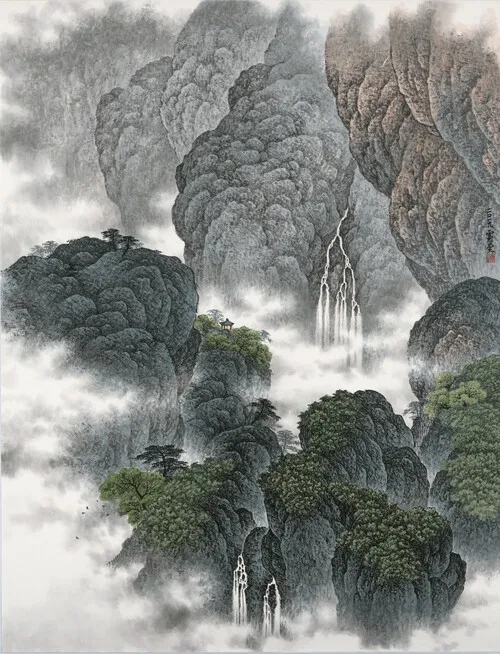
In the realm of contemporary art, the gap between the industrial and the ethereal is often wide, yet Taiwanese artist Chen Chun-hao bridges this divide with a tool usually reserved for construction sites: the air nailer. Where traditional literati scholars once wielded brushes made of wolf hair and pine soot ink, Chen employs a pneumatic gun and headless finishing nails to reconstruct the misty, philosophical landscapes of ancient China.
His works are a study in paradox. At a distance, they appear as soft, graded ink wash paintings—monumental landscapes filled with voids and presence. Upon closer inspection, the illusion dissolves into a rigid, metallic field of hundreds of thousands of iron nails. It is a transformation of the mundane into the meditative, proving that the spirit of an artwork resides not in the material itself, but in the manipulation of light and perception.
Taiwanese artist Chen Chun-hao used iron nails to masterfully reproduce the celebrated 8th-century work Court Ladies Adorning Their Hair with Flowers by Tang Dynasty artist Zhou Fang. (Fragment)
The Alchemy of Light and Hardness
Chen’s technique is less about applying color and more about sculpting shadow. He refers to this process as a translation of the “five colors of ink”—the traditional spectrum of tonal values in Chinese painting—into a binary language of pin and void. By varying the density, height, and spacing of the nails, he controls the shadows cast upon the canvas.
“The interplay of lights and shadows evokes the essence of ink wash paintings, while the arrangement of the nails creates a layered effect,” Chen observes. This is not a static viewing experience. As the viewer moves, or as the lighting shifts, the “ink” appears to flow and morph. The shadows elongate and retract, giving the mountains and streams a kinetic vitality that ink on paper often lacks. It is a three-dimensional pointillism where the dots are not pigment, but projections of darkness cast by steel stems.
The artist’s background informs this unique synthesis. Chen studied ink wash painting at the Taipei National University of the Arts, spending his formative years strictly adhering to the discipline of copying masterpieces. “Over time, I grew bored of the traditional approach to ink painting, so I ventured into experimenting with decorative arts,” he recalls. Yet, he never truly abandoned the philosophy of the ink lineage; he simply sought a medium that could withstand the weight of modern reinterpretation.
Resurrecting the Northern Song
The subjects of Chen’s labor are not chosen at random. He deliberately engages with the heavyweights of art history, specifically the monumental landscape painters of the Northern Song and Tang dynasties. In his hands, Guo Xi’s Early Spring (ca. 1023–1087), Fan Kuan’s Travellers Among Mountains and Streams (ca. 950–1032), and Li Tang’s Whispering Pines in Myriad Valleys (ca. 1049–1130) are reborn.
These are not mere reproductions; they are acts of reverence performed through extreme physical exertion. To recreate the subtle washes of a mountain mist or the intricate folds of a court lady’s robe requires a staggering volume of fasteners. “My pieces often demand hundreds of thousands or even millions of nails, all meticulously secured by my hand with an air nailer,” Chen explains.
Upon closer inspection, the unevenly spaced iron nails and their shadows create the impression of overlapping mountain ranges.
The process is grueling and repetitive, akin to a monastic practice. Where the ancient masters sought the “qi” (spirit resonance) through the spontaneous flow of the brush, Chen finds it through the rhythmic, deafening percussion of the nail gun. He insists on executing this labor himself, rejecting the studio assistant model common in contemporary production. “When replicating these ancient paintings, it’s crucial that I do it personally. It’s my way of honouring these ancient sagas and capturing the spirit they embody.”
A Modern Materiality
There is a profound tension in Chen’s work between the permanence of the nail and the transience of the shadow. The nails are industrial, mass-produced, and sharp—objects of utility. The images they form are organic, fluid, and steeped in Taoist philosophy regarding nature and emptiness.
By forcing these opposing elements together, Chen Chun-hao questions the definition of “soft” power in art. He demonstrates that the delicacy of a whispering pine or the elegance of a Tang dynasty court lady does not require silk or paper. It can be forged from the very hardware that holds our modern world together, provided one has the patience to see the shadow within the steel.

 Taiwanese artist Chen Chun-hao used iron nails to masterfully reproduce the celebrated 8th-century work Court Ladies Adorning Their Hair with Flowers by Tang Dynasty artist Zhou Fang. (Fragment)
 Upon closer inspection, the unevenly spaced iron nails and their shadows create the impression of overlapping mountain ranges.