History often remembers Lady Diao Chan through the lens of romance and intrigue. As one of ancient China’s “Four Beauties,” her legacy is enshrined in the 14th-century epic Romance of the Three Kingdoms. To the casual observer, she is the ultimate femme fatale—a woman of unparalleled allure who dismantled a tyrannical warlord and his fearsome adopted son through a calculated love triangle. She accomplished with a glance what entire armies failed to do with swords: ending a reign of terror during the late Han Dynasty.
However, when Carol Huang, a principal dancer for Shen Yun Performing Arts, stepped into this role for the dance drama The Beauty Trap (2019–2020), she sought something deeper than mere aesthetic perfection. To portray a woman capable of altering the fate of an empire, Huang had to look past the surface of beauty and locate the steel core of the character.
The Architecture of Sacrifice
For Huang, the essence of Diao Chan is not found in her ability to manipulate, but in her profound capacity for devotion. The popular narrative focuses on the “trap,” yet Huang’s interpretation anchors itself in xiao (filial piety) and loyalty. Diao Chan did not enter the fray for power; she offered herself as a weapon to her adoptive father to save a crumbling nation.
“After reading Romance of the Three Kingdoms,” Huang observes, “I felt that Diao Chan is very respectful of her adoptive father and devoted to her country. She’s willing to sacrifice herself for the sake of others. She’s very courageous.”
This perspective shifted the artistic challenge of the role. The Beauty Trap is a technically demanding production, culminating in a third act filled with rapid, complex techniques as Diao Chan navigates the physical and emotional crossfire between the tyrant and the warrior. Yet, Huang found the true crucible of the performance in the quietude of the second act.
Huang spends six months each year touring the world with Shen Yun Performing Arts as a principal dancer.
In the garden scene, before the intrigue begins, Diao Chan is approached by her father with the impossible mission. It is a moment of stillness where the character’s internal world fractures. “Inside, she didn’t want to do it,” Huang reflects. “But she also saw her father’s distress, and the country’s dire situation. She was struggling with many emotions: whether she should sacrifice herself, her love and gratitude for her adoptive father… as well as her determination once she made up her mind.”
Portraying this invisible conflict required more than physical agility; it demanded a “rationality” in dance—an intellectual engagement where the artist must scrutinize the thought process behind every gesture.
The Invisible Technique
In classical Chinese dance, the physical form is merely a vessel for the spirit. This discipline operates on the principle that the body follows the heart. If the internal intent is absent, the movement, no matter how acrobatic, remains hollow. Huang utilized this philosophy to differentiate the layers of Diao Chan’s journey, using the music as a guide to integrate her own psyche with the character’s emotional arc.
This approach highlights a unique characteristic of the art form: the malleability of movement based on intent. “The same movement can be fast or slow, sorrowful or joyful, all depending on what type of feeling the dancer wants to express,” Huang explains. A sleeve tossed in anger looks physically similar to one tossed in despair, yet the energy projecting to the audience is vastly different.
Years of diligent study and hard work have enabled Huang to embody the unique beauty of classical Chinese dance.
Having started her training at age four in China before being accepted into New York’s prestigious Fei Tian Academy of the Arts at twelve, Huang has spent years refining this connection between mind and body. The gold prize winner of the 2018 NTD International Classical Chinese Dance Competition notes that maturity as an artist comes from this intellectual rigor. It is not enough to move; one must understand why one moves. This deepening understanding of traditional Chinese culture, which prizes inner meaning over superficial display, has allowed her to navigate complex characters with a newfound ease.
When Art Mirrors Life
There is a poignant resonance between the historical figures Huang portrays and her own trajectory as an artist. While Diao Chan’s story is one of separation and sacrifice for a greater cause, Huang’s real-life narrative carries its own weight of displacement.
Born in China, Huang’s artistic rise in New York occurred against a backdrop of personal anxiety. Her parents are practitioners of Falun Gong, a spiritual discipline centered on truthfulness, compassion, and forbearance. Following its immense popularity in the 1990s, the Chinese Communist Party launched a brutal persecution against the practice in 1999. Growing up, Huang witnessed an environment of fear, where practitioners faced illegal detention, torture, and discrimination.
The separation from her parents, who remained in China while she trained in the United States, created a profound silence in her life. She went years without seeing them, communicating rarely, always aware of the threat hanging over them. This lived experience of longing and resilience bled into her art.
Huang enjoys music and reading outside of dance.
In one specific Shen Yun piece, Huang played a celestial maiden watching over practitioners persecuted in China. The performance ceased to be mere acting. “When I saw how they persevered with unwavering faith, I was very touched,” she recalls. “I knew how difficult the situation was for practitioners inside China. I couldn’t help but think of all the people I know there.”
The narrative of separation eventually found a resolution. Huang received unexpected news that her parents had escaped to the United States after a recent detention. Their reunion was a moment of “wild joy” tempered by the bittersweet reality of exile. Like Diao Chan leaving her home to restore order, Huang and her family have found safety but at the cost of their homeland.
This personal history fuels Huang’s commitment to Shen Yun’s mission. The company seeks to revive the five millennia of divinely inspired culture that has been systematically dismantled under communist rule. For Huang, the exhaustion of a six-month global tour dissipates when weighed against the importance of this cultural restoration. She dances not just to perform, but to preserve a heritage and to tell the stories of those who, like her parents, have preserved their faith through silence and separation.

 Huang spends six months each year touring the world with Shen Yun Performing Arts as a principal dancer.
 Years of diligent study and hard work have enabled Huang to embody the unique beauty of classical Chinese dance.
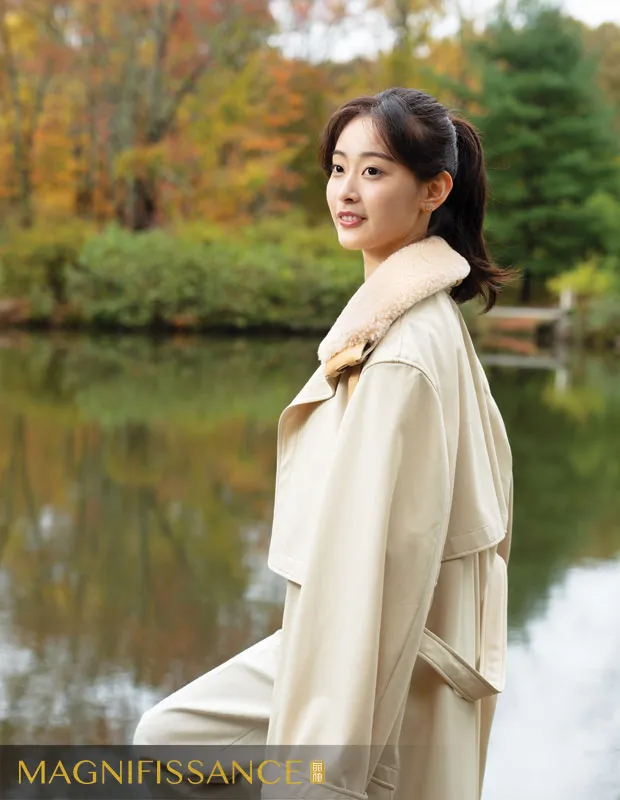 Huang enjoys music and reading outside of dance.


