History often moves in circles, but art moves through the transfer of vision. More than thirty years ago, American petroleum magnate J. Paul Getty presented his daughter-in-law, Ann Getty, with a singular object: a German Baroque cabinet, finished in exquisite white and blue lacquer, resting elegantly on a stand.
It was a gift of remarkable foresight. That cabinet did not merely furnish a room; it ignited a lifelong pursuit. Since that moment, Ann Getty has evolved into one of the most discerning collectors of Chinoiserie—a style that represents not just a geographical aesthetic, but a historical romance between the East and the West.
The gift that started it all: a German Baroque white and blue-lacquered cabinet on stand in Mrs. Getty’s bedroom.
The Architecture of Fantasy
To understand Mrs. Getty’s collection is to understand the origin of Chinoiserie itself. Rising to prominence in the 17th century, the style was never a literal documentation of Asian culture. Rather, it was a “whimsical European interpretation,” a dream of the Orient constructed by craftsmen who had often never set foot in China.
It was an art form born of fascination. European artisans, enchanted by the porcelain and lacquerware arriving on merchant ships, began to translate these exotic forms into their own vernacular. They painted tea pavilions beside English ponds and carved dragons—symbols of imperial power—with a fairy-tale touch.
“Whether or not they realized the dragon was a powerful symbol of the emperor, or that the peach was a symbol of the God of Long Life, craftsmen started painting, carving and enameling those and other exotic shapes onto their artistic goods,” Mrs. Getty observes.
For Ann Getty, who grew up amidst the walnut and peach orchards of California’s Sacramento Valley, this appreciation for craftsmanship is innate. Her upbringing was one of self-sufficiency, where painting, sewing, and driving tractors were all part of a robust education in how things are made. This hands-on understanding of materiality allows her to see beyond the surface of the lacquer to the labor underneath.
Antique giltwood armchair with Coromandel screen-paneled walls.
Shadows and Lacquer
Among the many textures in her collection, the Coromandel screen holds a particular gravity. These screens, characterized by their dark, lustrous lacquer and intricate inlaid decorations, serve as both furniture and architecture. Mrs. Getty often utilizes them not merely as dividers, but as immersive backdrops that redefine the spatial dimensions of a room.
“I like to use Coromandel screens in my designs as they are themselves works of art, and add rich texture to a room,” she notes. The interplay of deep shadow and inlaid light creates a dramatic tension, grounding the often airy and playful elements of Chinoiserie with a sense of historic weight.
Her expertise is such that in 2006, the Asian Art Museum in San Francisco curated A Curious Affair: The Fascination between East and West, an exhibition drawn largely from her private holdings. It was a testament to a collection that rivals major museums, built not just on wealth, but on a studious devotion to the principles of design.
The residence of a prominent San Francisco couple designed over two years by Mrs. Getty. 18th-century Venetian chairs and a 17th-century Chinese altar.
The Badminton Chairs and The Masters
In the hierarchy of Chinoiserie, certain names command reverence. Mrs. Getty’s collection houses a pair of the fabled Badminton chairs, designed circa 1754 by William and John Linnell for the Chinese bedroom at Badminton House in Gloucestershire. These chairs are not merely seats; they are sculptural evidence of the English aristocracy’s 18th-century obsession with the exotic.
While the Linnells are responsible for some of the genre’s most important examples, Mrs. Getty’s curatorial eye also recognizes the contributions of their contemporaries. She points to Thomas Chippendale, whose lattice-work fused sturdy English cabinetry with Oriental geometry, and Giles Grendey, famous for his vibrant red japanned furniture supplied to the Spanish nobility at the Castle of Lazcano.
These pieces represent a high-water mark of craftsmanship, where the “strangeness” of the East was tamed and polished by the technical precision of Western cabinetmakers.
William and John Linnell chair, circa 1754, for the Chinese bedroom in Badminton House, a large country manor in Gloucestershire, England.
A Private Serenity
Despite owning pieces of monumental historical significance, Mrs. Getty’s personal favorite is intimate and serene. Residing in the dining room of her country house is a reverse glass painted cabinet, crafted in England around 1760.
It is a piece that invites quiet contemplation. Bright-colored birds perch amongst blooming cherry blossoms, while peonies stretch toward figures that seem suspended in a moment of eternal stillness. The magic lies in the technique: “I love the reverse glass mirror paintings that cover the upper section of the breakfront,” she says. “The mirror paintings are a wonderful example of the chinoiserie style.”
Here, the aesthetic function of Chinoiserie is fully realized—not just as decoration, but as a portal to a tranquil, idealized world.
Mrs. Getty adores the reverse glass mirror paintings on this chinoiserie cabinet that lives in her dining room. Circa 1760.
Preservation and Evolution
Mrs. Getty’s role extends beyond that of a custodian; she is an active participant in the continuity of the craft. Through her Ann Getty House line, she selects pieces from her personal collection to be reproduced with exacting precision. This process often takes her to Jingdezhen, China’s millennia-old porcelain capital.
“We meet with artisans who produce beautiful reproductions of Chinese export porcelain from the 18th and 19th centuries,” she explains. This pilgrimage to the source closes the historical loop: modern Chinese artisans reproducing the European interpretations of their own ancestors’ work.
Travel remains her primary wellspring of inspiration. Whether analyzing the quality of light in a foreign city or the architecture of a museum, the displacement from the familiar sharpens her gaze. “When you are out of your home environment you look at things with a fresh eye,” she reflects.
Amid innumerable layers of complexity throughout Ann Getty’s home, a boat’s lines echo on a sculpture and a vase.
The Modern Tension
Today, Chinoiserie is enjoying a renaissance, transitioning from a rarefied pursuit to a broader aesthetic movement. Yet, the challenge remains in the application. For Ann Getty, the secret lies in the mix.
“I think that the future trend will turn towards the more traditional,” she predicts. “Adding more traditional chinoiserie elements into a modern setting creates some tension and makes the room more interesting.”
It is this tension—between the ancient and the contemporary, the foreign and the familiar—that keeps the style alive. In the hands of a master designer, Chinoiserie is not a relic of the past, but a tool for creating a “worldly, sophisticated interior” that transcends time.
Inlaid panels of a Coromandel screen—the dark portion outlining the green wallcovering—around one of her hearths at home.

 The gift that started it all: a German Baroque white and blue-lacquered cabinet on stand in Mrs. Getty’s bedroom.
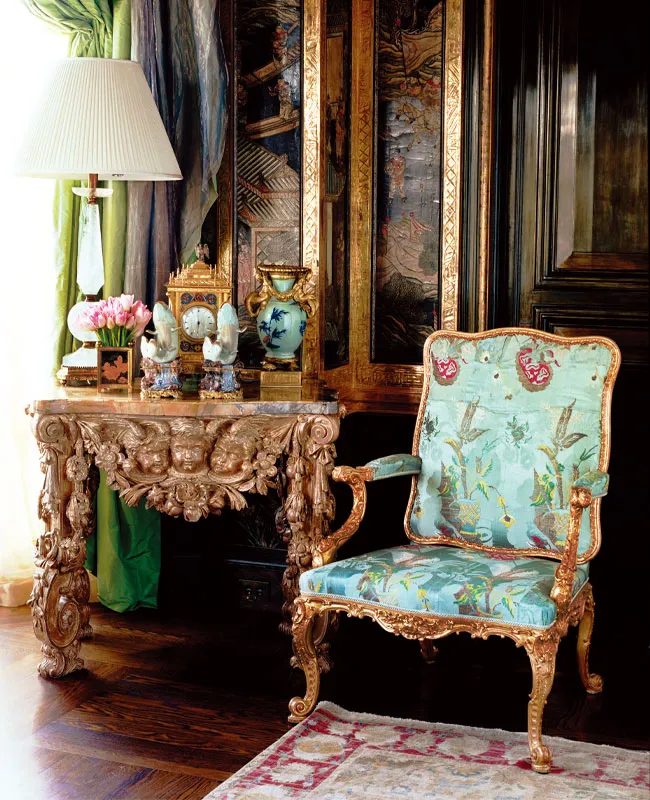 Antique giltwood armchair with Coromandel screen-paneled walls.
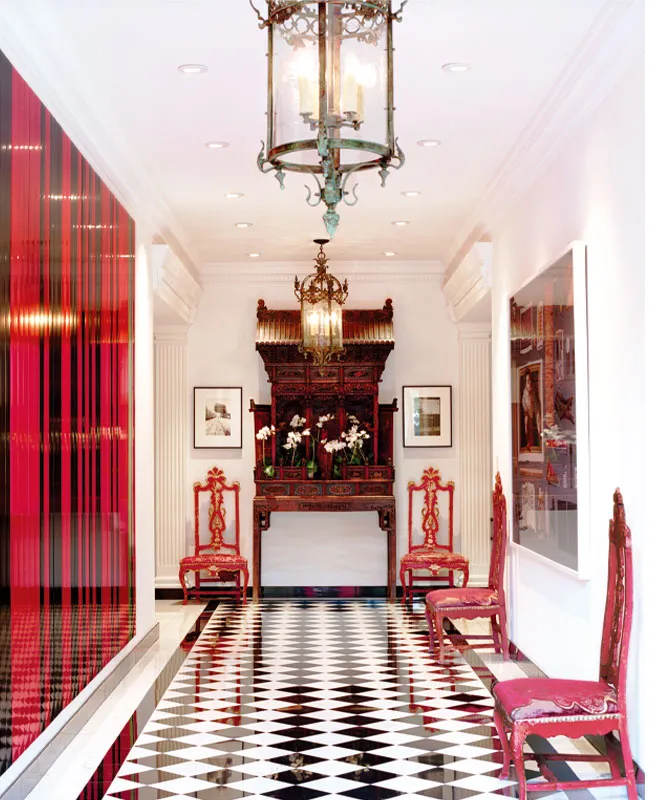 The residence of a prominent San Francisco couple designed over two years by Mrs. Getty. 18th-century Venetian chairs and a 17th-century Chinese altar.
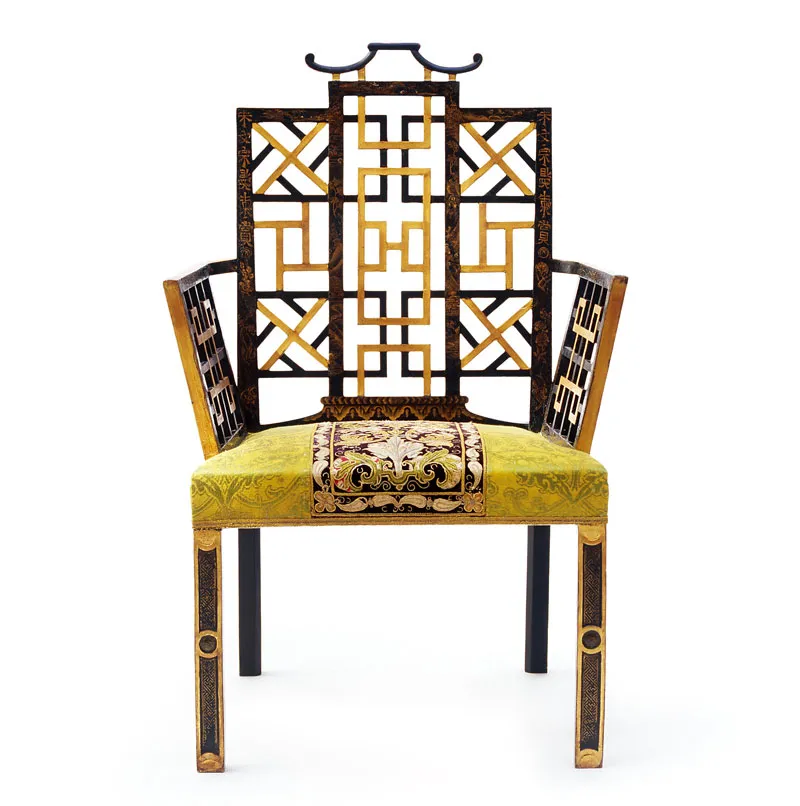 William and John Linnell chair, circa 1754, for the Chinese bedroom in Badminton House, a large country manor in Gloucestershire, England.
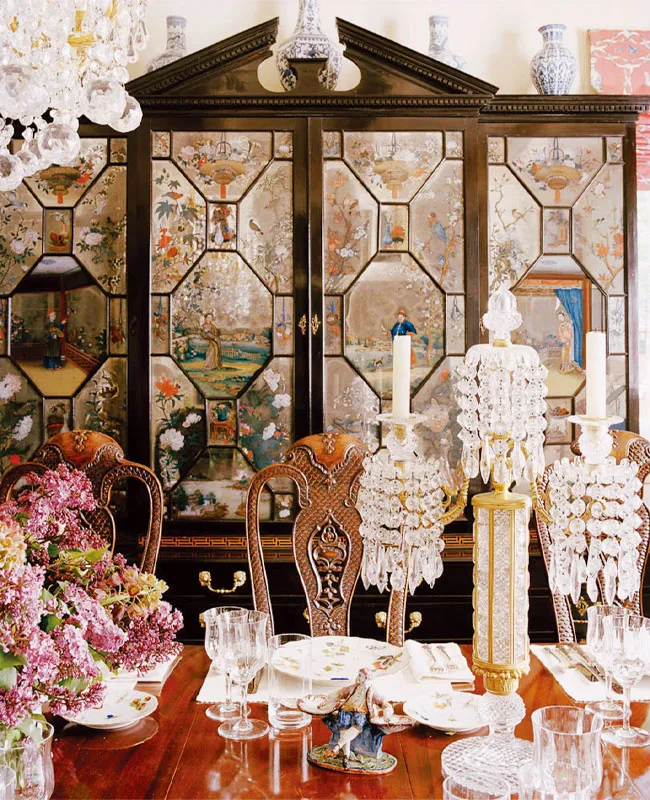 Mrs. Getty adores the reverse glass mirror paintings on this chinoiserie cabinet that lives in her dining room. Circa 1760.
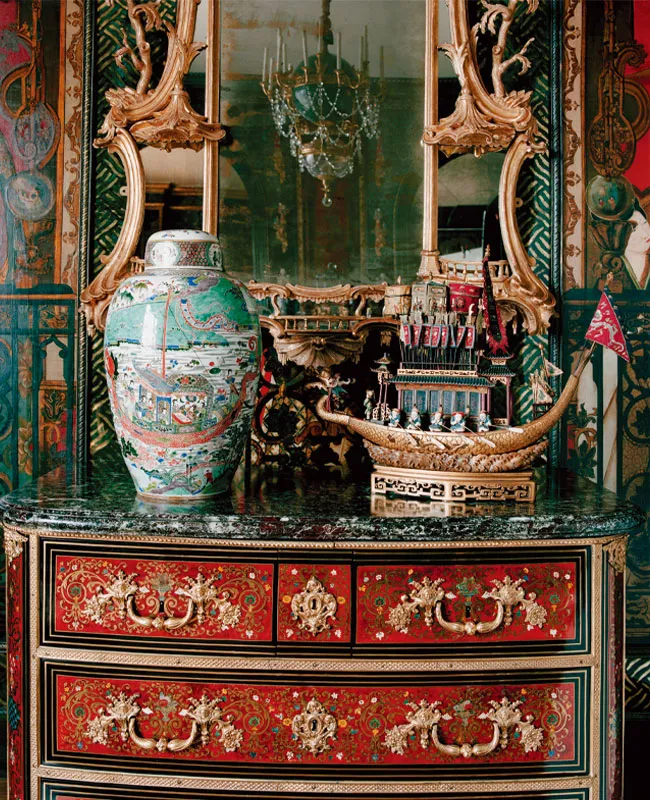 Amid innumerable layers of complexity throughout Ann Getty’s home, a boat’s lines echo on a sculpture and a vase.
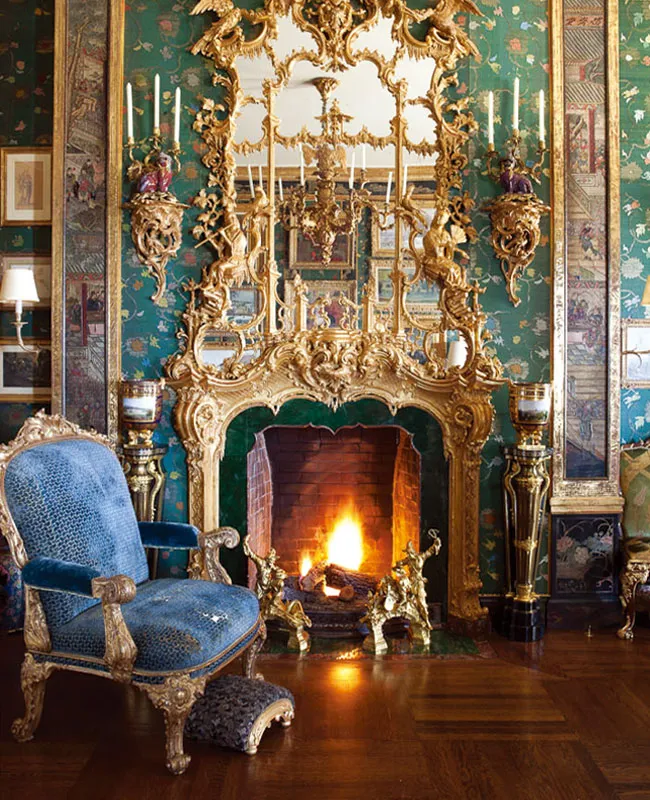 Inlaid panels of a Coromandel screen—the dark portion outlining the green wallcovering—around one of her hearths at home.