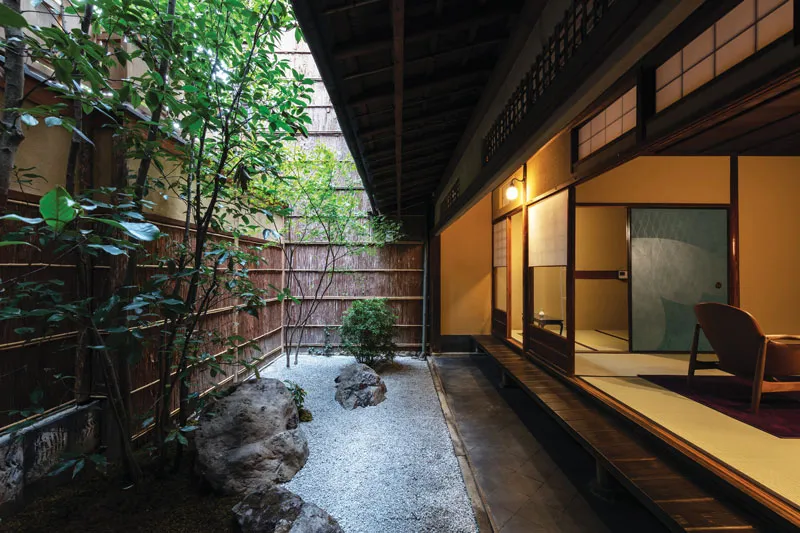
To enter a Japanese temple is to step out of chronological time and into a carefully constructed equilibrium. It is not merely a visitation to a religious site, but an immersion into a spatial philosophy where every beam, stone, and shadow serves a specific purpose. Whether it is the curve of a blue-tiled roof meeting the sky or the austere silence of a raked sand garden, these spaces are designed to reflect the eternal cosmic harmony between the earth and the larger universe.
Buddhism, since its arrival from China some 1,400 years ago, has deeply sedimented itself into the Japanese aesthetic consciousness. It has shaped not only the rituals of the spirit but the very architecture of daily life. Across the archipelago’s nearly 80,000 temples—concentrated heavily in the ancient capitals of Kyoto, Nara, and Kamakura—one finds a convergence of Northern and Southern dynasty influences and Tang Dynasty grandeur. Yet, the Japanese interpretation softens these origins, integrating wood and water to create a sanctuary where the boundary between the interior self and the exterior world dissolves.
We journey here to five specific sites, each offering a distinct vantage point on history, craftsmanship, and the Zen pursuit of nothingness.
Genko-an Temple: The Geometry of Perception
In the northwest hills of Kyoto, tucked away at the end of a path marked by an unpainted wooden sign, lies the Soto Zen temple of Genko-an. It is a modest structure compared to the great cathedral-like halls of the city center, yet it holds one of the most profound architectural statements in Zen Buddhism.
The temple is renowned not for a statue, but for two windows cut into the wall of the main hall. They serve as deliberate frames for the world outside, turning the changing seasons into a living painting. However, their primary function is philosophical.
Japanese temple: Genko-an-Temple
To the left sits the square “Window of Delusion.” In Zen symbology, the square represents the artificial limits of the human condition—our obsession with attachments, the rigidity of ego, and the inescapable cycle of birth, sickness, and death. It is the view of the world bound by four corners, defined by suffering and mortality.
To the right is the round “Window of Enlightenment.” The circle is the shape of Zen itself—fluid, complete, and infinite. It represents the universe and the wisdom that transcends the linear struggle of life.
Japanese temple 2: Genko-an Temple
Sitting before these portals, one is asked to make a silent choice. As the light shifts and the leaves in the courtyard garden turn from the tender green of spring to the deep reds of autumn, the windows remain constant. On a windless day, when time seems to arrest itself in the courtyard, the chirp of a bird is the only reminder that the world continues to spin. It is a place to lay down one’s troubles and gaze outward, moving visually from the confines of the square to the liberation of the circle.
Kiyomizu-dera Temple: Suspension Over the Void
While some temples invite introspection through enclosure, others reach outward toward the heavens. Kiyomizu-dera, a UNESCO World Cultural Heritage site in eastern Kyoto, exemplifies the principles of feng shui, perfectly positioned between the solidity of the mountain and the fluidity of water.
The temple’s name translates to “pure water,” derived from the Otowa Waterfall that flows from the mountain above. This water is channeled into three distinct streams representing longevity, health, and wisdom. For centuries, pilgrims have stood at the foot of the mountain, using long-handled spoons to drink from these currents, imbibing the mountain’s blessings in a ritual that marries physical thirst with spiritual aspiration.
Japanese temple 3-Kiyomizu-dera Temple
The architectural marvel of Kiyomizu-dera, however, is its massive wooden stage. Jutting out from the main hall, this 400-year-old viewing platform hangs suspended over the valley, supported by a lattice of 18 towering zelkova logs.
The construction is a testament to traditional Japanese joinery; not a single nail holds this structure together. Instead, the complex interlocking mortise-and-tenon joints provide a flexibility that allows the massive stage to sway with, rather than break against, the tremors of earthquakes. Standing upon it offers a vantage point that feels precarious yet secure, a metaphor for the Buddhist path—supported not by rigid iron, but by the resilient, natural interplay of wood and gravity.
Japanese temple 4-Kiyomizu-dera-Temple
Kinkaku-ji Temple: The Golden Mirror
In northern Kyoto, Kinkaku-ji (The Golden Pavilion) presents a vision that seems almost contradictory to the humble aesthetic often associated with Zen. It is a showstopper, a blinding assertion of beauty where the upper two floors are entirely sheathed in gold leaf.
Originally the villa of an aristocratic family during the Kamakura period, the structure has known destruction and rebirth, having been burned down and rebuilt multiple times, most recently in 1955. The pavilion sits poised above the Kyoko-chi, or “Mirror Pond,” creating a dual image: the solid gold temple rising against the sky, and its shimmering, wavering reflection in the water below.
Japanese temple 5-Kinkaku-ji-Temple
The architecture is a layered history of Japan’s spiritual and political evolution. The first floor, the Chamber of Dharma Waters, is built in the shinden-zukuri style of Heian aristocracy, housing a statue of Sakyamuni. The second floor, the Tower of Sound Waves, adopts the style of samurai residences, dedicated to Guanyin (Kannon). Finally, the third floor, the Cupola of the Ultimate, is purely Zen in its Tang Dynasty style, capped with an auspicious golden phoenix.
The progression from earthly nobility to martial strength, and finally to Zen emptiness, mirrors the life of the Buddha himself—a prince who turned away from worldly power to seek enlightenment. The gold, while opulent, serves as a reminder of the fleeting nature of wealth and fame. Dynasties vanish, but the light reflected in the Mirror Pond remains, ethereal and constant.
Japanese temple 6-Kinkaku-ji Temple
Daitoku-ji Temple: The River of Sand
Daitoku-ji is not a single building but a sprawling complex, a “temple town” that preserves the Zen architecture of the Muromachi period. Known for its association with the eccentric master Ikkyu, whose calligraphy is still preserved here, the temple offers a profound lesson in abstraction through its karesansui (dry landscape) gardens.
In these spaces, water is entirely absent, yet its presence is felt more powerfully than in a rushing stream. The “water” is white sand, raked into meticulous patterns; the “mountains” are rugged stones. It is a landscape of suggestion, requiring the viewer’s mind to complete the picture.
Japanese temple 7-Daitoku-ji Temple
The garden at Daisen-in, a sub-temple within the complex founded by Kogaku Soko, is akin to a three-dimensional Song Dynasty landscape painting. The arrangement is narrative: rocks representing the trials of life are scattered across a field of sand. The raked lines mimic a river that begins as a narrow, youthful torrent, gradually widening as it flows past obstacles, symbolizing the maturation from youth to old age.
Eventually, the lines smooth out into a flat expanse of white gravel. Here, the turbulence of existence dissolves into nothingness. The garden is dynamic, altered daily by the wind and the monks’ rakes, articulating the Taoist philosophy of the eternal cycle—the flow of life returning to the void.
Japanese temple 8-Daitoku-ji-Temple
Toshodai-ji Temple: The Vision of the Blind
The history of Buddhism in Japan is inextricably linked to the perilous journeys of monks who crossed the sea. While Xuanzang is celebrated for bringing scriptures from India to China, it was the monk Jianzhen who brought the rigorous precepts to Japan. His arrival was not easy; it took six attempts over eleven years, a struggle that cost him his eyesight due to infection.
When he finally arrived in Nara, he established Toshodai-ji. Unlike the imposing, state-sponsored Todai-ji, this temple was a personal testament to faith, built in the elegant style of the Tenpyo era.
Japanese temple 9-Toshodai-ji Temple
The main hall evokes the grace of the Tang Dynasty, characterized by the striking contrast between snow-white walls and dark, weathered woodwork. Its deep eaves and raised cornices create a sense of profound ease and stability. Although a repair 300 years ago disproportionately raised the roof—earning it the affectionate nickname “big-headed house”—the structure retains the dignity of its founder.
The presence of Jianzhen is felt most acutely in the dry-lacquer statue of the master, created shortly before his death. Exhibited only a few days each year, it is a masterpiece of realism. The sightless eyes and calm posture convey a deep inner vision. Standing before it, one feels the “breath” of the master, a silent dialogue across centuries with the man who built a sanctuary he would never see with his own eyes, but perceived perfectly with his spirit.

 Japanese temple: Genko-an-Temple
 Japanese temple 2: Genko-an Temple
 Japanese temple 3-Kiyomizu-dera Temple
 Japanese temple 4-Kiyomizu-dera-Temple
 Japanese temple 5-Kinkaku-ji-Temple
 Japanese temple 6-Kinkaku-ji Temple
 Japanese temple 7-Daitoku-ji Temple
 Japanese temple 8-Daitoku-ji-Temple
 Japanese temple 9-Toshodai-ji Temple
 Japanese temple 10-Toshodai-ji-Temple