In the venerable lineage of Shanghai’s art collectors, history is not merely observed; it is inherited. For Tony Dai, an antique dealer and scholar, the scent of ink and the rustle of ancient paper were the atmospherics of his childhood. Born into a family of collectors whose passion stretches back to the Qing Dynasty, Dai carries a reverence for the brush that courses through his veins—a four-generation legacy that has shaped him into a dedicated custodian of Chinese antiquity.
His initiation into this realm was precocious. By age six, Dai was already disciplined in the rigors of traditional calligraphy, and by eight, he had secured a second-place victory in a national competition. Yet, the fork in the road appeared early: the choice between creating art and preserving it. At twelve, with allowance money in hand, he made his first acquisition—a painting chosen not for its market speculation, but for an inexplicable, personal allure. It was the decision that defined his life.
A copy of Gu Kaizhi’s work The Nymph of the Luo River from the Song Dynasty. The painting employs rich imagination and sophisticated techniques, creating a composition in which reality and illusion intertwine.
Guided by mentors and the rich cultural fabric of Shanghai, Dai’s expertise matured rapidly. By nineteen, he had orchestrated his first major exhibition in Australia, juxtaposing the masterful restraint of the Ming and Qing Dynasties with the bold strokes of the 20th century. Today, his collection is more than a repository of objects; it is a testament to the philosophy that underpins traditional Chinese art—a philosophy where the unseen is as potent as the seen.
The Pulse of the Ink: Spirit Resonance
To the untrained eye, a landscape is a landscape. To Tony Dai, a true masterpiece vibrates with an invisible energy. Drawing from the wisdom of the Fourth Monks of the Qing Dynasty and the calligraphy of Wang Xizhi, Dai emphasizes that great art is a mirror of the creator’s internal cultivation. He aligns his own artistic insight with his spiritual practice of Falun Dafa, noting, “Through my cultivation, I find myself more attuned to the spiritual essence that those master painters sought to convey thousands of years ago.”
This concept is rooted in Qiyun—or “spirit resonance”—the first and most vital of the six principles established by the 6th-century critic Xie He. Spirit resonance is not technique; it is the breath of life within the work.
“To achieve seamless continuity in a painting, a deep mastery of fundamentals is crucial,” Dai explains. “The artist must authentically capture the subject’s essence—its ‘spirit resonance’—by deftly wielding the brush and ink to recreate its vivid reality.”
It is this elusive quality that acts as the ultimate litmus test for authenticity. A forgery may mimic the stroke, the composition, and the seal, but it cannot replicate the flow of Qi. In a copy, the spirit is fractured, the breath interrupted. In a genuine work, the ink seems to pulse with a life of its own, transmitting the vitality of the artist across centuries.
A partial view of Mi Youren’s painting Cloudy Mountains, Southern Song Dynasty. The painting adopts the typical technique of the “Mi Family Landscape,” where the mountain slopes are first lightly shaded with ink, and then varying-sized horizontal ink dots are repeatedly applied to depict mountain peaks and ridges. In Mi’s painting, this technique captures the lush and misty scenery of Jiangnan.
The Architecture of Silence
If Western art often seeks to fill the canvas, traditional Chinese painting seeks to empty it. This is the aesthetic of Liubai—literally “leaving white”—a deliberate use of negative space that serves as a visual echo of Taoist philosophy. As Lao Tzu wrote in the Tao Te Ching: “All things under Heaven are born from what exists, and what exists is born from emptiness.”
This void is not an absence of content, but a presence of possibility. It reached its zenith during the Song Dynasty (960–1279), an era defined by intellectual refinement and artistic minimalism. Dai points to Ma Yuan’s Angler on a Wintry Lake as the supreme embodiment of this technique.
“The painting draws inspiration from a Tang Dynasty verse: ‘In a lone boat, an old man in a straw rain hat and straw raincoat fishes upon the frigid river snow in solitude,’” Dai recounts.
In Ma Yuan’s masterpiece, the water is not painted; it is suggested. A few subtle lines hint at ripples, but the vastness of the river is conveyed through the untouched silk. This expanse of nothingness invites the viewer to step into the frame, to feel the cold mist and the profound solitude of the fisherman. It is an interaction that requires a tranquil mind to appreciate. In the modern world’s relentless noise, Dai suggests that Liubai offers a necessary respite—a psychological space for the weary soul to breathe.
Fishing Alone on the Cold River, Ma Yuan, Southern Song Dynasty. This piece is an excellent example of the “blank space” aesthetic in Chinese ink painting. The extensive use of blank spaces around the boat depicts the vast and misty river, offering readers scope for imagination
Xieyi: Writing the Soul
Distinct from the detailed precision of court painting is the genre of Xieyi, or “writing ideas.” Often misunderstood as merely “freehand” or compared loosely to Western impressionism, Xieyi is a deeply intellectual pursuit. It does not aim for anatomical accuracy but for the transmission of character.
“Gu Kaizhi introduced the concept of ‘expression of spirit through form,’ which meant that the portrayal of a subject’s physical appearance should be a conduit to unveiling its inner essence and vitality,” Dai clarifies.
Historically, these works were the domain of the literati—scholar-officials who were poets, politicians, and philosophers first, and painters second. Their artworks were extensions of their poetry, visual manifestations of their moral standing and inner landscapes. Unlike abstract art, which often prioritizes visual impact and emotional turbulence, Xieyi is designed to evoke mental tranquility and enlightenment. The brush moves not just to depict a bamboo stalk or a bird, but to articulate the artist’s resilience, integrity, or sorrow.
Double Fish by Zhu Da. Zhu Da, also known as Bada Shanren, was one of the famous “Eight Eccentrics of Yangzhou.” Zhu expressed his frustration at the fall of the Ming Dynasty through flower and bird paintings. In this particular painting, his sentiments are reflected in the eyes of the two fish, both portrayed with a disdainful “white-eyed” expression.
The Alchemy of Art and Healing
In the classical Chinese worldview, the boundary between the viewer and the artwork is porous. The concept of the “Unity of Heaven and Man” implies that a great painting is not a static object, but a reservoir of virtuous energy that can physically and spiritually affect the observer.
Dai shares a legendary account from the Qing Dynasty regarding Wang Hui, a celebrated landscape artist. Upon completing his work Mountains, Streams, and Autumn Trees, the painting was viewed by his contemporary, Wang Shimin. So profound was the artwork’s harmony and energy that Shimin claimed gazing upon it cured him of a persistent, long-standing cough.
“A great painting isn’t just aesthetically pleasing. Its virtuous energy holds the potential to benefit viewers in profound ways,” Dai asserts.
This belief elevates the role of the collector from a mere accumulator of goods to a guardian of spiritual medicine. In preserving these scrolls, Tony Dai is not just keeping ink on silk; he is maintaining a conduit to the divine, ensuring that the wisdom, tranquility, and “spirit resonance” of the ancients continue to heal and inspire the modern world.
Mountains, Streams and Autumn Trees by Wang Hui, Qing Dynasty. This famous painting depicts the enchanting scenery of autumn mountains. Interestingly, after painter Wang Shimin viewed this work, his long standing cough miraculously disappeared.

 A copy of Gu Kaizhi’s work The Nymph of the Luo River from the Song Dynasty. The painting employs rich imagination and sophisticated techniques, creating a composition in which reality and illusion intertwine.
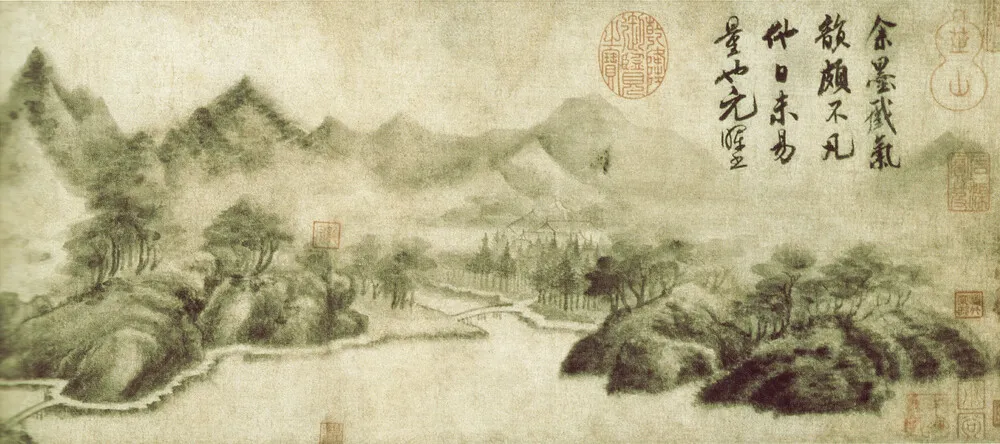 A partial view of Mi Youren’s painting Cloudy Mountains, Southern Song Dynasty. The painting adopts the typical technique of the “Mi Family Landscape,” where the mountain slopes are first lightly shaded with ink, and then varying-sized horizontal ink dots are repeatedly applied to depict mountain peaks and ridges. In Mi’s painting, this technique captures the lush and misty scenery of Jiangnan.
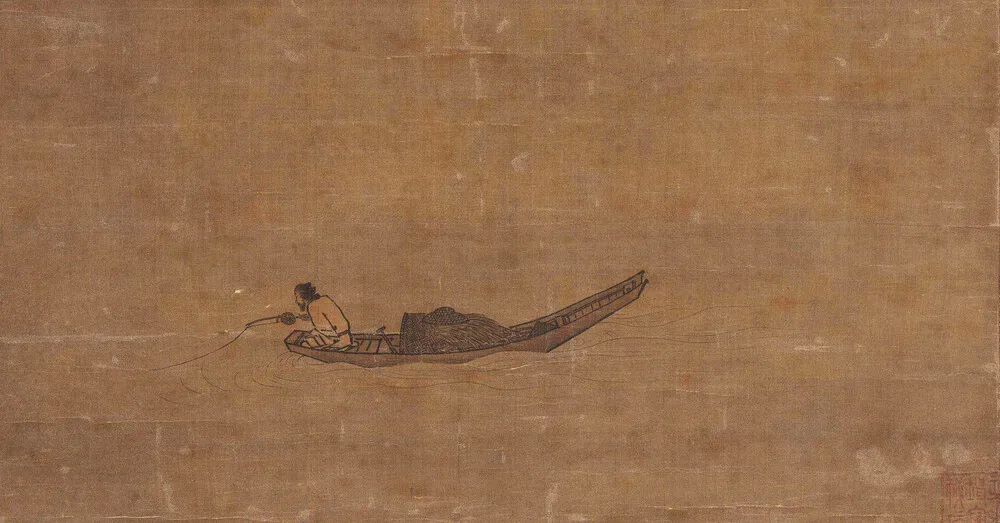 Fishing Alone on the Cold River, Ma Yuan, Southern Song Dynasty. This piece is an excellent example of the “blank space” aesthetic in Chinese ink painting. The extensive use of blank spaces around the boat depicts the vast and misty river, offering readers scope for imagination
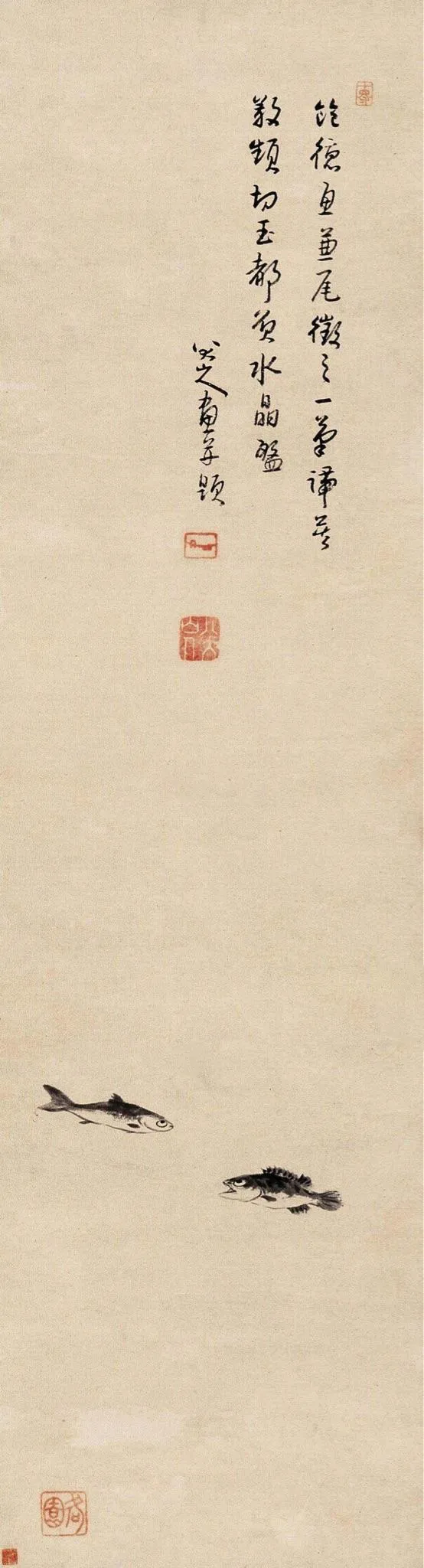 Double Fish by Zhu Da. Zhu Da, also known as Bada Shanren, was one of the famous “Eight Eccentrics of Yangzhou.” Zhu expressed his frustration at the fall of the Ming Dynasty through flower and bird paintings. In this particular painting, his sentiments are reflected in the eyes of the two fish, both portrayed with a disdainful “white-eyed” expression.
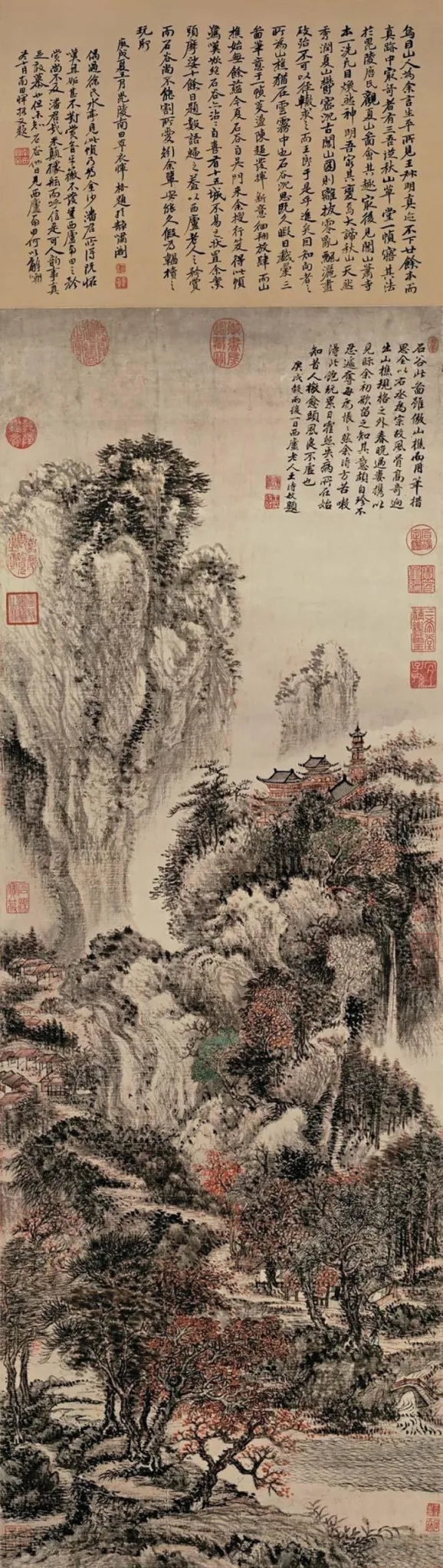 Mountains, Streams and Autumn Trees by Wang Hui, Qing Dynasty. This famous painting depicts the enchanting scenery of autumn mountains. Interestingly, after painter Wang Shimin viewed this work, his long standing cough miraculously disappeared.