In the realm of historic preservation, time moves differently. While modern interior design often operates on cycles of trends and decades, the custodians of England’s great estates must think in centuries. This specific gravity of time defines the recent collaboration between de Gournay-the renowned British house of hand-painted wallcoverings-and Belvoir Castle, the ancestral seat of the Duke and Duchess of Rutland.
The project centers on the revitalization of the Howard Room (formerly known as the Brown Room), a space now breathing with a new, historically infused narrative. Yet, this is more than a mere cosmetic update; it is an act of cultural stewardship, bridging the castle’s 11th-century origins with a living future.
The Custodian’s Philosophy
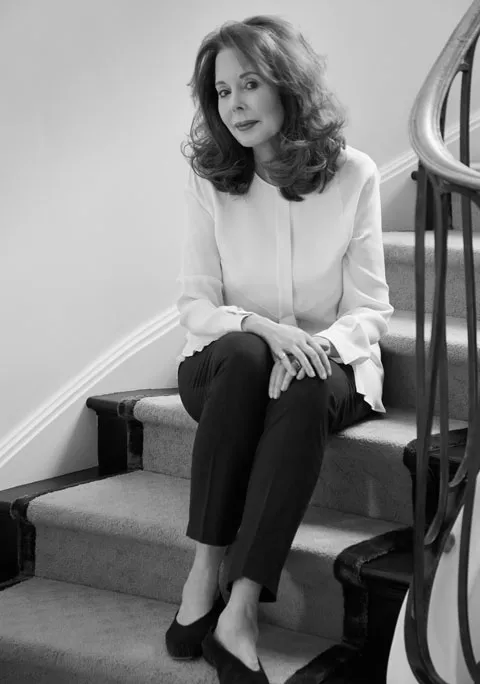
Dominic Evans-Freke, director of de Gournay, frames the renovation not as ownership, but as a fleeting moment of caretaking in an unbroken timeline. He draws a parallel to the famous Patek Philippe adage: one never truly owns such treasures, but merely looks after them for the next generation.
“These ‘treasure houses’ are part of the historic fabric of the nation, woven into the story of England,” Evans-Freke observes. The perspective required here is vast. “Within our own homes, you and I might say that 10 years is a long horizon for the decoration of a room. But at Belvoir, they’re looking for the decoration to stand up to another two centuries.”
This philosophy dictates a material choice that rejects the ephemeral. De Gournay’s signature-hand-painted and hand-embroidered surfaces-aligns perfectly with the Regency architecture of Belvoir. It is a commitment to craft that mirrors the castle’s endurance.
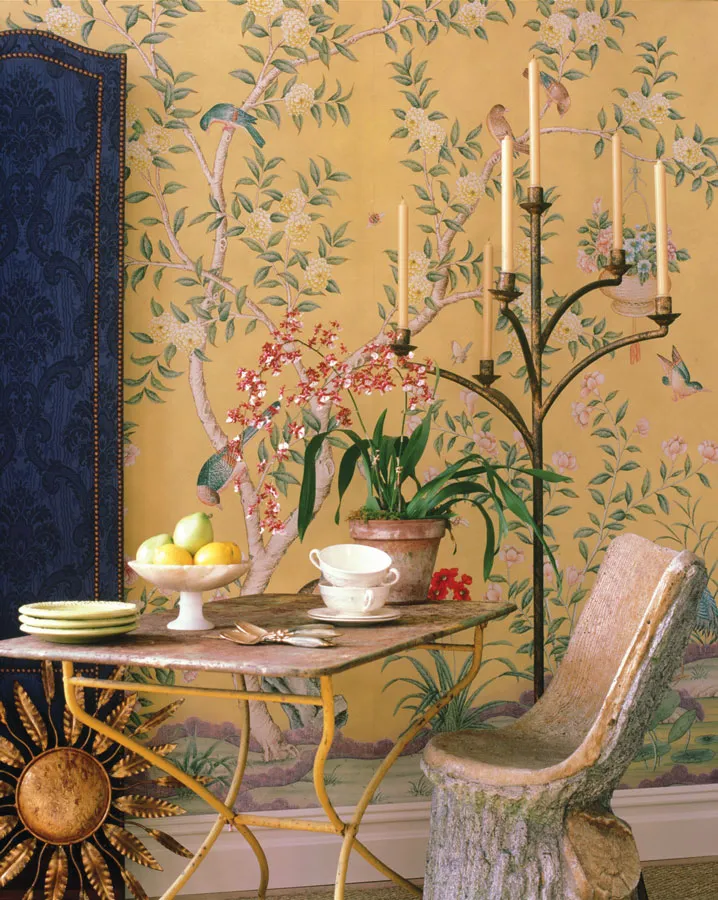
The newly renovated Howard Room adorned with de Gournay wallpaper and British crafts
A Lineage of Aesthetics
Belvoir (pronounced ‘beaver’) commands the Vale of Belvoir in Leicestershire, its silhouette instantly recognizable from its appearances in The Crown and The Da Vinci Code. However, its true significance lies in its continuity. For nearly 1,000 years, it has remained the seat of a single dukedom. The current stewards, David and Emma Manners (the Duke and Duchess of Rutland), view their tenure as a chapter in an ongoing biography.
The renovation of the Howard Room draws deep inspiration from this lineage, specifically the castle’s existing relationship with Chinoiserie. Belvoir houses a prized collection of antique Chinese wallpapers dating back to the 1700s, most notably in the Wellington Room-named for the Duke of Wellington’s stay in the 1850s.
Here, the walls tell stories of an idealized East. The Wellington Room features an ornate Chinese garden scene, where peonies bloom in delicate pistachio and vivid berry hues, surrounded by exotic birds. It is a masterclass in the decorative arts of the 18th century, a time when walls were treated as canvases for immersive art rather than mere backgrounds.
The Art of Continuity
De Gournay’s intervention is a dialogue with these existing masterpieces. By employing the same traditional hand-painting methods used on the original 18th-century papers, the artisans have ensured that the new additions do not feel like modern intrusions, but rather like recovered memories.
The result in the Howard Room is a sumptuous interior that respects the “classic good looks” of the stately home while injecting a vitality that only fresh craftsmanship can provide. It is a delicate balance: preserving the solemnity of a national monument while maintaining the warmth of a family home.
Detail of the Wellington Room’s antique Chinese wallpaper recreated by de Gournay
In an era of rapid consumption, the alliance between Belvoir Castle and de Gournay stands as a testament to the slow art of preservation. It reminds us that true luxury is not about opulence, but about longevity-the ability of a room, a craft, or a legacy to stand up to the scrutiny of two hundred years, and still offer beauty to those who follow.

 The newly renovated Howard Room adorned with de Gournay wallpaper and British crafts
 Detail of the Wellington Room’s antique Chinese wallpaper recreated by de Gournay