“A painting with good technique but no high moral meaning is merely a decorative piece. The value of art lies in its pursuit of authentic beauty.”
For Chen Xiaoping, the canvas is not merely a surface for pigment, but a mirror for the interiority of the artist. As a two-time gold winner (2009 and 2011) and now a judge for the NTDTV International Figure Painting Competition, Chen represents a distinct artistic lineage: one that fuses the disciplined mastery of Western realism with the metaphysical depth of Eastern cultivation. Her work acts as a bridge between two worlds, suggesting that the revival of classical realism is not just a technical renaissance, but a spiritual necessity.
Oil painting ‘Stirred by Her Song’ depicting a young woman singing while being arrested in Tiananmen Square
In Stirred by Her Song, Chen offers a poignant study in contrast. The painting depicts a young woman in Tiananmen Square, arrested for her beliefs, yet her response is not one of physical resistance but of melodic transcendence. Based on the true account of an American woman who traveled to China in 2002 to support Falun Dafa, the work captures a moment of suspended tension.
The viewer’s eye is drawn to the subject’s expression-serene, dignified, and totally devoid of malice-which stands in stark juxtaposition to the implied violence of her captivity. Here, Chen utilizes the vocabulary of realism not to document a political event, but to visualize a spiritual state: the capacity of compassion to disarm aggression.
The Circular Motion of the East
Before mastering the layered luminosity of oil, Chen’s artistic foundation was built on the absorbent absorbency of rice paper and the rhythmic discipline of ink. Beginning at the age of ten, her training in traditional Chinese painting and calligraphy instilled a philosophy of “roundness” that predates her foray into Western techniques.
“The feel of using a brush to paint the smooth lines in Chinese painting is something I deeply enjoy,” Chen notes. In this tradition, the artist and the instrument must merge into a singular entity, akin to a swordsman and his blade. This union is governed by the Taoist understanding of Yin and Yang, where movement is never linear but cyclical.
Traditional Chinese landscape painting ‘Endless White Clouds’ showing mountains and rolling mist
In works like Endless White Clouds, one can observe this philosophical undercurrent. The mountains and rolling clouds are not static objects but breathing forms, generated by brushstrokes that understand the necessity of return. “In classical Chinese dance, before you move left you must first move right… This is very similar to the brushstrokes of Chinese calligraphy,” she explains. “At the end of each stroke, your brush must go back the way it came in order to wrap up the stroke.”
This inherent circularity-the refusal of the abrupt ending-imbues her ink works with a sense of infinite continuity, a visual echo of the Tao.
Chinese calligraphy artwork featuring bold black characters on white paper
A New Vessel for Divine Imagery
The transition from the ethereal wash of ink to the tactile weight of oil paint was driven by a need for greater vividness. While ink excels at capturing spirit and atmosphere (Qi), Chen found herself seeking a medium capable of rendering the tangible luminosity of the divine dimensions she wished to portray.
This shift coincided with a spiritual awakening in 1998, when her family began practicing Falun Dafa in Saipan. The practice, rooted in the principles of Truthfulness, Compassion, and Forbearance, reconnected Chen with the ancient imagery of the Dunhuang murals she had studied as a child. The meditation hand gestures (mudras) she observed in the practice were not foreign motions but familiar echoes of Buddhist iconography.
Oil painting ‘In Harmony’ featuring a meditating woman, cherubs, and three spiraling flowers overhead
Her first major oil painting, In Harmony (2004), stands as a testament to this technical migration. The piece visualizes the concept of sanhua juding (“three flowers gathering above the head”), a meditative state described in Zhuan Falun.
The challenge here was compositional as much as it was spiritual. How does one depict three massive columns of light spiraling into the heavens without crushing the figure beneath them? Chen’s solution was to introduce cherubs-“cultivated infants” in Chinese lore, yet reminiscent of Raphael’s putti in the West. These playful figures break the vertical severity of the energy columns, introducing lightness and movement. The surrounding sea, vast and calm, mirrors the internal state of the practitioner, suggesting that true harmony is not the absence of power, but the tranquil containment of it.
The Furnace of Realism
As a judge for the NTDTV International Figure Painting Competition, Chen now evaluates art through a lens that demands both technical rigor and moral substance. She observes a “famine of creativity” in the contemporary art world, where skill often exists without direction, and expression often lacks discipline.
“Artists were once highly respected,” Chen reflects on the degradation of artistic education. “A few random brushstrokes without any technique or deeper meaning can now be called a work of art.”
Artist Chen Xiaoping standing next to her large scale oil painting ‘Bathing Under Noble Light’
For Chen, the competition acts as a crucible. The requirement for realism forces artists to confront the physical world with honesty, mastering proportion, perspective, and light. Yet, technique is merely the threshold. The gold standard requires the work to emanate “pure authenticity, pure goodness, and pure beauty.”
This tripartite criteria transforms the act of painting from a creative indulgence into a cultivation practice. The artist must refine their own interior world before they can project a high moral meaning onto the canvas. “Anything that doesn’t meet the principles… will slough off,” she asserts, “and what’s left will be golden and dazzling.”
Traditional ink painting ‘Misty Morning Scene’ depicting a landscape shrouded in light mist
In Misty Morning Scene, we see the persistence of her roots-the landscape shrouded in mist, inviting the viewer on a journey that is as much internal as it is visual. It serves as a reminder that whether through the bite of oil or the flow of ink, the ultimate goal remains the same: to reveal the unseen dignity of the human spirit and the orderly magnificence of the universe.

 Oil painting ‘Stirred by Her Song’ depicting a young woman singing while being arrested in Tiananmen Square
 Traditional Chinese landscape painting ‘Endless White Clouds’ showing mountains and rolling mist
 Chinese calligraphy artwork featuring bold black characters on white paper
 Oil painting ‘In Harmony’ featuring a meditating woman, cherubs, and three spiraling flowers overhead
 Artist Chen Xiaoping standing next to her large scale oil painting ‘Bathing Under Noble Light’
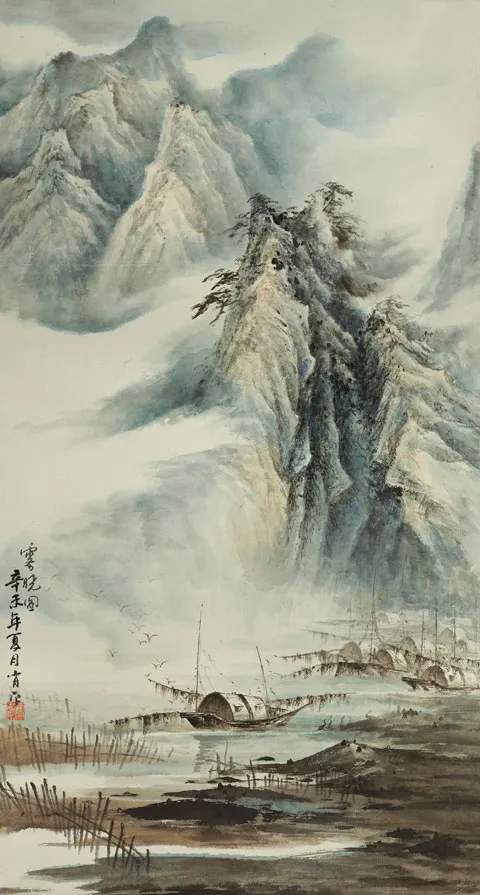 Traditional ink painting ‘Misty Morning Scene’ depicting a landscape shrouded in light mist