True luxury is rarely about the logo stamped upon the surface; it is about the ritual contained within. For Liu Zao, the founder of the leather art studio Nashici, this realization did not come from a fashion runway, but from a quiet moment of intergenerational dissonance.
Growing up in Beijing, surrounded by the lingering shadows of the imperial past, Liu was accustomed to the aesthetic of the Palace Museum. However, the epiphany arrived on the 90th birthday of her grandmother, a descendant of the Manchu royal family. Liu presented her with a gift that the modern world deems the pinnacle of luxury: a compact of makeup powder from a renowned international house.
The grandmother’s reaction was one of mild disappointment. To her, it was merely “a plastic box.” She recounted the vanity rituals of the palace, where face powder made from crushed pearls was housed in ornate enamel vessels, applied with embroidered silk puffs, and guarded by a double-edged silver comb. The silver was functional poetry; if it turned black, it signaled the powder had spoiled. This was not just consumption; it was a refined lifestyle where every object held a dialogue with its user.
This memory became the genesis of Nashici. Liu realized that the “luxury” of the present lacked the weight and soul of the past. She sought to create an object that could bridge this divide—specifically, a leather bag that carried the visual language of classical Chinese painting.
The Line Between Leather and Silk
Liu Zao’s vision was conceptually simple but technically contradictory: she wanted to transpose Gongbi—the meticulous, realist style of traditional Chinese painting—onto leather. Unlike the interpretive “xieyi” style, Gongbi relies on precision, fine brushwork, and controlled narrative.
Liu Zao, owner of the Nashici Workshop, reflects on the heritage that inspires her designs.
To achieve this, she began by deconstructing high-end leather goods from around the world, dissecting their stitching and engraving. What she found was a technical impasse. Western leather tooling is predominantly percussive and modular; craftsmen use molds and tools to punch the surface vertically, creating depth through impact. While effective for geometric or floral repetition, this method could not replicate the fluid, breathing lines of a Chinese brush. It was too rigid, too fixed.
Liu realized she could not simply borrow a technique; she had to invent one. Selling her villa in Beijing to fund the Nashici Studio in 2011, she committed herself to a path of experimentation that would consume years of her life.
The Weight of the Brush
The breakthrough came through a reinvention of the tool itself. Liu and her team of young artisans moved away from stamps and molds, opting instead for a pen made of steel. This tool allowed for the freedom of a paintbrush but required the physical exertion of sculpture.
The technique demands a unique duality in the craftsman: they must possess the delicate aesthetic sensibility of a Gongbi painter and the physical endurance of a laborer. The steel pen is pressed into the leather using sheer wrist strength to carve continuous, flowing lines. It is an arduous process where the hand must not tremble, for leather, unlike paper, forgives no errors.
A close-up of the ornate leather carving on a Nashici bag, showing the depth and fluidity of the lines.
“Many of our techniques are original, that cannot be learned from predecessors,” Liu notes. The result is a surface that feels less like a manufactured product and more like a relief sculpture. The leather bears the tension and energy of the artist’s hand, capturing the spirit of the original paintings rather than just their outline.
A Scroll of Hide and History
The ambition of Nashici extends beyond mere decoration; it aims for narrative. The leather becomes a canvas for historical storytelling. A testament to this scale is the Ode to the Silk Road, a monumental leather carving spanning 8.8 meters.
Nashici’s leather carvings feature auspicious patterns like dragons and phoenixes alongside intricate floral motifs.
This piece functions almost like a dunhuang mural brought to a tactile medium. It depicts the ancient trade routes, populated by travelers on camelback and Buddhas resting amidst mountainous landscapes. It is a convergence of Liu’s personal heritage and a broader cultural memory, materialized through millions of precise strokes.
The studio does not limit itself to the grand narrative. They also explore the intimate symbolism of Chinese culture, carving auspicious motifs like dragons, phoenixes, and complex floral arrangements. Each piece is an attempt to arrest time, to fix a fleeting cultural memory onto a durable material.
The Vermilion Depth
Beyond the carving, Liu sought to capture the color palette of the Qing Dynasty, specifically the deep, imperishable red of Ti Hong lacquerware—a favorite of the Qianlong Emperor. Traditional lacquerware involves applying hundreds of layers of sap, a process taking years, before carving into the accumulated depth.
Detail of Nashici's unique leather techniques showing flowers and traditional Chinese patterns.
To translate this aesthetic to leather, Nashici developed a saturation technique that differs fundamentally from surface painting. The artisans soak the leather in vermilion pigment until the color penetrates the hide entirely, from the grain to the flesh side.
This “through-dyeing” ensures that the object ages with grace. “There is no need to worry that the bag will have scratches,” Liu explains. Because the red is not a skin but the substance of the leather itself, a scratch does not reveal a raw wound underneath. Instead, like the grandmother’s silver comb, the object is designed to endure the wear of life, requiring only polishing to return to its luster.
The Virtue of Repetition
The name “Nashici” is a transliteration of the Mongolian word for leather, but in Mandarin, it carries a phonetic double meaning: “those ten times.” This serves as a mantra for the studio’s philosophy of perseverance.
The creation of a single bag involves over 100 steps—drafting, modeling, engraving, dyeing, and sewing. The margin for error is nonexistent; a slip of the steel pen during the final stages renders the entire piece ruined. It is common for ten failed attempts to pave the way for a single perfect creation.
Liu Zao working meticulously on the Ode to the Silk Road leather carving.
This devotion mirrors the spirit of the anonymous artists who painted the caves of Dunhuang. It is a submission to the craft, where the ego of the artist is secondary to the perfection of the work. For Liu Zao, Nashici is less a commercial enterprise and more a continuous act of cultural preservation.
“If I can’t finish it,” she says, looking toward the horizon of her craft, “future generations will keep up and continue to do it.” In a world of plastic boxes and instant gratification, she has chosen the slow, difficult path of the steel pen, etching the refined past into the future, one line at a time.

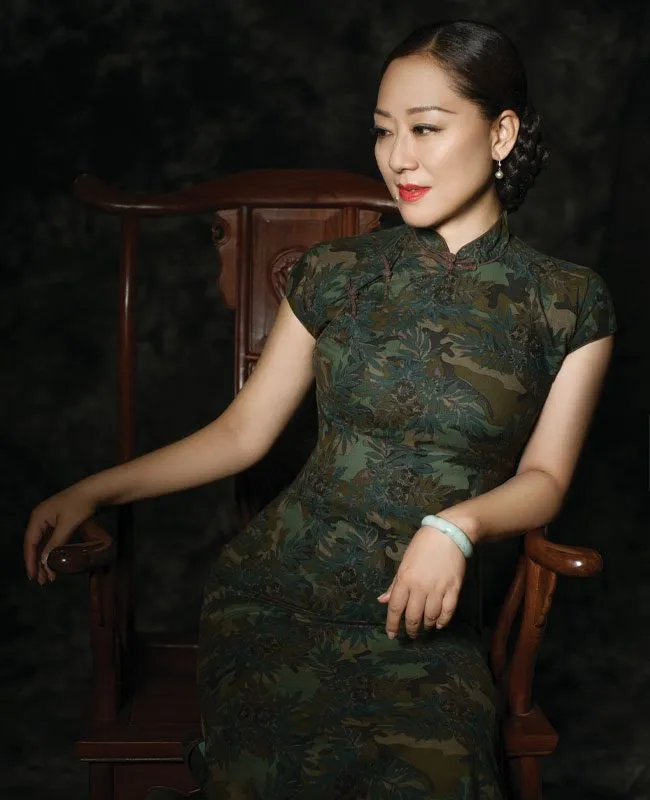 Liu Zao, owner of the Nashici Workshop, reflects on the heritage that inspires her designs.
 A close-up of the ornate leather carving on a Nashici bag, showing the depth and fluidity of the lines.
 Nashici’s leather carvings feature auspicious patterns like dragons and phoenixes alongside intricate floral motifs.
 Detail of Nashici's unique leather techniques showing flowers and traditional Chinese patterns.
 Liu Zao working meticulously on the Ode to the Silk Road leather carving.