High in the mountains of Miaoli County, western Taiwan, the silence of the midnight hour is broken only by the roar of fire and the focused breath of a craftsman. Here, Tian Chengtai stands before a kiln that breathes heat like a living entity. His clothes are soaked in sweat, his brow furrowed in concentration as he feeds wood into the inferno. This is not merely the production of ceramics; it is a dialogue between earth, timber, and flame, mediated by a man who has dedicated his life to the unpredictable art of ash glaze.
Tian’s journey is not one of linear success, but a testament to the resilience of the artistic spirit. Before he was a master potter, he was a carver of wood and stone, struggling to reconcile his creative drive with economic survival. In his forties, facing financial ruin, he turned to clay—a medium that promised nothing but demanded everything.
Ash Glaze Master Chengtai Tian at his home with his wife Yuelian Chen
The Pivot to Clay
The transition began with a question of survival and a spark of audacity. When the economics of carving failed him, Tian proposed a shift to pottery, a medium where a few hundred New Taiwan dollars’ worth of clay could be transmuted into objects of immense value. His wife, Chen Yuelian, posed the pragmatic question: “Can you make it?”
Tian’s answer was a simple affirmative, yet it carried the weight of a six-year promise. He asked for time; she gave him trust and the capital to begin. While critics and friends likened his new venture to something “worse than opening a beef noodle restaurant,” Tian saw a different horizon. He envisioned works that would not compete with factory mass production but would speak to a select few who valued the raw, elemental beauty of nature.
While Chen supported the family through a boutique in Taipei, Tian immersed himself in the alchemy of the kiln. He sought to master ash glaze—a technique where the wood ash generated during firing is not a defect to be avoided, but the primary aesthetic agent.
The Aesthetic of Imperfection
In the hierarchy of traditional Chinese ceramics, pristine porcelain often reigns supreme, celebrated for its flawless, glass-like surfaces where ash is considered a contaminant. Tian Chengtai chose the opposite path. He embraced the chaotic beauty of the wood-fired kiln, where pottery, ash, and open flame coexist in a volatile environment.
The process creates a natural glazing that Tian likens to layers of makeup. The initial soot and charcoal act as a foundation, penetrating the clay’s fine pores. As the heat intensifies, the wood ash melts, coating the vessel in a glaze that is born solely from the fuel itself. The result is rustic, thick, and ancient—a tactile surface that resonates with the simplicity of the earth.
Portrait of Tian Chengtai showing the intensity of the craftsman
To achieve the complex colorations that define his work, Tian treats wood not just as fuel, but as a palette. Different timbers yield different chemical signatures in their ash. He scours the coastline for driftwood and experiments with exotic varieties—Vietnam’s juniper, longan, acacia, and teak. By mixing rare genera, he orchestrates a symphony of minerals that, when melted, produce colors no commercial pigment can replicate.
“A ton of wood can be burned into six or seven catties of ash,” Tian notes, highlighting the scarcity of the medium. The effort required to glaze just three large tea cans involves days of burning and tons of lumber, a ratio of input to output that defies modern efficiency but ensures artistic singularity.
Tian Chengtai working at his kiln amidst piles of wood
A Kiln Built for Two
Success eventually allowed Tian and Chen to leave Taipei and return to his roots in Nanzhuang. There, they discovered the local green mountain soil was ideally suited for pottery—a serendipitous gift from the land. However, the true turning point was the construction of their own kiln.
Under the tutelage of Mingzhao Jian, a teacher trained in Japanese wood-firing techniques, the couple learned the architecture of heat. When asked how many workers would operate the kiln, they replied it would just be the two of them. Thus, the “Couple’s Kiln” was born. Unlike commercial operations that employ dozens of hands, every piece of Tian’s work, from the wedging of clay to the final firing, passes only through the hands of the husband and wife.
This intimacy extends to the loading of the kiln, a task Tian describes as the most difficult. Arranging 300 pieces in a cramped space requires a strategic mind; one must predict the path of the flame and the accumulation of ash. A poor arrangement disrupts the airflow, risking the collapse of the stack when wood is thrown in.
Portrait of Ash Glaze Master Tian Chengtai
The Ordeal of Fire
Once the kiln is lit, the process shifts from intellectual design to physical endurance. For a week, the couple maintains a vigil, consuming 5,000 kilograms of wood to keep the temperature hovering around 1,000 degrees Celsius. The heat radiating from the kiln is so intense that they drink Pu’er tea constantly to regulate their body temperature.
The climax of the firing is a dangerous dance with the elements. Before sealing the kiln, the temperature must be pushed to between 1,250 and 1,280 degrees Celsius. In the final stage, Tian opens the top hatch to add charcoal—a technique that imbues the works with specific carbon effects.
“It is really very dangerous,” Chen observes. A shift in wind can send flames surging upward, threatening the potter. Yet, they persist, driven by the knowledge that this risk is the price of the aesthetic. During the final twenty-four hours, the kiln glows with a transparent red light, resembling flowing lava, before turning a blinding white.
Ash Glaze works displaying rich textures and colors
The Judgment of the Cool
After the fury of the firing comes the agony of the wait. The cooling process is slow, and the anticipation is often too much to bear. To avoid the temptation of opening the kiln too early—which once caused a piece to crack in Tian’s hands—the family often leaves the site entirely, retreating to nature until the kiln cools to a safe 50–60 degrees.
Opening the kiln is, in Tian’s words, “like running a lottery.” The variables are too numerous to control completely. A gust of wind during firing, a variation in humidity, or a slight drop in pressure can alter the outcome.
It is here that Tian transforms from creator to destroyer. In a practice that blends high standards with ruthlessness, he smashes any piece that does not meet his criteria. The mountainside echoes with the sound of cracking clay. Out of 300 pieces, perhaps only 30 will survive this cull.
Mr. Tian Chengtai holding a piece of pottery
The Breath of the Vessel
Tian is willing to fire works repeatedly, risking their destruction, to achieve a specific depth of texture—surfaces that look like moss, webs, or ancient stone. He rejects the safety of a single firing for the potential of a masterpiece.
The ultimate purpose of this arduous process is functional. Tian’s tea sets are prized not just for their visual beauty but for their interaction with tea. Unlike fully vitrified porcelain, the wood-fired clay retains fine capillary pores. “It can breathe,” Tian explains. This density and porosity allow the vessel to maintain the fragrance of the tea, enhancing the sensory experience of the drinker.
Mr. Tian Chengtai sitting at his tea room
For Tian, the connection with the collector is spiritual. He is moved by the idea that when someone uses his pottery at the end of a long day, they can feel the persistence and energy he poured into the clay. It is an echo of spirits, a transmission of fortitude through fire and earth.
“You have to use it—don’t just display it,” he insists. Only through use does the pottery reveal its true character, changing constantly, living alongside its owner. In this way, the ash, the sweat, and the fire of the Miaoli mountains find a quiet, permanent home in the daily rituals of life.
Close up of Tian Chengtai using his own ash glaze tea set

 Ash Glaze Master Chengtai Tian at his home with his wife Yuelian Chen
 Portrait of Tian Chengtai showing the intensity of the craftsman
 Tian Chengtai working at his kiln amidst piles of wood
 Portrait of Ash Glaze Master Tian Chengtai
 Ash Glaze works displaying rich textures and colors
 Mr. Tian Chengtai holding a piece of pottery
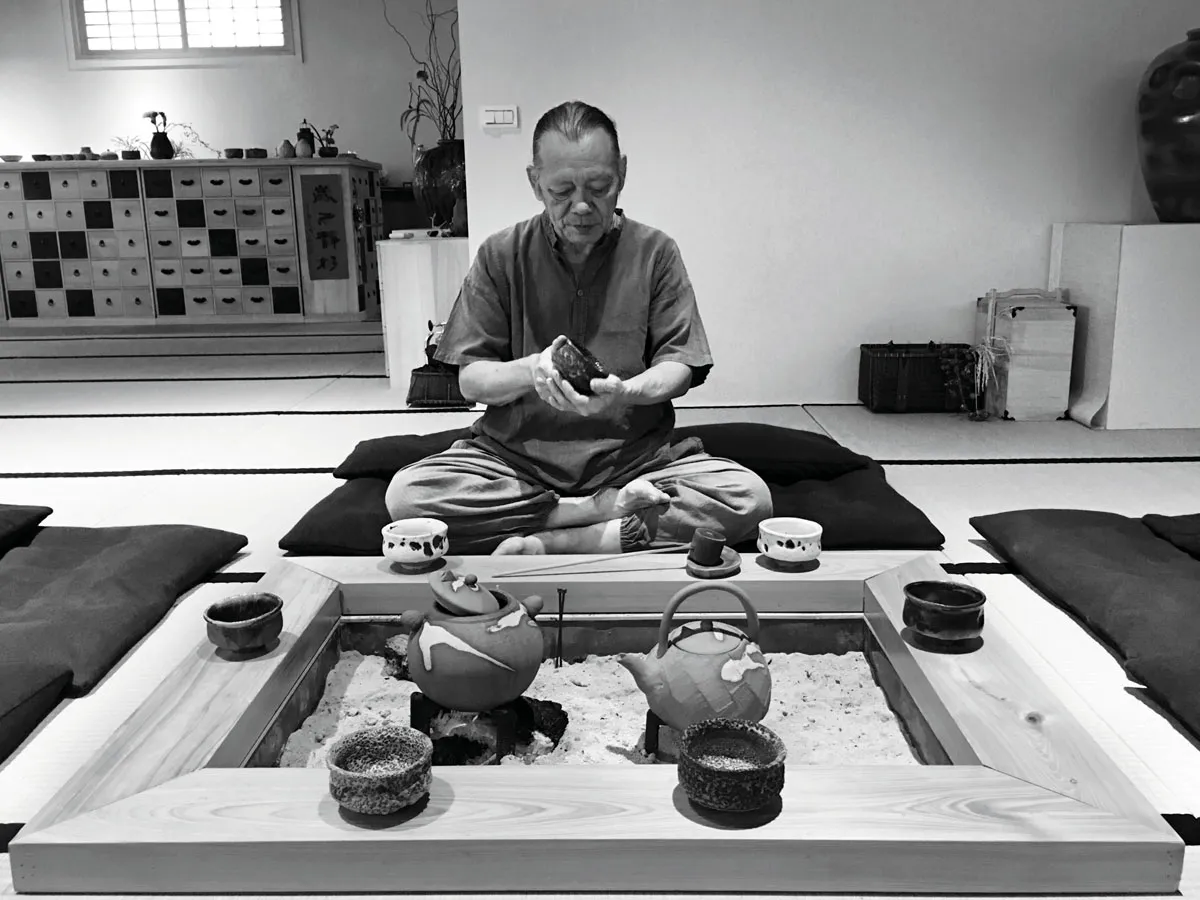 Mr. Tian Chengtai sitting at his tea room
 Close up of Tian Chengtai using his own ash glaze tea set