The stage is often a place of artifice, but occasionally, it becomes a vessel for a purity that defies the physics of the theater. Haolan Geng stands alone in the spotlight, framed by a gown of vibrant jade—a color symbolizing rectitude and grace in the East. Her arms open in a gesture of unconditional welcome, and from this regal stillness emerges a sound that seems to suspend time.
For the seasoned opera-goer, the experience is startling. Geng, a soprano for Shen Yun Performing Arts, produces long, seamless legato lines that carry a tender vigor, filling the hall with an effortless resonance rarely heard even in the hallowed halls of The Metropolitan Opera. But the true marvel lies in the linguistic alchemy at play: she is singing Bel Canto—the quintessential Italian “beautiful singing”—in Mandarin Chinese.
Theoretically, this union should be dissonant. The Romance languages, with their rolling vowels and liquid transitions, are the natural cradle for operatic tradition. Mandarin, by contrast, is a tonal language, often perceived as having abrupt stops and a lack of roundness. Yet, Geng’s performance dismantles this preconception. In her throat, the angularity of Chinese diction dissolves into a silkiness that rivals the Italian masters, suggesting that the universality of music lies not in the language itself, but in the technique of the soul that carries it.
The Echo of Destiny
It is difficult to reconcile the maturity of Geng’s sound with her youth. In an art form where the voice typically ripens over decades of arduous training, she possesses a poise that seems innate, almost remembered rather than learned.
“I loved to sing ever since I was very young,” Geng reflects, tracing the origin of her vocation not to a specific ambition, but to a primal response to sound. “When I heard singing on the radio, I knew I wanted to learn as well.”
Born into a traditional family that revered the arts, her path was paved with the quiet discipline of the East. She progressed through city and provincial choirs, her voice expanding in tandem with the stages she inhabited. Geng humbly attributes this early trajectory to tian fen—a gift from the heavens—admitting that youthful exuberance, rather than a heavy sense of purpose, was her initial engine.
Shenyun-Singer-Geng
By age 16, the prodigy had enrolled in the Guangzhou Conservatory of Music. It was here that the rigorous academic structuring of her talent began. “I mostly focused on how to improve myself technically and how to better express and interpret the song in order to touch people,” she notes.
The results were immediate and tangible. In 2007, she secured the gold medal at the First Music Competition of the Guangdong Arts Festival. A year later, her graduation recital garnered critical acclaim, segueing immediately into a starring role with the Guangdong Opera Company.
However, the trajectory of an artist is rarely a straight line. In 2009, a trip to the United States for a global singing competition—hosted by a New York-based Chinese television network—shifted her axis. She won the competition, enthralling the judges and catching the eye of the director of Shen Yun Performing Arts. She joined the company expecting to elevate her existing artistry. Instead, she found herself at the foothills of a new mountain.
The Architecture of the Acoustic Dome
Upon joining Shen Yun, Geng encountered a revelation that would require her to unlearn much of her contemporary training. She discovered that ancient Chinese theater and European opera shared a common, almost forgotten, genetic code: the authentic Bel Canto technique.
While history often attributes the fame of Bel Canto to 19th-century composers like Gioachino Rossini, its roots dig much deeper into the intellectual soil of the Renaissance. In the 1500s, the Camerata Fiorentina—a circle of intellectuals gathering at the palace of Count Giovanni Bardi—sought to revive the emotive power of classical Greek art. From their pursuit of “divine vocal beauty” emerged a technique designed to bypass the limitations of the human body.
Geng explains the mechanics of this lost art: “It was only after I came to Shen Yun that I realized that my previous vocal placement was incorrect.”
Authentic Bel Canto utilizes a specific acoustic position—a “dome” high in the head cavity. This anatomical manipulation acts as a natural amplifier, allowing the human voice to project with crystal clarity over a 50-piece orchestra without the aid of microphones. This is not merely about volume; it is about the preservation of tonal quality across the spectrum of sound.
“Along with social changes that brought about the waning of traditional culture and arts, this genuine technique had been lost,” Geng observes. The modern iteration of Bel Canto has diverged from this original purity. The process of mastering this technique was a complete recalibration for Geng, a return to the fundamentals of resonance that allows her voice to reach thousands without distortion, bridging the physical gap between the stage and the furthest seat in the gallery.
The Vessel of Silence
Technique, however, is merely the vessel. The substance of Geng’s art is drawn from a deeper, more metaphysical wellspring. At Shen Yun, she reconnected with Falun Dafa, a traditional meditation system rooted in the principles of Truthfulness, Compassion, and Tolerance—a practice her grandparents had followed.
For Geng, the cultivation of character is inextricable from the cultivation of voice. “To reach a higher realm as an artist, I think morality plays a vital role,” she reveals. “It’s about leading a life of integrity. If you go about pretentiously offstage, you won’t be able to express any sincerity on stage.”
This philosophy posits that the voice is a direct reflection of the spirit. By practicing meditation and working to eliminate internal impurities like fear, pride, and anxiety, Geng clears the internal interference that often clouds artistic expression. The result is a state of “wu qiu”—non-pursuit. “I no longer purposefully try to emotionally touch the audience one way or another,” she says. “Without pursuit, these things actually happen naturally, and in a more powerful way.”
Shenyun-Singer-Geng
The physical demands of a 130-city global tour require a resilience that goes beyond athleticism. Here, the principle of Ren (forbearance) becomes a source of stamina. The discipline required to maintain such high-frequency performance schedules is sustained not just by muscle memory, but by inner tranquility.
The lyrics she sings—laden with themes of enlightenment, the meaning of life, and the path to the divine—serve as both the message to the audience and the sustenance for the singer. “It truly speaks to your inner world,” she notes.
When the lights dim and the music swells, the transaction between Geng and her audience transcends entertainment. It becomes a shared moment of recognition. “If the theater is bright enough, I can see the audience wiping away tears when I’m on stage,” she says, a smile touching her face that is at once adult and childlike. In those moments, the jade dress and the high notes fade away, leaving only the vibration of a truth recognized by the heart.

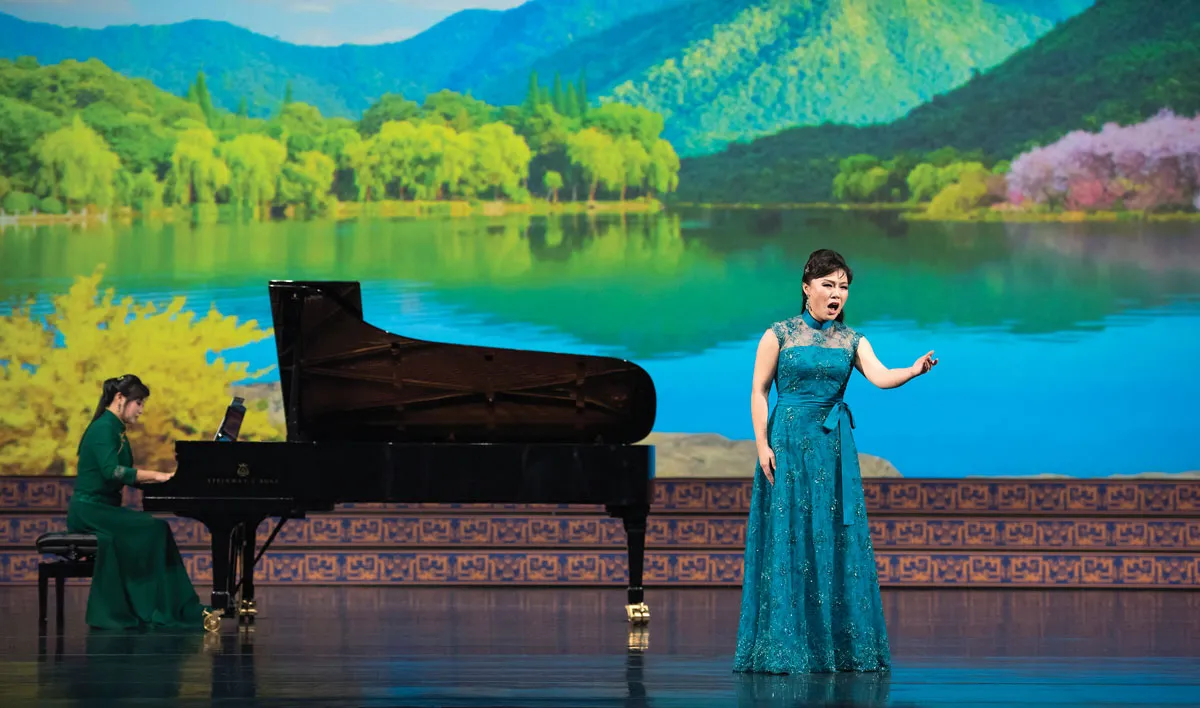 Shenyun-Singer-Geng


