For nearly four decades, the art of Karen Bit Vejle existed in a state of deliberate concealment. In the quiet solitude of her home, she would wield a small pair of scissors, transforming plain sheets of paper into intricate, lace-like narratives of immense complexity. Yet, once completed, these masterpieces were not framed or celebrated; they were folded and tucked silently beneath the rugs of her living room.
This act of hiding was born of a teenage embarrassment—a belief that papercutting, or psaligraphy, lacked the social currency of more conventional pursuits. However, as Vejle matured, the secrecy evolved into a sanctuary. The rhythmic motion of the blades became a meditative necessity, a way to anchor the soul amidst the turbulence of life and the physical toll of myalgic encephalopathy (ME). This neurological condition, characterized by profound exhaustion and chronic pain, forced a departure from her fast-paced career as a television producer, yet it inadvertently deepened her relationship with the paper.
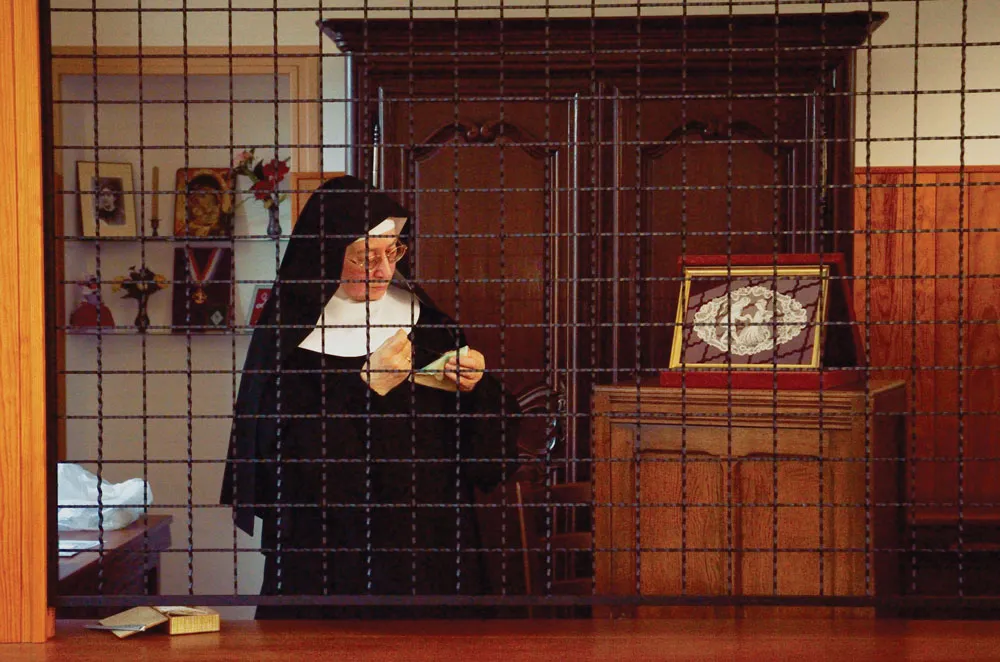
Karen Bit Vejle working with scissors on intricate paper art
It was a chance discovery that pulled these works from the floor to the gallery wall. When a colleague, visiting during one of Vejle’s sick leaves, stumbled upon the paper scraps littering her floor and subsequently the hidden cache beneath the carpets, the National Museum of Decorative Arts in Norway was immediately alerted. This revelation marked the transition of her work from private therapy to public treasure, eventually leading to exhibitions at Hermès, Georg Jensen, and the establishment of her own Center for Papirkunst in Denmark.
The Irreversible Cut
To understand Vejle’s work is to understand the terrifying finality of her medium. Unlike a painter who can layer over a mistake, or a writer who can delete a sentence, the psaligrapher operates in a realm of zero error. “If you cut the wrong places, it will fall apart,” Vejle notes. The structural integrity of the entire piece relies on a continuous, unbroken web of paper.
This process requires a form of mental mapping that borders on architectural engineering. Vejle does not rely on knives, which allow for disjointed incisions; she uses only scissors, demanding a continuous flow of movement. Before the blades ever touch the page, the image—often vast and allegorical—is constructed entirely in her mind. She memorizes the negative space, rehearsing the lines in the quiet of the night, ensuring that when the moment comes, her hands move with the certainty of muscle memory.
Karen Bit Vejle exhibition showing paper art encased in glass
The result is a tension between fragility and strength. Vejle views paper as a metaphor for the human condition: easily torn, yet capable of bearing immense structural weight when interconnected. This philosophy dictates her display method. She mounts her works between two sheets of glass, suspending them in transparency. This choice is not merely aesthetic but conceptual; it allows light to pass through the voids, casting shadows that double the artwork’s presence. “That, symbolically, is very close to us humans, because we also have a shadow in our lives,” she observes. “There’s always something behind us.”
Narrative Architecture
Vejle’s aesthetic lineage can be traced back to the Danish tradition of gaekkebrev—elaborate paper letters exchanged at Easter—and the legacy of Hans Christian Andersen. While famous for his fairy tales, Andersen was also a prolific paper artist. Vejle channels this dual capability, embedding “deep layers” within her visual stories. To the casual observer, a piece may appear as a whimsical fairy tale, but closer inspection reveals biting allegories and profound observations on life, wisdom, and resilience.
One of her most significant works, Twittering in the Royal Copenhagen Tree, stands three meters tall—a monumental testament to this narrative density. The tree serves as an axis of life, its branches laden with over a hundred distinct characters, each carrying a specific history.
Detail of paper art showing a figure emerging from a tree holding a bird
Among these figures is Miss Robinson, a bird forced to sacrifice her breakfast to a king, and a ballerina poised precariously on a branch. For Vejle, the ballerina is not a symbol of delicate beauty, but of iron will—representing the immense, often invisible strength required to make difficult feats appear effortless. It is a fitting avatar for the artist herself, whose delicate paper lace belies the grueling discipline and physical stamina required to create it.
The Rhythm of the Blade
The creation of these silent paper worlds is often driven by sound. Vejle describes her scissors as a conductor’s baton, moving in sympathy with the music filling her studio. The cadence of the cut mimics the tempo of the composition; a delicate, fluttering pattern might emerge from a light melody, while a dramatic, sweeping incision responds to a crescendo.
During the year-long creation of the Royal Copenhagen Tree, the studio was filled with the sounds of Champagne Galop by Danish composer Hans Christian Lumbye. The piece’s upbeat, effervescent energy—mimicking the pop of a champagne cork—infused the paper with a “light story,” counterbalancing the intense, slow focus required by the artist’s hand.
Paper cut detail of a ballerina representing strength and determination
This musicality extends to the final stage of the process: the unfolding. After months of cutting the folded paper, blind to the full visual impact, Vejle opens the sheet. It is a moment she describes as “magic”—the collapse of the imagined into the real. The paper dances between the blades one last time as she refines the details freehand, no longer hiding the work beneath the rug, but allowing the light to finally tell its story.
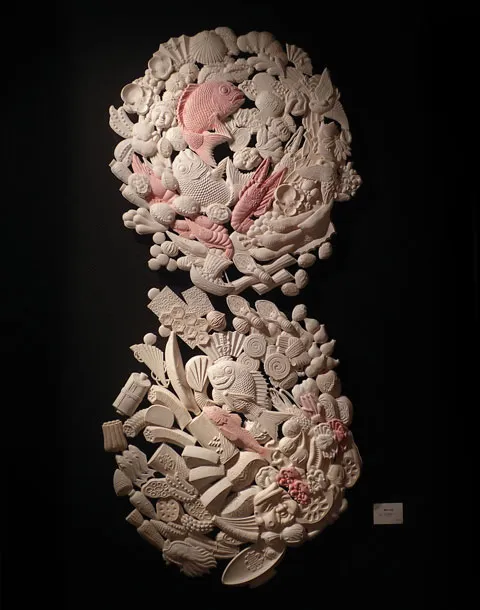
Wide shot of intricate white paper art hanging against a dark background

 Karen Bit Vejle working with scissors on intricate paper art
 Karen Bit Vejle exhibition showing paper art encased in glass
 Detail of paper art showing a figure emerging from a tree holding a bird
 Paper cut detail of a ballerina representing strength and determination
 Wide shot of intricate white paper art hanging against a dark background