The journey of an artist is rarely a straight line; it is often a spiral, circling back to the beginning with new eyes. For singer-songwriter Katy Mantyk, the music began not with a sound, but with a question posed to the vast silence of a moonless New Zealand night.
Standing at the edge of a cliff, suspended between the earth and the infinite, a young Mantyk sent a humble invocation into the dark. “In that moment, I decided to ask the divine, or God, the Creator, or whoever it was… I just wanted to ask them to show me the meaning of life.”
It was a request for substance over spectacle. Shortly after that night, the answer arrived in the form of stillness. She discovered Falun Dafa (also known as Falun Gong), a practice rooted in the ancient Buddhist and Taoist traditions of cultivation. The discipline offered a framework of Truthfulness, Compassion, and Forbearance—simple principles that acted as a key. As Mantyk focused on improving her heart and raising her level of understanding, the internal locks began to turn. As her spirit opened, her voice followed, and the music began to pour out.
Yet, the river of destiny required a deepening before it could flow freely.
The Crucible of Experience
Art created in youth often possesses a raw, primal energy, but it can lack the weight of lived reality. “When I was creating music in the beginning, I felt clueless,” Mantyk reflects on her early twenties. Despite the spiritual awakening that gave her songs meaning, she felt a hollow echo in her creative process—a lack of worldly wisdom to anchor the ethereal.
Rather than forcing the muse, she stepped away. After completing a degree in sound engineering, Mantyk traded the ocean breezes of her youth for the concrete canyons of New York City. For ten years, the guitar remained silent.
The city became a forge. Working in television, navigating the subway grind, and managing the relentless demands of urban life, Mantyk underwent a transformation. She describes New York as “a kind of sandpaper on my soul.” It was an abrasive, exhausting era, yet essential. The friction was not destructive; it was polishing the vessel. She now views that decade not as lost time, but as the foundation of her practice—a period where the abstract search for meaning was tested against the grit of reality.
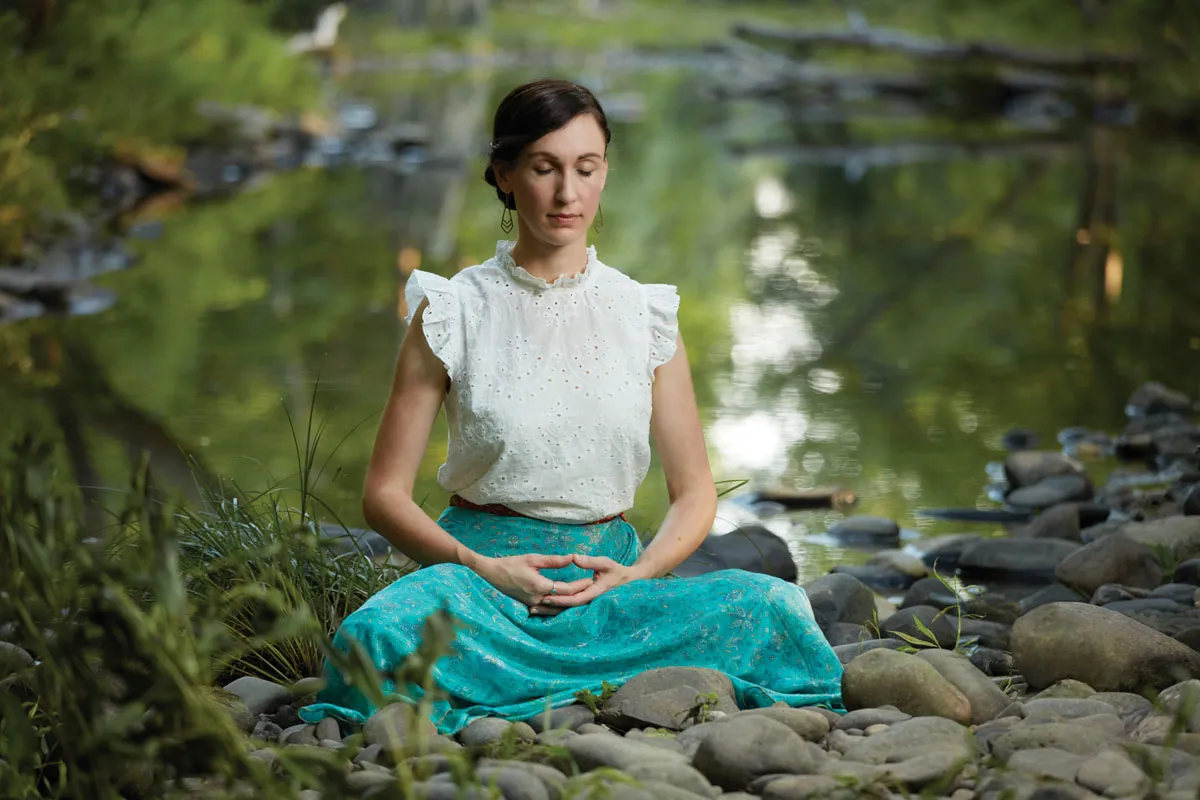
Kate Mantyk is on her spiritual journey, and find her creative source of inspiration.
The Witness of the Forest
The silence broke when Mantyk and her family relocated to the Catskill Mountains, settling in a mountaintop cabin in Mount Hope, New York. The frantic frequency of the metropolis was replaced by the deep, rhythmic breathing of nature.
“Once I got out of the city and into the countryside again, the music was just calling to me,” she observes. The environment did not just provide a backdrop; it provided a dialogue. Surrounded by an ancient forest, Mantyk found herself contemplating the trees as silent historians—witnesses to the rise and fall of human kingdoms, indifferent to the chaos of the moment yet deeply rooted in the earth.
This communion with the land birthed her single, Let It Flow. The lyrics emerged not as a composition, but as an answer to her inquiry about the forest’s wisdom:
The trees in the forest, they have stories to tell Of ages come and kingdoms that fell Ask them how they weathered all the storms And they will sing in unison Let the wind blow, let it blow Trust your roots are deep in the earth below
Kate Mantyk
Resonance as Nourishment
Mantyk’s return to music is characterized by a shift in intent. The songs are no longer just artistic expressions; they are mechanisms of self-healing. “I write my music for myself,” she admits with refreshing candor. “It really heals me. My lyrics incorporate the kind of things that I need to reinforce in myself.”
There is a distinct lack of performative ego in her work. Her voice, described as having a lilting, calming touch, carries the weight of the decade she spent silent. When she sings Let It Flow, it is an act of active remembrance—a reminder to accept life’s challenges and rely on inner strength.
The result is an acoustic landscape that invites the listener to slow down. It is music born from the convergence of a spiritual search, the abrasive lessons of the city, and the timeless patience of the mountains. In finding the “Way”—a path through the stars she once gazed at—Mantyk has found a voice that does not just sing, but resonates.

 Kate Mantyk is on her spiritual journey, and find her creative source of inspiration.
 Kate Mantyk