In the quiet folds of the Veneto region, where the Brenta River meanders between the artistic poles of Padua and Venice, lies Fiesso d’Artico. To the uninitiated, it is a modest town of 8,000 souls. To the connoisseur, it is a sacred geography. For over eight centuries, this specific bend in the river has served as the cradle of luxury footwear, a lineage stretching back to the 13th century when local artisans first shod the Venetian aristocracy.
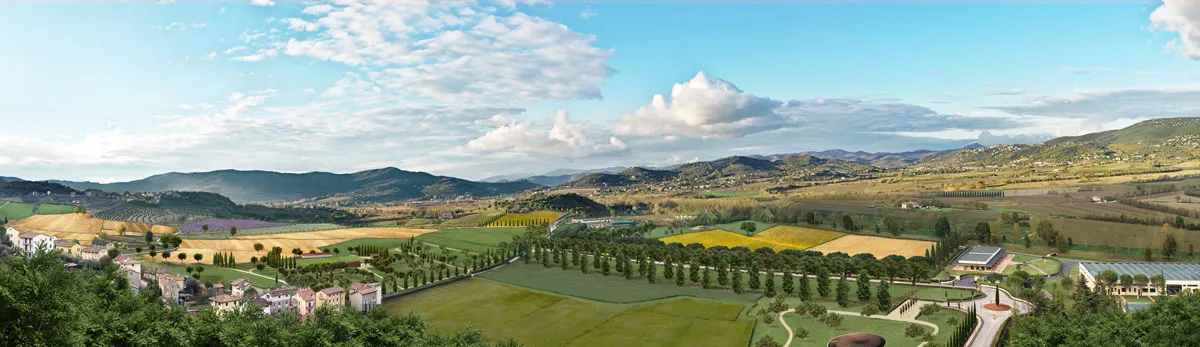
It is here, amidst this dense stratification of history, that Louis Vuitton chose to plant its flag—not with a modest workshop, but with a 14,000-square-meter architectural statement. The Manufacture de Souliers is a campus that defies the traditional aesthetic of a factory. Often described as a “giant silver shoebox,” the structure is draped in a veil of glittering metal rings, playing with the Italian light and signaling a thoroughly modern reverence for an ancient practice.
Louis Vuitton’s shoe factory in Fiesso d’Artico, a centre of craftsmanship and manufacturing
A Geography of Talent
The decision to situate such a pivotal facility in Fiesso d’Artico was not a matter of convenience, but of cultural necessity. In the world of high artisanship, geography is destiny. Louis Vuitton’s CEO, Michael Burke, articulates this regional specialization with clarity: “The best watchmakers are in and around Geneva. Tanneries are outside Florence. High-end shoe manufacturers are in the Veneto. Silk businesses are around Como.”
This philosophy underscores a belief in the transmission of talent—an ecosystem where savoir-faire is not taught in classrooms but passed from hand to hand, generation to generation. By embedding its operations within this historical cluster, the Maison taps into a reservoir of tacit knowledge that has accumulated over nearly a millennium. It is a gathering place where tradition does not stagnate; rather, it is the soil from which new ideas germinate.
Fiesso d’Artico's 13th-century heritage in crafting footwear for Venetian aristocracy
The Choreography of the Hand
Inside the metallic skin of the factory, the atmosphere shifts from architectural spectacle to intimate precision. Approximately 400 craftspeople inhabit four distinct workshops, covering the entire spectrum of production from the initial design sketches to the final tactile inspection of leatherwork.
The creation of a single pair of shoes is a study in patience, standing in stark contrast to the velocity of modern consumption. On average, the process consumes two full days. It is a rigorous ballet comprising 150 to 200 individual steps, the number fluctuating based on the complexity of the design and the rarity of the materials.
Handcrafting the shoe last, a skill showing the attention to detail of a master shoemaker
This operational density is documented in the book Louis Vuitton Manufactures (Assouline), which functions less as a catalog and more as a photographic tribute to the human element behind the brand. The volume captures the “intelligence of the hand”—the specific pressure applied during polishing, the tension of the stitch, and the experienced eye required to read the grain of the leather.
The Synthesis of Form and Spirit
The pursuit of superior quality requires a level of detail that defies automation. It demands the judgment of artisans who understand that perfection is often found in the unseen components of a shoe. The factory in Fiesso d’Artico is designed to facilitate this level of focus, providing a space where time is measured not in seconds, but in the rhythm of the stitch.
A craftsman cuts, stitches, and polishes leather alongside other distinct manufacturing steps
In the final stages of assembly, a distinct cultural synthesis occurs. The unmistakable French design codes of the Maison are fused with the structural mastery of Italian leatherwork. When the logo is finally applied, it signifies more than a brand; it represents the integration of the spirit of travel with the permanence of heritage, all grounded in the soil of the Brenta.

 Louis Vuitton’s shoe factory in Fiesso d’Artico, a centre of craftsmanship and manufacturing
 Fiesso d’Artico's 13th-century heritage in crafting footwear for Venetian aristocracy
 Handcrafting the shoe last, a skill showing the attention to detail of a master shoemaker
 A craftsman cuts, stitches, and polishes leather alongside other distinct manufacturing steps