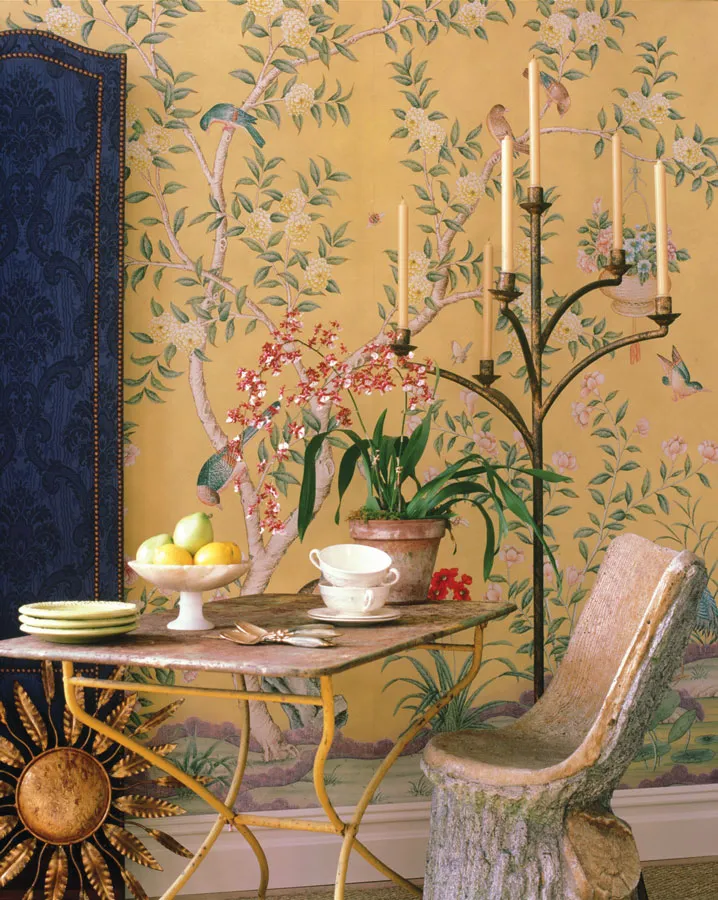
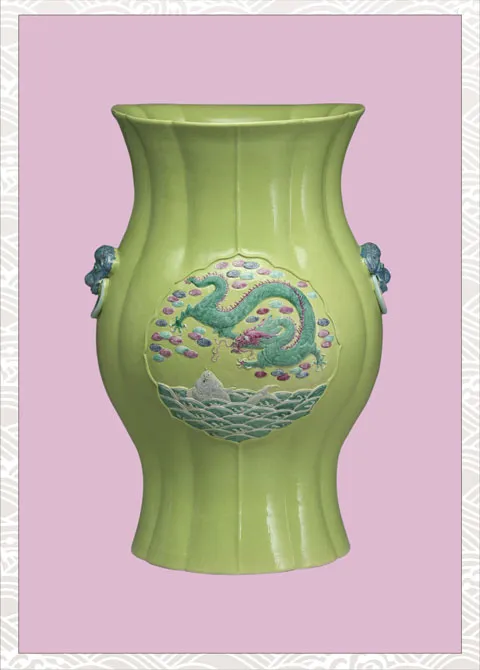
The walls of Britain’s most storied estates hold a quiet, gilded paradox. Within the stone architecture of English manor houses lies a fragile, vibrant world of paper—a meticulous documentation of a faraway land that, for many 18th-century Europeans, existed only in imagination. Chinese wallpaper is not merely a decorative surface; it is, as Emile de Bruijn of the UK’s National Trust observes, a “living tradition” and a complex dialogue between East and West.
This art form represents a unique heritage phenomenon. While Chinese artisans historically adorned their own interiors with hanging scrolls of birds, flowers, and landscapes, the European appetite for immersion demanded something different. They desired the exotic scenes to envelope them completely, pasted directly onto the architecture. Thus, Chinese wallpaper was born: a product manufactured in China, yet conceptually tailored for the Western gaze—a “high-tech luxury good” of the 16th and 17th centuries that stood alongside silk, porcelain, and lacquer.
Study, 1740s; Before Chinese wallpaper, Chinese prints would be placed together in aesthetic, often symmetrical, patterns. Photo by Paul Highnam
These papers did more than beautify a room; they transported the occupant. They illustrated deep philosophical virtues, often depicting a Confucian ideal where society functions in perfect hierarchy and harmony. High above the floorboards, one could gaze upon a utopian vision where every class, from the scholar to the laborer, fulfilled their role with grace. Today, five historic houses in the United Kingdom remain as custodians of this exquisite, cross-cultural legacy.
Harewood House: The Harmony of Craft
In the rolling hills of West Yorkshire, Harewood House stands as a testament to the mid-18th-century golden age of design. Here, the legendary furniture maker Thomas Chippendale orchestrated a “total work of art,” curating not just the mahogany tables but the atmosphere in which they sat. Chippendale’s genius lay in his ability to blend the authentic with the interpreted; he supplied genuine Chinese wallpaper and paired it with furniture finished in green and gold imitation lacquer.
Harewood House was completely furnished by famous furniture-maker Thomas Chippendale, including the Chinese wallpaper.
The wallpaper at Harewood is a visual treatise on social cohesion. It depicts the rhythms of daily life in a Confucian society, where agricultural and domestic work is performed with a serene fluidity. The scenes suggest a world without friction, a perfect backdrop for the aristocratic life of the British estate.
This interior represents a seamless fusion of trade and craftsmanship. As de Bruijn notes, it is a prime example of how “genuine Chinese products were combined with imitation Asian products made in Britain,” creating a hybrid aesthetic that felt entirely native to the English country house.
Harewood House, with mid-18th-century Chinese wallpaper and a mid-19th-century handwoven French carpet.Depictions of Confucian society illustrated how workers of all classes harmoniously lived together. Photo Courtesy of Harewood House Trust
Penrhyn Castle: A Neo-Medieval Juxtaposition
Situated in northern Wales, Penrhyn Castle presents a striking architectural contrast. Built in the 1830s by Thomas Hopper in a formidable Neo-Medieval style, its stone exterior evokes the ruggedness of a fortress. Yet, inside, Hopper introduced the delicate refinement of the Orient. The presence of Chinese wallpaper within a mock-medieval castle underscores just how essential this aesthetic had become to the British definition of luxury. By the 19th century, no high-end interior was complete without the touch of the East.
Thomas Hopper designed Penrhyn Castle in the Neo-Medieval style.
The Lower India Room serves as a portal to a different world, far removed from the cold Welsh stone. The wallpaper here unfolds as a lush Chinese garden, complete with scholar’s rocks, flowering trees, and the flutter of birds and butterflies. It is an invitation to escapism, designed to transport the viewer to a mysterious, idealized landscape.
The juxtaposition here is profound: the heavy, defensive architecture of the castle protecting the fragile, ephemeral beauty of the paper gardens within. It speaks to the era’s eclectic tastes, where historical revivalism could comfortably coexist with imported exoticism.
State Dressing Room, early 1830s. Photo by Paul HighnamAdorning the State Bedroom of a Neo-Medieval castle with Chinese wallpaper shows how important a status symbol Oriental art had become. Photo by Paul Highnam
Saltram House: The Silent Narratives
Before the continuous rolls of wallpaper became the standard, there was the collage. Saltram House in Devon, a George II era mansion, preserves this earlier, more fragmented approach to Chinoiserie. Here, the walls are adorned not with a single unified scene, but with a collection of individual Chinese prints, purchased separately and then artistically arranged by the European owners to create a mosaic of imagery.
Saltram House, from the King George II era.
These walls hold a secret history. Many of the woodblock prints preserved at Saltram depict scenes from Romance of the Three Kingdoms, one of China’s great classical novels, as well as spiritual landscapes populated by Taoist immortals. In China, these images would have been instantly recognizable as specific legends and moral tales.
However, to the British aristocracy who pasted them onto their walls, the narrative context was often lost, replaced by an appreciation for pure form and color. Today, these rooms serve as rare archives; de Bruijn points out that many of these specific prints no longer exist in China, surviving only because they were unknowingly preserved on the walls of an English country house.
Chinese Dressing Room, probably 1740s. Photo by Paul Highnam
Belton House: The Whimsy of Perspective
By the time the Chinese Bedroom at Belton House in Lincolnshire was commissioned around 1840, the taste for the exotic had matured into a comfortable, almost playful familiarity. The wallpaper here is distinct for its surreal manipulation of scale, a detail that hints at symbolic depth rather than realism.
Belton House, built by Sir John Brownlow, 3rd Baronet, in the mid-17th century.
The room is dominated by bamboo stalks that defy nature, stretching continuously from the floor to the high ceiling. In contrast, the human figures on the ground are depicted in diminutive scale. This distortion is not accidental; in Chinese symbolism, bamboo represents uprightness and resilience. By enlarging it, the artist emphasizes the righteousness that underpins the social order. Meanwhile, the tiny figures below engage in leisure and trade—playing checkers, exchanging goods—existing happily beneath the protective canopy of virtue.
This room illustrates the domestication of the exotic. By the mid-19th century, these “alien” elements had been fully absorbed into the British vernacular of power and taste. The wallpaper was no longer a shock of the new, but a standard bearer of sophistication.
Erddig House: The Window to the East
In the Picture Room of Erddig House in Wales, one finds a specific evolution of the genre: the panoramic print set. Unlike repetitive patterns, these were produced by Chinese workshops as sets of 12 to 20 prints intended to be mounted together, creating a sweeping, continuous narrative. The walls here recount the technical and agricultural processes of rice cultivation and silk production—themes that celebrated industry and nature.
The Erddig House, built for the High Sheriff of Denbighshire.
De Bruijn describes these wallpapers as functioning “almost like windows.” This aesthetic development occurred alongside the rise of the English Landscape Garden, which favored a naturalistic, asymmetrical approach to exterior design. There is a poetic symmetry in the experience of the resident: looking through the glass window, one saw the manicured “natural” English garden; looking at the walls, one saw the idealized agrarian landscapes of China.
These paper landscapes offered a parallel reality, a curated vision of the East that mirrored the curated nature of the West. It was a visual conversation between two cultures, conducted in silence across the walls of a drawing room.
State bedroom, 1770s; bed upholstered with Chinese silk and imitation lacquer chairs 1720s. Photo by Paul HighnamChinese Room, 1770s; Chinese prints depicting silk production and rice cultivation blended with actual windows, letting you also peer into English gardens. Photo by Paul Highnam

 Study, 1740s; Before Chinese wallpaper, Chinese prints would be placed together in aesthetic, often symmetrical, patterns. Photo by Paul Highnam
 Harewood House was completely furnished by famous furniture-maker Thomas Chippendale, including the Chinese wallpaper.
 Harewood House, with mid-18th-century Chinese wallpaper and a mid-19th-century handwoven French carpet.
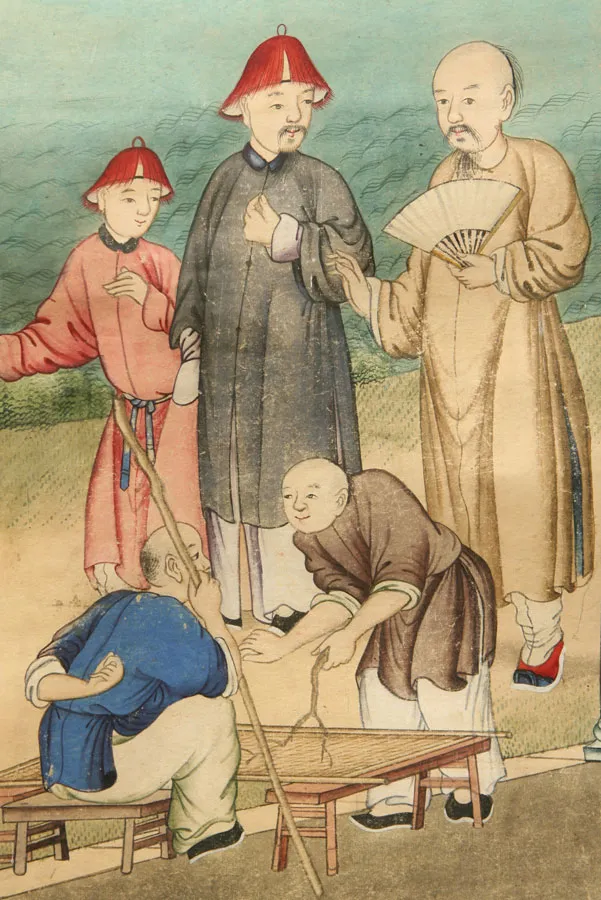 Depictions of Confucian society illustrated how workers of all classes harmoniously lived together. Photo Courtesy of Harewood House Trust
 Thomas Hopper designed Penrhyn Castle in the Neo-Medieval style.
 State Dressing Room, early 1830s. Photo by Paul Highnam
 Adorning the State Bedroom of a Neo-Medieval castle with Chinese wallpaper shows how important a status symbol Oriental art had become. Photo by Paul Highnam
 Saltram House, from the King George II era.
 Chinese Dressing Room, probably 1740s. Photo by Paul Highnam
 Belton House, built by Sir John Brownlow, 3rd Baronet, in the mid-17th century.
 The Erddig House, built for the High Sheriff of Denbighshire.
 State bedroom, 1770s; bed upholstered with Chinese silk and imitation lacquer chairs 1720s. Photo by Paul Highnam
 Chinese Room, 1770s; Chinese prints depicting silk production and rice cultivation blended with actual windows, letting you also peer into English gardens. Photo by Paul Highnam