In the rolling hills of Umbria, where the light shifts with a painterly softness across vineyards and olive groves, the medieval hamlet of Solomeo stands as a silent witness to time. From a distance, it appears as yet another picturesque remnant of Italy’s past, a cluster of stone clinging to the topography of the land. Yet, beneath the terracotta roofs and within the restored masonry, something distinct from mere preservation is occurring. This is not a town frozen in a museum-like stasis, but a living organism where the ancient concept of genius loci—the spirit of the place—has been harmonized with the pulse of modern industry.
Since 1985, this hamlet has served as the spiritual and operational heart of Brunello Cucinelli’s vision. While the fashion world often gravitates toward the frenetic energy of Milan or Paris, Cucinelli chose to retreat to the roots of his wife’s hometown, turning a fourteenth-century castle into the headquarters of a global luxury brand. It was a choice dictated not by logistics, but by a philosophical imperative: to prove that work, art, and landscape can coexist without one diminishing the other.
The view from Solomeo stretches out into the Umbrian countryside, dotted with farms and pastures.
The Philosophy of Stone and Soul
The restoration of Solomeo was never purely architectural; it was an exercise in “humanistic capitalism.” This concept, which Cucinelli speaks of with the reverence of a scholar, posits that profit should not be an end unto itself but a means to achieve a higher form of fairness. The growth of the enterprise, therefore, is mirrored by the qualitative growth of the hamlet. The population remains intimate—fewer than 500 souls—but the civic texture has been enriched.
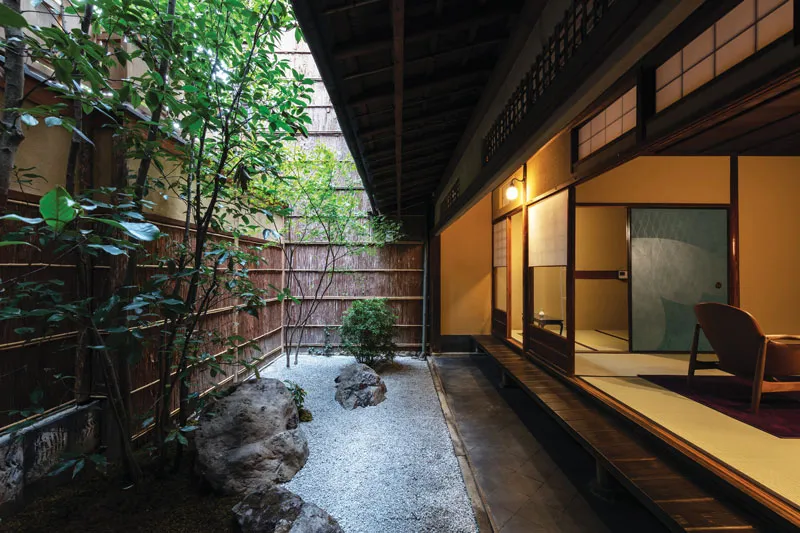
Cucinelli’s approach treats the workplace as a sanctuary. In an era where industrial spaces are often sterile and detached from nature, the workspaces in Solomeo are designed to let the Umbrian landscape flood in. Large windows frame the agricultural valley, dissolving the barrier between the artisan’s hand and the earth that sustains them. It is a deliberate rejection of the alienation found in modern labor, replacing it with a rhythmic connection to the seasons.
“In Solomeo, beauty can be found in every place where we live and work,” Cucinelli observes. “It can be found in the medieval castle… as well as in the valley, where modernity is smoothly intertwined with the agricultural heritage of the countryside.” This integration suggests that beauty is not a luxury, but a necessary condition for human dignity.
The medieval Italian village of Solomeo retained most of its original buildings during its revitalization in recent decades.
Guardianship of Craft
The revitalization extends beyond bricks and mortar to the intangible heritage of Umbrian craftsmanship. The region has a centuries-old lineage of textile mastery, a narrative that Cucinelli has woven into the fabric of his company. To ensure this lineage does not vanish into the digital ether, the School for Arts and Crafts was established within the hamlet. Here, the transmission of knowledge acts as a bridge between generations, teaching the “humanistic technology” of the hand.
The curriculum is a defense of the artisan’s role in the 21st century. It is a recognition that true luxury lies in the imperfection and warmth of human touch, something machines cannot replicate. The school serves as a reminder that history is not something to be viewed passively; it must be practiced. By training new masters in textile arts and masonry, Solomeo preserves the “humanistic essence of craftsmanship,” ensuring that the town remains a producer of culture, not just a consumer of tourism.
All of the company’s production takes place at headquarters, ensuring quality products and improving the local economy.
A Project for Beauty
In 2018, the vision for Solomeo reached a new apogee with the completion of the “Project for Beauty.” This initiative expanded the scope of restoration from the hilltop hamlet to the valley below, reclaiming approximately 100 hectares of land. The project is divided into three distinct zones: the Industrial Park, nestled within gardens; the Laic Oratory Park, dedicated to the community; and the Agrarian Park.
The centerpiece of this expansion is the “Tribute to Human Dignity,” a monument that feels both timeless and startlingly new. Situated in the Agrarian Park, it consists of five grand arches constructed from travertine. Above the arches, bronze letters spell out the monument’s name, while the names of the five continents rest beneath, signifying a universal embrace.
Architecturally, the structure is a rigorous exercise in classical principles. Rejecting modern concrete shortcuts, the builders utilized ancient construction techniques derived from the treatises of Vitruvius, Palladio, and Sebastiano Serlio. It is a structure built to age, to weather, and to stand for centuries, defying the disposable nature of contemporary construction. It stands as a physical manifesto of Cucinelli’s belief in “guardianship”—the duty to leave the world more amiable than we found it.
The Tribute to Human Dignity was completed in 2018 and utilizes classical design and construction techniques.
The Echo of the Future
Walking through Solomeo, one encounters quotes from Socrates, Confucius, and other philosophers inscribed on plaques, turning the village streets into an open-air library of wisdom. These are not mere decorations but guiding stars for the community’s ethos. When Socrates reminds the passerby that “Only the just man is happy,” it reinforces the connection between ethical living and aesthetic surroundings.
This dialogue with the past is ultimately a conversation about the future. For Cucinelli, the restoration of Solomeo is a legacy project intended for his grandchildren and theirs. The involvement of his family—his wife, daughters, and their husbands—in the stewardship of the company underscores this multigenerational perspective.
The hamlet stands today not as a monument to one man’s ego, but as a testament to the possibility of a different kind of existence. It proposes that by looking backward to the “great rules of harmony” found in creation, we might find the blueprint for a more humane future. In the quiet of the Umbrian hills, Solomeo offers a compelling argument that beauty, when allied with dignity, is the most durable substance of all.
The epitome of a family man, Brunello Cucinelli sits with his wife, two daughters, their husbands, and his two grandchildren.

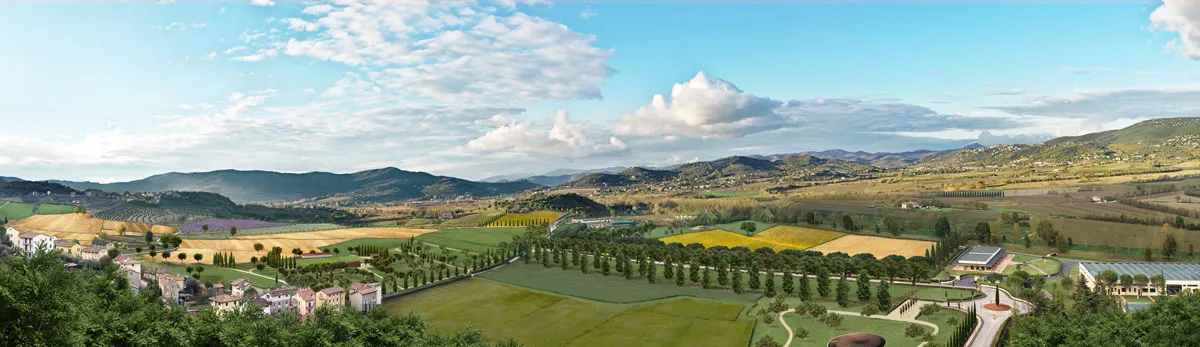 The view from Solomeo stretches out into the Umbrian countryside, dotted with farms and pastures.
 The medieval Italian village of Solomeo retained most of its original buildings during its revitalization in recent decades.
 All of the company’s production takes place at headquarters, ensuring quality products and improving the local economy.
 The Tribute to Human Dignity was completed in 2018 and utilizes classical design and construction techniques.
 The epitome of a family man, Brunello Cucinelli sits with his wife, two daughters, their husbands, and his two grandchildren.