“We’re vigilant to live the heritage of our past and faithfully preserve our tradition, and through this process develop virtues of patience, perseverance, humility, and silence.”
These words, spoken by the Mother Prioress, serve as the spiritual foundation for a craft that transcends mere decoration. In the quiet corridors of the Benedictine community, a fabric is woven that is described as rare as it is precious. Its motifs are spun from linen thread and gold, filaments as delicate as angel’s hair. For centuries, the women who guard the secrets of this needle lace have maintained a singular belief: to gaze upon its intricate beauty is to witness a reflection of the Divine.
This pursuit of perfection led to the Abbaye Notre-Dame d’Argentan, a sanctuary nestled in the village of Argentan, some 250 kilometers west of Paris. The monastery is not merely a place of residence but a living testament to resilience. Its roots trace back to the 6th century, a timeline marked by the violence of Viking raids, the dispersion forced by the French Revolution, and the devastation of Second World War bombings. Yet, after every collapse, the Benedictine sisters have humbly rebuilt, returning always to their contemplative rhythm of prayer and the needle.
The Grille and the Vow
The encounter with this heritage is physically demarcated by the architecture of the cloister. Mother Colette, a keeper of the tradition, appears behind a grid of metal bars. This barrier is symbolic rather than punitive; on one side lies the secular world, and on the other, a life dedicated to solitude, purity, and silence.
Through this grille, a small offering of homemade cookies is passed—a gesture of penance and gratitude for the opportunity to witness such devotion. Mother Colette accepts the gift with a reassuring warmth. When eyes meet through the partition, the gold spectacles framing her face seem to amplify a radiant joy. It is the look of a woman who has ceased searching for the meaning of life because she has already found it.
Mother Colette demonstrates the making of Point de France lace. Photo by Gaelle Didillion
On the fourth finger of her right hand sits a gold band, a visible sign of her commitment. “Yes, we’re married to the Lord,” she explains. Having entered the monastery in 1967 at the age of 23, Mother Colette has spent nearly half a century within these walls, her life intertwined with the rhythm of the stitch.
The King’s Decree and the Point de France
The narrative of this lace is inextricably linked to the grand history of France itself. In the 17th century, under the Sun King, Louis XIV, the French aristocracy was enamored with luxurious needlepoint lace imported from Italy. Jean-Baptiste Colbert, the king’s pragmatic finance minister, viewed this outflow of wealth with concern.
In a move of economic nationalism, Colbert banned the imports and transplanted skilled masters from Venice to Normandy. Their mandate was to instruct the locals in the creation of a new, superior handmade lace. This initiative birthed the Point de France. Cottage industries flourished in towns like Alençon and Argentan, transforming the region into the epicenter of European luxury.
France soon rose to prominence as the producer of the world’s finest handmade lace, a textile so exquisite it became known as “the lace of queens.” The value of the fabric lay not just in its materials, but in the immense discipline and labor required to produce it.
Postcard designed by nuns from Abbaye Notre-Dame d’Argentan, 2015. Photo by Gaelle Didillion
Historically, this ornamental fabric was a luxury afforded only by kings and nobles. Today, within the abbey, it represents something far more enduring: a physical manifestation of patience, a silent prayer woven into eternity.

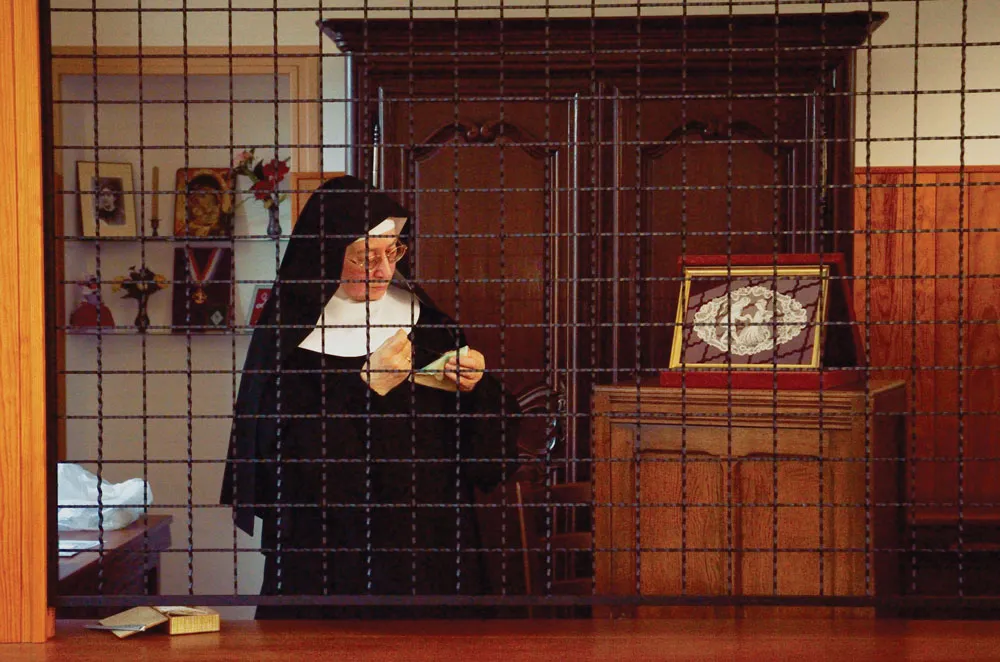 Mother Colette demonstrates the making of Point de France lace. Photo by Gaelle Didillion
 Postcard designed by nuns from Abbaye Notre-Dame d’Argentan, 2015. Photo by Gaelle Didillion