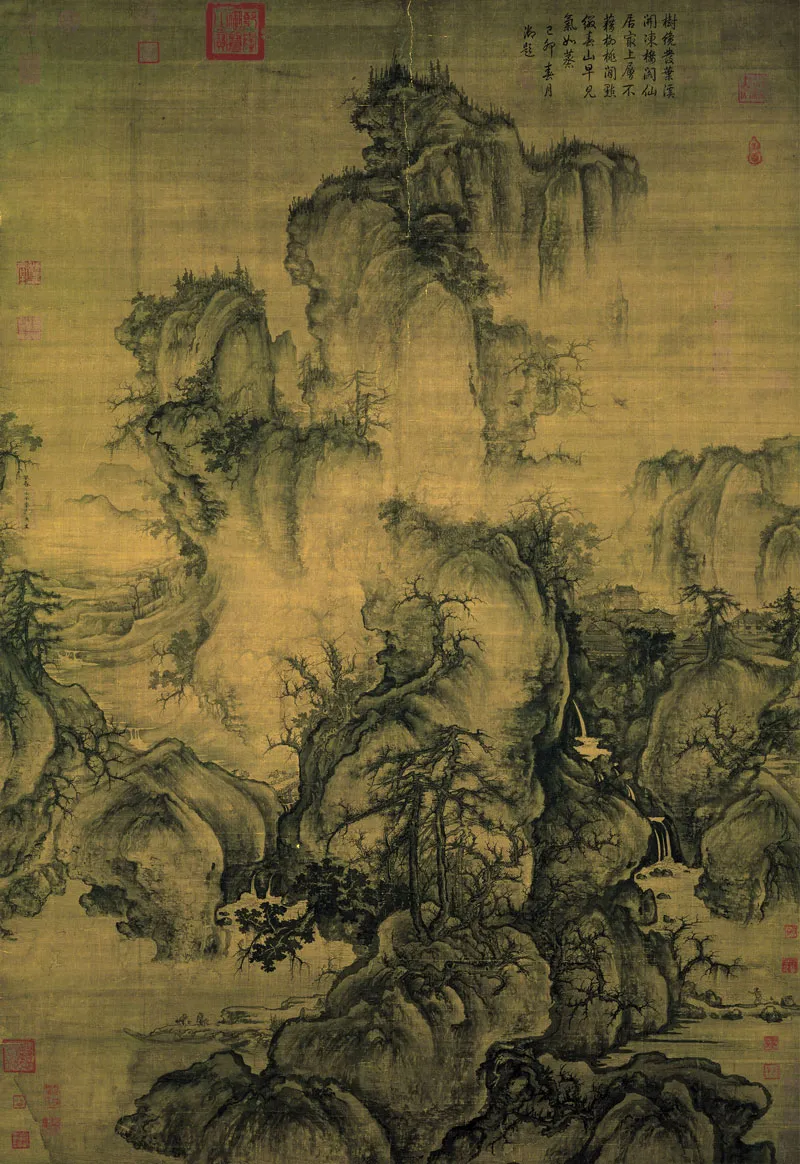
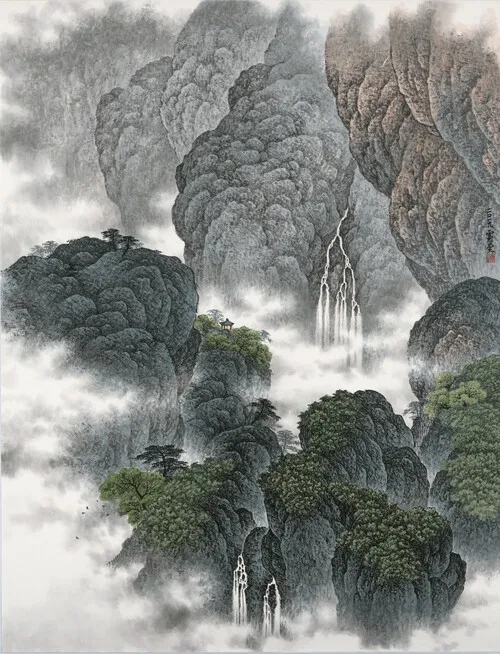
To engage with traditional East Asian ink painting is to enter a dialogue with silence. It is a medium where the ethereal meets the tangible, born from the elemental interplay of water, soot, and absorbent paper. Watch closely, and you will see that the ink does not merely stain the surface; it dances, creating a mesmerizing spectrum of chromatic variations that suggest form rather than dictate it.
But how does one navigate this landscape of mist and void? The map was drawn long ago. In the 6th century, amidst the Southern Qi and Liang dynasties, the scholar and critic Xie He penned the Record of Old Paintings. Within it, he established the “Six Principles of Painting”-a canon that remains the definitive lens for appreciating the vitality of ink.
Through these ancient principles, we explore thirteen contemporary works that bridge the divide between traditional technique and modern vision.
1. Spirit Resonance: The Breath of Life (Qiyun Shengdong)
For Xie He, the supreme quality of a painting was its ability to capture Qi-the vital spirit or inner life force of the subject. It is not enough to replicate the shape of a mountain or the posture of a bird; the artist must articulate the resonance that vibrates within them. This requires the painter to move beyond technical prowess and enter a state of deep connection with nature, translating philosophical realization into brushwork.
Wide view of Hou Xiantang’s Flying Dragon ink painting showing mountain peaks
For Taiwanese artist Hou Xiantang, painting is an act of spiritual retreat-a deliberate departure from the urban cacophony into a realm of solitude. In Flying Dragon, the mountain range does not merely sit; it undulates. The peaks rise through the mist like the spine of a divine beast ascending to the heavens, embodying a kinetic energy that defies the static nature of paper.
Detail of Flying Dragon showing the misty clouds and texture of the mountain
Hou employs a masterfully woven array of tonal variations, juxtaposing the solid rock against the uncertainty of the clouds. The mist below is thick and concealing, imbuing the scene with mystery. Yet, nestled among the pines on the foreground peak, a small temple sits unbothered. It looks outward, detached from the secular world below-a visual metaphor for an enlightened mind that finds stillness amidst the shifting winds of existence. The mountains here are not realistic renderings but spiritual anchors, reminding us that nature is both humbling and magnanimous.
Full view of Chen Shi-hang’s Daybreak painting featuring dark mountains
Chen Shi-hang’s Daybreak proves that the absence of color does not equate to a lack of vividness. The painting captures that breathless moment of transition when the world sheds the blanket of night. The viewer’s eye is immediately drawn to the interplay of light and shadow, where the dawn just begins to spill across the ridges.
Detail of Daybreak showing the waterfall contrasting with dark rocks
In the deepest shadows, untouched by the morning light, pristine waterfalls trickle over the rocks. This water serves as the landscape’s pulse-a stark, bright presence in the darkness that conveys life slumbering but stirring. The work is imbued with a quiet conviction: that light is inevitable, always waiting just beyond the horizon.
2. The Bone Method: Structure in the Stroke (Gufa Yongbi)
Literally translated as the “bone method,” this principle speaks to the structural integrity of the brushstroke. Rooted in calligraphy, ink painting relies on the spontaneity and unrepeatable nature of each mark. The “bone” is the skeleton of the work-the lines that convey the essence of form without the need for intricate, corrective layering common in Western oil painting.
Hou Xiantang’s Into the Wild showing stormy mountains and horses
Into the Wild (2020)Hou Xiantang | Ink on washi paper
In Into the Wild, Hou Xiantang uses the brush to construct a universe of imposing magnitude. Lofty mountains loom against a stormy gray backdrop, awakening a primal self-awareness in the viewer. The brushwork here is heavy and decisive, conveying the sheer weight of the stone.
Detail of Into the Wild focusing on the horses and restless grass
Contrast this with the bottom left, where two horses and a cluster of trees stand against the elements. The restless grass, rendered with swift, agitated strokes, makes the invisible wind visible. The composition balances the immensity of the cosmos with the fragility of life, provoking an impulsive desire for the recluse’s path.
Sha Ching-hwa’s Undiscovered: Mysterious Realm showing a floating rock formation
Undiscovered: Mysterious Realm (2016)Sha Ching-hwa | Ink and color on xuan paper
Here, the “bone method” is used not for realism, but for fantasy. Sha Ching-hwa presents a craggy, porous mountain floating in the ether, resembling both a deep-sea coral and a celestial meteor. The contours are emphasized to highlight a multi-layered texture that defies earthly geography.
Detail of Undiscovered showing the waterfall and birds
Sha’s aim is to transport the viewer to a realm of infinite possibility. However, a waterfall plunging down the left side and birds in flight provide a crucial tether to reality. These elements animate the stillness, allowing us to recognize the floating form as a mountain rather than a lifeless rock, balancing the surreal with the organic.
3. Proper Resemblance: The Truth of Form (Yingwu Xiangxing)
Xie He advocated for a representation that honors both external appearance and inner essence. As the 20th-century master Qi Baishi famously noted, “To be too alike is conventional, to be unlike is deceptive.” The magic lies in the subtle balance between the two.
Chiu Su-mei’s Melody of Lingering Lotuses with kingfisher and lotus pod
Melody of Lingering Lotuses (2015)Chiu Su-mei | Ink and color on silver paper
Chiu Su-mei explores the cycle of life and death through a delicate interplay of form. The kingfisher, vibrant and alert, commands attention, perched atop a lotus pod. It is surrounded by leaves that are long past their prime, their edges curling in decay.
Detail of the withered lotus leaves showing veins and texture
The meticulous depiction of the veins and the twisted, bent stalks increases the realistic quality, yet the intent is poetic. The painting suggests that autumn’s decay is not a cause for grief; rather, the fading backdrop serves to make the remaining spark of life burn even brighter.
Chiu Su-mei’s An Ode to Happiness featuring starlings on branches
An Ode to Happiness (2017)Chiu Su-mei | Ink on paper
This work captures the spiritual essence of joy through composition. The starlings are not merely placed; they are animated with a palpable sense of playfulness.
Detail of the starlings interacting on the branches
Strategically positioned on branches that zigzag rhythmically across the paper, the birds imbue the scene with dynamism. Chiu’s astute observation allows the viewer to partake in the exuberant communication radiating from the canvas.
4. Specific Coloration: Identity in Hue (Suilei Fucai)
While ink often implies monochrome, the fourth principle addresses the assignment of color to define elements. In the contemporary context, this extends to the nuanced application of washes to create cohesion and identity.
Chen Jiu-xi’s Glistening Allure with mantis and grapes
Glistening Allure (2016)Chen Jiu-xi | Earth pigment on silk
Chen Jiu-xi demonstrates that color can be starkly different yet harmoniously unified. In Glistening Allure, the birds, grapes, and praying mantis are rendered in distinct palettes.
Detail of the praying mantis on the grapes
The colors do not clash; they converse. The light, translucent green of the grapes complements the mantis’s vivid, deeper green, allowing the insect to stand out as a central character without disrupting the visual flow.
Chen Jiu-xi’s Breezy Arrival showing birds and bamboo
Breezy Arrival (2020)Chen Jiu-xi | Ink on silk
Here, coloration serves as a stage. The background is a wash of greens and yellows-a soft focus setting that ensures the bamboo and rocks provide context without distraction.
Detail of the pair of birds in Breezy Arrival
This restraint allows the main subjects-a pair of birds-to emerge distinctly. The russet-feathered female and the white-feathered male with ribbon-like tails are defined by their contrast against the verdant bamboo, emphasizing their interaction.
5. Planning of Composition: The Art of Placement (Jingying Weizhi)
A remarkable ink painting is distinguished by its composition-the arrangement of concealment and revelation, elevation and distance. Central to this is liubai, or “leaving blank,” where negative space becomes a potent narrative element.
Hou Xiantang’s Beneath the Celestial Vault showing vast mountains
Beneath the Celestial Vault (2023)Hou Xiantang | Ink on washi paper
Hou Xiantang utilizes scale to evoke philosophy. The foreground mountain is set against a backdrop of distant peaks, creating a sense of infinite recession.
Detail showing the tiny traveler and building in the vast landscape
The sheer magnitude of nature is revealed by the diminutiveness of the human elements: a lonely traveler and a small building. The tension between the majestic enormity of the earth and the man’s fleeting presence invokes a profound awe, encapsulating the silence of time and space.
Hou Xiantang’s Majestic Mountains and Flowing Water
Majestic Mountains and Flowing Water (2018)Hou Xiantang | Ink on washi paper
Rolling mountains consume eighty percent of this composition, yet it does not feel crowded. The positioning of the waterfalls creates a vertical continuity, stitching the peaks into a single, breathing unit.
Detail of the small boat at the foot of the mountain
A small boat in the bottom left corner is nearly swallowed by the landscape, blending into the rock. It is the stream running down the slope that subtly guides the eye to its presence, rewarding the attentive viewer.
Chen Jiu-xi’s Rippling Reflection with pied kingfishers
Rippling Reflection (2017)Chen Jiu-xi | Mineral pigment on Kumohada mashi paper
Composition can also be a symbol of cosmic balance. Chen Jiu-xi positions two pied kingfishers in diagonal corners, creating a visual dialogue between motion and stillness-an ingeniously subtle representation of yin and yang.
Detail of the kingfishers showing the contrast in posture
The male on the left is the agent of motion (yang), while the female on the right remains motionless (yin). The space between them is charged with their silent interaction.
Chiu Su-mei’s Cherry Blossom Salmon 2 showing fish in water
Cherry Blossom Salmon 2 (2013)Chiu Su-mei | Ink on paper
Here, liubai is used to depict water without painting it. A large expanse of negative space surrounds the nearly extinct cherry salmon.
Detail of the salmon swimming in negative space
This void invites the viewer’s imagination to fill the emptiness with the weight and clarity of water, evoking a sense of boundless freedom for the gliding fish.
Sha Ching-hwa’s Touch of the Divine with geometric mountains
Touch of the Divine (2017)Sha Ching-hwa | Ink and color on xuan paper
Finally, Sha Ching-hwa challenges traditional composition with geometry. Rising from a sea of clouds against an immense setting sun, the mountains take on precise, squared shapes.
Detail of the geometric mountain texture
The “egg-trees” growing from these blocks reinforce the fantastical nature of the landscape. It is a composition designed to startle and provoke, proving that the principles of ink painting are not shackles of the past, but foundations for the limitless imagination of the future.
 Wide view of Hou Xiantang’s Flying Dragon ink painting showing mountain peaks
 Detail of Flying Dragon showing the misty clouds and texture of the mountain
 Full view of Chen Shi-hang’s Daybreak painting featuring dark mountains
 Detail of Daybreak showing the waterfall contrasting with dark rocks
 Hou Xiantang’s Into the Wild showing stormy mountains and horses
 Detail of Into the Wild focusing on the horses and restless grass
 Sha Ching-hwa’s Undiscovered: Mysterious Realm showing a floating rock formation
 Detail of Undiscovered showing the waterfall and birds
 Chiu Su-mei’s Melody of Lingering Lotuses with kingfisher and lotus pod
 Detail of the withered lotus leaves showing veins and texture
 Chiu Su-mei’s An Ode to Happiness featuring starlings on branches
 Detail of the starlings interacting on the branches
 Chen Jiu-xi’s Glistening Allure with mantis and grapes
 Detail of the praying mantis on the grapes
 Chen Jiu-xi’s Breezy Arrival showing birds and bamboo
 Detail of the pair of birds in Breezy Arrival
 Hou Xiantang’s Beneath the Celestial Vault showing vast mountains
 Detail showing the tiny traveler and building in the vast landscape
 Hou Xiantang’s Majestic Mountains and Flowing Water
 Detail of the small boat at the foot of the mountain
 Chen Jiu-xi’s Rippling Reflection with pied kingfishers
 Detail of the kingfishers showing the contrast in posture
 Chiu Su-mei’s Cherry Blossom Salmon 2 showing fish in water
 Detail of the salmon swimming in negative space
 Sha Ching-hwa’s Touch of the Divine with geometric mountains
 Detail of the geometric mountain texture