For Belgian artist Pieter Wagemans, the canvas is not merely a surface for representation, but a vessel for preservation. In the realm of hyper-realism, where technical precision often courts the mechanical, Wagemans distinguishes himself through a profound sensitivity to the botanical soul. His work is a duel with time, an attempt to capture the fleeting sensory perfection of a living bloom before it succumbs to the inevitable cycle of decay.
Wagemans approaches his subjects with the rigor of a botanist and the eye of a romantic. His compositions do more than replicate appearance; they evoke texture and weight. One can almost feel the coarseness of a wicker basket cradling clustered primula, the cool, metallic smooth of an ornate silver box from which butter-yellow roses spill, or the delicate, waxy resistance of red tulips that appear ready to be plucked from the two-dimensional plane.
“In art, flowers have long been a symbol of aesthetics, friendship, love, decoration, and veneration—but also one of transience,” Wagemans observes. This acknowledgement of Vanitas—the traditional reminder of life’s brevity—infuses his work with a quiet urgency. The challenge, he notes, lies not just in the shape, but in matching the “colours, boldness, and fine details that occur in nature.”
The Shadow of the Dutch Masters
The trajectory of Wagemans’ artistic life was set early, beginning his formal studies at the Royal Academy of Fine Arts Antwerp at the age of fifteen during the 1960s. However, the true crystallization of his style occurred not in the classroom, but in the gallery. A pivotal exhibition dedicated to the Dutch Masters of the 17th and 18th centuries altered his perspective entirely, introducing him to the grandeur of the Golden Age of still life.
Standing before the works of giants like Jan Davidsz de Heem and Jan van Huysum, Wagemans found his vocabulary. He was captivated by the Baroque sensibility—the dramatic interplay of light and shadow, the complex arrangements, and the sheer reverence for nature’s bounty. “I was moved by the baroque compositions, the incredibly realistic renderings of flowers, and the overwhelming impression of nature displaying its treasures,” he reflects. It was here that he resolved to not only study these historical techniques but to master them.
Spring Time Explosion, oil on panel flower painting by Pieter Wagemans
The Alchemy of Alla Prima
To achieve the luminosity and depth characterizing his work, Wagemans adopts the exacting methods of his predecessors. He utilizes the alla prima, or “wet-on-wet,” technique. This method requires a confident hand and a disciplined mind, as the composition is built up through layers of oil paint applied while the previous layers remain wet. It is a process that allows for soft edges and rich blending, essential for mimicking the organic transitions found in flower petals, yet it leaves little room for hesitation.
However, Wagemans separates himself from the Old Masters through a distinct philosophical choice regarding reality. The floral masterpieces of the 17th century were often “impossible bouquets”—fantasies where flowers from different seasons bloomed simultaneously within a single vase. The Dutch Masters painted from sketches and memory, prioritizing the grandeur of the composition over temporal logic.
Detailed floral still life painting by Pieter Wagemans
A Discipline of Observation
Wagemans, by contrast, adheres to a stricter form of hyper-realism grounded in the observed moment. “The difference between my paintings and those of the Old Masters is that my compositions are seasonally related,” he explains. He refuses to paint from memory or fantasy. If tulips are on the canvas, they are accompanied only by what nature provides in that specific window of time.
This commitment to seasonal accuracy adds a layer of documentary truth to his aesthetic pursuits. In Wagemans’ art, the viewer is not just looking at a beautiful object, but witnessing a specific, frozen moment in the turning of the year, rendered with a perfection that nature promises but rarely holds for long.

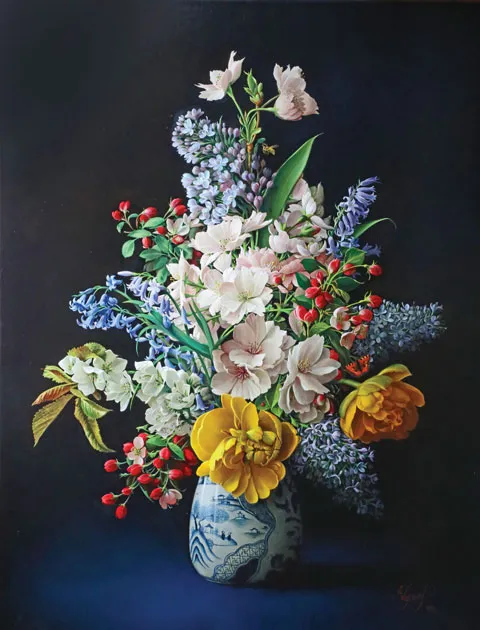 Spring Time Explosion, oil on panel flower painting by Pieter Wagemans
 Detailed floral still life painting by Pieter Wagemans