In the ancient echoes of Sanskrit, the word “Sowaka” resonates as a mantra-a whisper of “happiness” or “well-being” offered to the spirits that govern the cosmos. It is a blessing, a vibration of peace. In the heart of Kyoto, amidst the quiet gravity of historic temples and shrines, this mantra takes physical form.
The Sowaka Hotel is not merely a place of accommodation; it is a spatial meditation. Stepping through its threshold is akin to entering a suspended moment where the noise of the contemporary world dissolves, replaced by the hushed reverence of a bygone era meticulously harmonized with the present.
The property is a dialogue between two distinct architectural volumes: a newly constructed modern annex and a historic main building. The latter carries the weight of memory, having once served as a ryotei-a traditional, invitation-only restaurant where the city’s elite once gathered. Where a developer might have seen a site ripe for demolition and replacement with condominiums, architect Shigenori Uoya saw a vessel of cultural heritage waiting to be reimagined.
Sowaka hotel 5
“I wanted to pass this building on to future generations,” Uoya reflects. His vision was not one of sterile preservation, nor was it a total erasure of the past. Instead, he sought to transform the structure into an oasis that embraces the comforts of modern living without severing the delicate threads of history.
This restoration process required a curator’s eye for “ma”-the Japanese concept of negative space and pause. Uoya notes that the original ryotei architecture possessed a certain glamour and liveliness inherent to its function as a social hub. His intervention was an act of tempering that energy, quieting the space to suit a sanctuary of rest. “While retaining that aspect, I tried to create a slightly quieter atmosphere,” he explains. “We managed a balance between history and the luxurious facilities required for a modern hotel.”
Sowaka hotel
The culinary experience within the hotel mirrors this architectural philosophy. At La Bombance, the on-site Michelin-starred restaurant, the menu offers contemporary interpretations of traditional Japanese cuisine, further blurring the lines between heritage and innovation.
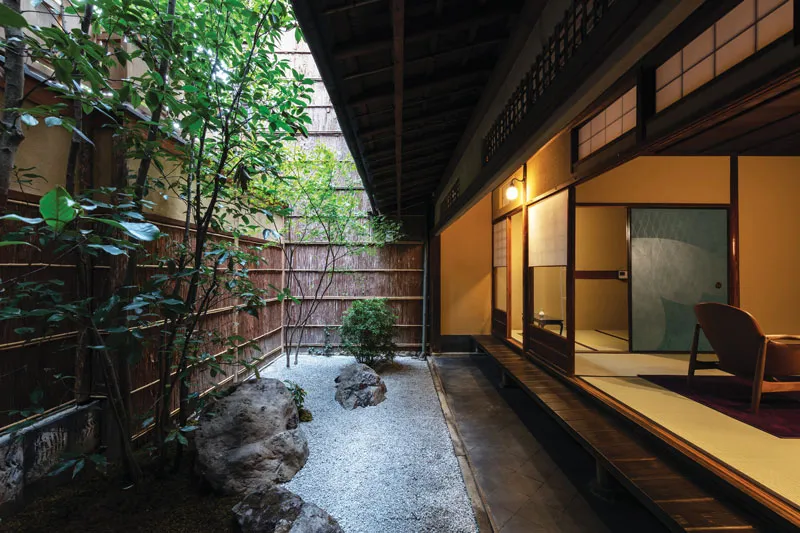
A defining feature of the Sowaka experience is its relationship with light and nature. Uoya orchestrated the layout so that the tsubo-niwa-intimate inner courtyard gardens-serve as the visual and spiritual anchor for the rooms. In traditional Kyoto architecture, these pocket gardens were functional lungs for a building, bringing air and light into the deep recesses of a townhouse. Here, they are elevated to living artworks.
Sowaka hotel 4
The tsubo-niwa does more than decorate; it facilitates a transition of the soul. By drawing the gaze outward to the moss, stone, and shifting sunlight, the architecture encourages a moment of personal reflection. It is a design choice that prioritizes inner serenity, allowing the guest to find stillness within the enclosure of the room.
The aesthetic palette throughout the hotel is muted and deliberate. It avoids the ostentatious, favoring the texture of wood, the softness of shadows, and the subtle gradation of natural materials. This minimalist approach heightens the sense of repose, allowing the architecture to recede so that the guest’s experience can come to the foreground.
Sowaka hotel 6
This philosophy of balance extends to the interior curation, where East meets West in a conversation of form and function. Uoya’s selection of furniture challenges the binary of “Japanese” versus “Western” style. “We use Japanese products, but we also try to use non-Japanese products,” he notes.
Prominent within the space are pieces from the Italian brand Flexform. Despite their Western origins, the Thomas armchairs and other selected pieces possess an uncluttered, minimalist aesthetic that aligns perfectly with the Japanese sensibility.
Sowaka hotel ss51_6_C7A5471
“It’s clearly a non-Japanese piece of furniture,” Uoya observes. “But when placed into this space, it actually looks like it’s from Japan. It’s an extension of traditional Japanese design.” This seamless integration suggests that true elegance is universal-a language of lines and proportions that transcends cultural borders.
Sowaka hotel 2
Ultimately, the Sowaka stands as a manifesto of Shigenori Uoya’s architectural belief system. It is a physical declaration that history is not a static relic to be visited, but a living current that can flow into the present.
“In the main building, I tried to create these ideas with a relatively classical architectural vocabulary. In the new building, I tried to create these ideas with a relatively modern architectural vocabulary,” Uoya concludes. The result is a unified whole, a timeless space where the mantra of well-being is felt in every beam of wood and every shaft of light.

 Sowaka hotel 5
 Sowaka hotel
 Sowaka hotel 4
 Sowaka hotel 6
 Sowaka hotel ss51_6_C7A5471
 Sowaka hotel 2
 Sowaka hotel 3