In the ancient Italian town of Santarcangelo di Romagna, where history clings to the cobblestones and the air carries the scent of heritage, there exists a workshop that functions less like a factory and more like a secular chapel. Here, Maurizio Betti, a master craftsman, does not merely build cages; he constructs palaces for the ephemeral.
Inheriting a legacy of restoration from his father, Pasquale—who once preserved the architectural beauty of Rimini—Betti has distilled the grandeur of Italian buildings into miniature scales. His aviaries are not instruments of confinement, but elaborate, fantastical residences designed to honor the creatures that possess the one thing humanity has always envied: the ability to fly.
Bird Aviary by Maurizio-Betti-1
The Redemption of Space
The physical location of Betti’s work is as symbolic as the objects he creates. His atelier is housed in a restored stable, a structure that once belonged to a butcher. It is a space that has undergone a profound metaphysical renovation.
“It used to belong to a butcher but now it’s the magical space of two vegetarians,” Betti reflects. The transformation of the building mirrors his own philosophy—a shift from utility and consumption to preservation and reverence. The workshop has become a sanctuary where the energy of the past is cleansed by the presence of wood, lacquer, and the quiet industry of creation.
Surrounding this reclaimed structure is a garden left intentionally rustic. It is not the manicured garden of a controller, but the wild, breathing space of a collaborator. Vines claim the pergola, and wild plants offer shelter, creating a porous border between the artisan’s interior world and the wild avifauna outside.
Bird Aviary by Maurizio-Betti-2
Micro-Architecture and the Renaissance of Craft
Betti’s aviaries are born from a synthesis of architectural discipline and whimsical imagination. The creative process is a dialogue between Maurizio and his partner, Loredana Cangini. It begins on paper, where Loredana translates concepts into scale sketches and delicate watercolors. These drafts are the blueprints for structures that blend the symmetry of the Italian Renaissance with the tiered elegance of Asian aesthetics.
However, the visual allure of these objects—rich with lacquering and intricate wall decorations—never supersedes their purpose. Betti approaches each piece with the rigor of a restorer and the empathy of a naturalist. “Aesthetic inspiration never prevails over functionality,” he asserts.
Every aviary is a response to a specific species. The dimensions, the perches, and the spacing are dictated by the needs of the bird, not the eye of the viewer. It is a humility rare in art: the masterpiece bows to the inhabitant.
Bird Aviary by Maurizio-Betti-4
The Heartbeat in the Palm
There is a profound paradox at the center of Betti’s fascination: a man afraid of flying devoting his life to those who can. Perhaps it is this very grounding that deepens his appreciation for the sky.
His connection to birds is tactile and intimate. He describes moments of rescue—a fallen chick, a bird in distress—as a suspension of the world’s chaos. “I hold the bird in the palm of my hand, feel its little heart beating hard… After a while the bird calms down, its heartbeat slows down, and I realize that it’s no longer afraid of me.”
This interaction is the emotional core of his craft. The aviaries are extensions of that protective hand—shelters designed to offer the same sense of safety he provides in those quiet moments of rescue.
A Life Measured by Light
In a modern era governed by digital urgency, Betti has chosen to step out of chronological time and into natural time. For over a decade, since making the ethical choice to stop eating animals, his perception of the world has shifted. He no longer wears a watch.
Instead, the rhythm of the workshop is dictated by the arc of the sun and the habits of the garden’s residents. “I realize that it’s 11:30 in the morning when a small flock of sparrows suddenly arrives chirping,” he notes. The birds are his clock; the light is his calendar.
Even the smallest creatures are welcomed into this ecosystem. A family of mice, once hunted by cats, now resides in a custom-built wooden house within the workshop, eating from the artisan’s hand. This radical hospitality defines the atmosphere of the studio.
Bird Aviary Master Maurizio-Betti
Walking through the tunnel of greenery to open his gate each morning, Maurizio Betti does not simply go to work. He enters a rhythm he has curated—a slow, deliberate tempo where restoration is not just about fixing old objects, but about maintaining a gentle, dignified way of existing in the world.

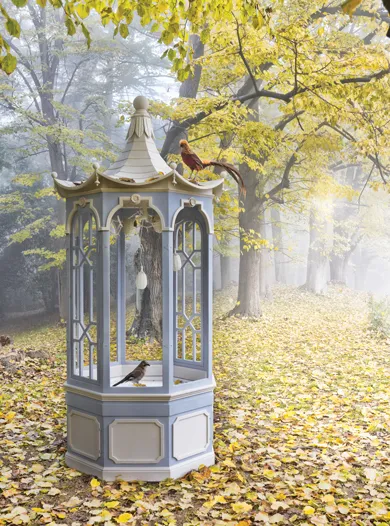 Bird Aviary by Maurizio-Betti-1
 Bird Aviary by Maurizio-Betti-2
 Bird Aviary by Maurizio-Betti-4
 Bird Aviary Master Maurizio-Betti