“The din of the dusty world and the locked-in-ness of human habitations are what human nature abhors; contrarily, the haze, mist, and mountain spirits are what human nature seeks, yet can rarely find.”
These observations, penned by the Northern Song master Guo Xi (ca. 1000–1090) in his seminal treatise Mountains and Waters, resonate with a startling immediacy nearly a millennium later. In an era defined by the verticality of concrete and the ceaseless luminescence of the city, the “dusty world” has only grown denser. Yet, the human spirit’s gravitation toward the wild—the nebulous mist and the silent peak—remains an immutable instinct.
In the classical Chinese tradition, the mountain was never merely a geological formation. It was a repository of cosmic energy (qi), a ladder to the heavens, and a mirror for the internal landscape of the scholar. To paint a mountain was not to map geography, but to manifest philosophy. From the monumental landscapes of the Song Dynasty to contemporary ink interpretations, these works invite us to step out of time and into a realm where the soul can wander, gaze, and finally, dwell.
The Shifting View: To Ramble and Dwell
Unlike the fixed, single-point perspective that dominated Western art history, traditional Chinese landscape painting (shan shui) operates on the logic of the mind’s eye. It is kinematic rather than static. Guo Xi championed the “angle of totality”—a method that allows the viewer to see the mountain not as a frozen snapshot, but as a living entity that reveals itself through movement.
“There are landscapes in which one may ramble, landscapes in which one may dwell,” Guo wrote. To achieve this, the artist rejects a singular vantage point, offering instead a composite of perspectives that unfold as one scrolls through the silk or paper.
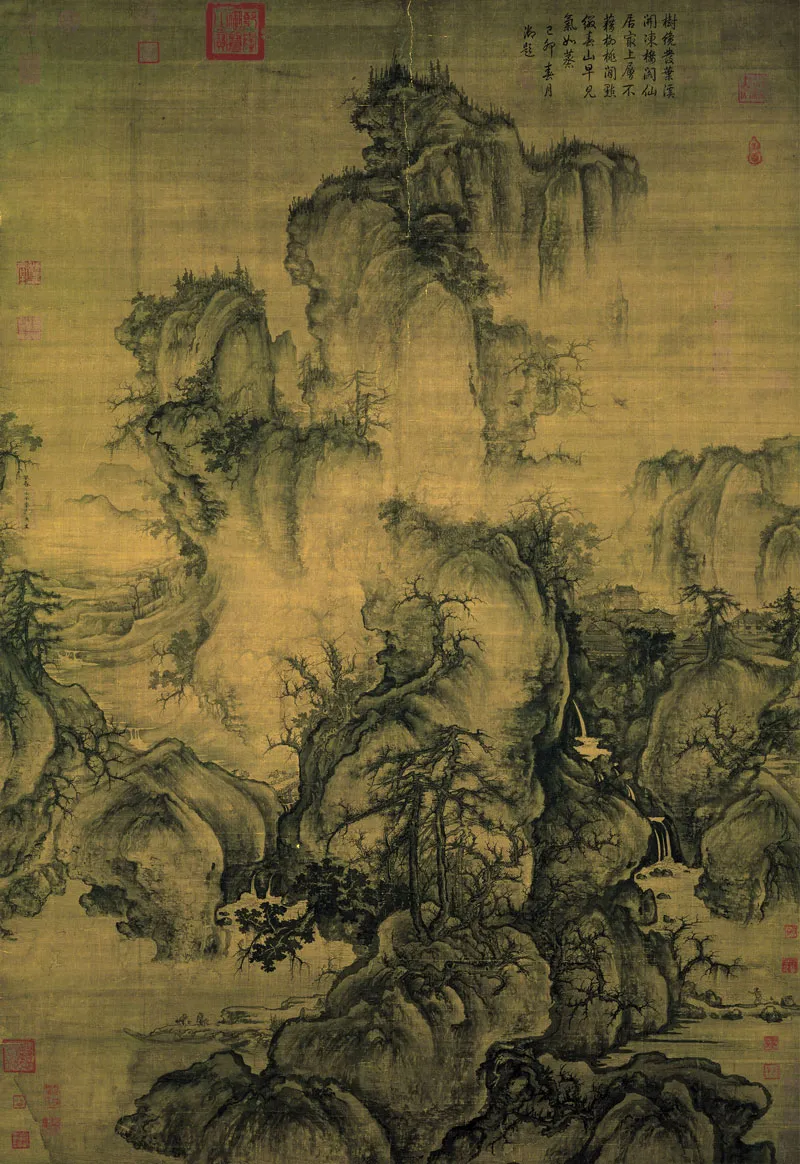
Early Spring by Guo Xi, Northern Song Dynasty
Early Spring (Zaochun tu) Guo Xi (c. 1020–1090), Northern Song Dynasty (1072) Ink and color on silk | National Palace Museum, Taiwan
In Early Spring, one of the most celebrated masterpieces of the canon, the mountain does not sit still. Through the strategic use of blank space, Guo Xi conjures a swirling mist that breathes dynamism into the stone. The vapor conceals as much as it reveals, creating a rhythm of visibility and obscurity. This is the visual equivalent of a journey: the mountain changes form with every step the viewer takes.
The artist’s observation was clearly exhaustive; only one who has lived among the peaks could capture the crooked interplay of pine and rock with such fidelity. Yet, it is the void—the undefined mist—that invites the viewer’s collaboration. We are asked to complete the landscape with our own imagination, entering a dialogue with the ink.
Beyond the Peaks by Hou Xian Tang
Beyond the Peaks Hou Xiantang (2023) Ink on washi paper
This philosophy of immersion persists in the contemporary ink work of Hou Xiantang. In Beyond the Peaks, the eye is drawn to the imposing grandeur of layered summits, but the soul is anchored by two diminutive figures perched on a cliff. They are proxies for us, the viewers.
Hidden in the foothills lies a cottage, connected to the peaks by a winding path. This narrative architecture implies a journey from the domestic to the sublime. The contrast is deliberate: the humble scale of the human figures against the azure wash of the distant ranges evokes a sense of cosmic vastness, reminding us of our small, yet significant, place within the natural order.
The Vista of the Immaterial: Painting the Invisible
French philosopher Maurice Merleau-Ponty once suggested that great art reveals “a deep geological stratum,” an intangible presence beneath the surface. Chinese mountain painting has always excelled at this—depicting not just the rock, but the spirit that animates it. These paintings serve as portals to the infinite, where the heartbeat synchronizes with the wind and water.
Dongtian Mountain Hall by Dong Yuan
Dongtian (Caved Paradise) Mountain Hall Dong Yuan (c. 934–962), Five Dynasties Period Ink and color on silk | National Palace Museum, Taiwan
Dong Yuan’s Dongtian Mountain Hall is a testament to the power of expressionism over strict realism. Created during the chaotic violence of the Five Dynasties and Ten Kingdoms period, the painting offers a psychological retreat. The “Caved Paradise” is not just a physical location but a state of mind.
The composition is dominated by soft, rolling peaks and deep spatial recessions, achieved through Dong’s signature “hemp-fiber strokes.” Pavilions emerge faintly from the mist, and tiny tourists marvel at the view, embodying the discovery of a sanctuary. Unlike the dramatic crags of the Northern Song, Dong Yuan’s southern landscapes offer a serene, expansive embrace—a visual antidote to the turbulence of his time.
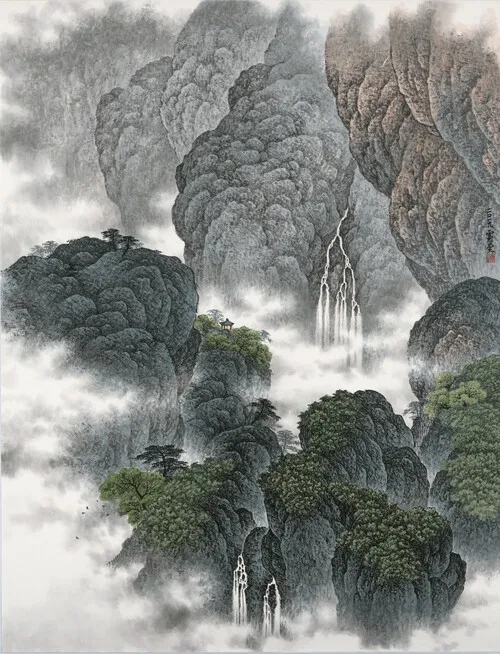
A Majestic Vista by Hou Xiantang
A Majestic Vista Hou Xiantang (2019) Ink on washi paper
Echoing this lineage, Hou Xiantang’s A Majestic Vista utilizes distinctive M-strokes to craft rounded, cloud-like peaks. The mist here is active, an enchanting force that blurs the line between the terrestrial and the celestial. A solitary pavilion suggests a longing for isolation, a recurring motif in the scholar-gentleman’s aesthetic.
Mountains and Lake in a Spring Dawn by Juran
Mountains and Lake in a Spring Dawn Juran (Five Dynasties/Northern Song) Ink and color on silk
The monk-painter Juran, a student of Dong Yuan, sought enlightenment through the observation of nature. In Mountains and Lake in a Spring Dawn, the mountains possess the fluidity of rushing water. The texture strokes create a sense of vibration, as if the landscape is humming with energy. The figures depicted—fishermen, travelers—are ordinary mortals, yet they move with the ease of immortals, liberated by their proximity to the wild.
Whimsical Voyage by Hou Xiantang
Whimsical Voyage Hou Xiantang (2018) Ink on washi paper
In a modern dialogue with these ancient masters, Hou Xiantang’s Whimsical Voyage uses color to suggest the intangible. The peaks glow with the reddish hue of a sunset, yet the sun itself is absent. A figure in a boat gazes upward, lost in the reflected glory. The mist here acts as a threshold, a magical border through which birds soar, crossing from the known world into the mystery of the mountains.
The Aesthetics of Emptiness: The Power of Liubai
In the West, we are often taught that “less is more.” In Chinese art, the philosophy is closer to “void is substance.” The technique of liubai—leaving blank space—is not merely an artistic choice but a Daoist imperative. As Lao Tzu wrote in the Dao De Jing: “Without the void in the clay, the vase would not contain water.”
Negative space allows the painting to breathe. It represents the water, the mist, the snow, and ultimately, the Tao itself—the unnameable source of all things.
Snowy Landscape by Liang Kai
Snowy Landscape Liang Kai (c. 1140–1210), Southern Song Dynasty Ink and color on silk | Tokyo National Museum
Liang Kai’s Snowy Landscape is a masterclass in the weight of emptiness. The biting cold of the snow is not painted with white pigment; it is defined by the absence of ink. The vast, blank silk creates a heavy silence, pressing down on the two travelers and their horses. It is a scene of profound desolation, yet the negative space gives the figures a heroic solitude. They are defined by what surrounds them—the great, white nothingness.
Waterfalls and Trees by Hou Xiantang
Waterfalls and Trees Hou Xiantang (2019) Ink on washi paper
Hou Xiantang applies this subtractive method in Waterfalls and Trees. In traditional ink painting, there is no white paint. The cascading water and the drifting clouds are created solely by the artist not painting. By darkening the surrounding rocks and trees, the paper’s original whiteness is liberated, transforming into rushing water and ethereal mist. It is a creation of substance through omission.
Reclusively Fishing in a Lake Among Pines by Li Tang
Reclusively Fishing in a Lake Among Pines Li Tang (c. 1050–1130), Southern Song Dynasty Ink and color on silk | National Palace Museum, Taiwan
The Southern Song academy often favored the “one-corner” composition, and Li Tang’s fan painting exemplifies this. Three-quarters of the surface is left empty, representing the vastness of the lake. In the corner, a fisherman waits. His diminutive presence against the expansive void suggests a reconciliation with the universe. He is not conquering the water; he is suspended within it, finding a “sought-after tranquility” that can only be found when the mind mirrors the emptiness of the lake.
Evergreen by Hou Xiantang
Evergreen Hou Xiantang (2019) Ink on washi paper
In Evergreen, the void becomes fog. Hou Xiantang obliterates the horizon line, merging lake and sky into a singular field of white. The world is hushed. A solitary pavilion stands as the only geometric counterpoint to the organic softness, a final reminder of the human capacity to find a home within the haze.

 Early Spring by Guo Xi, Northern Song Dynasty
 Beyond the Peaks by Hou Xian Tang
 Dongtian Mountain Hall by Dong Yuan
 A Majestic Vista by Hou Xiantang
 Mountains and Lake in a Spring Dawn by Juran
 Whimsical Voyage by Hou Xiantang
 Snowy Landscape by Liang Kai
 Waterfalls and Trees by Hou Xiantang
 Reclusively Fishing in a Lake Among Pines by Li Tang
 Evergreen by Hou Xiantang