In the vertical ascent of the Andaz Tokyo Toranomon Hills, the act of moving between floors ceases to be a mere transit; it becomes a passage through a suspended botanical world. Here, the walls do not merely enclose—they narrate. The works of Tetsuya Nagata, hanging within these five elevators, transform a confined mechanical space into a sanctuary of “Wagashi Zanmai”—a technique that fossilizes the ephemeral joy of celebration into the permanence of paper.
Nagata’s art is a silent conversation between two distinct Japanese lineages: Wagashi, the ornate confectioneries crafted for ceremony, and Washi, the resilient traditional paper. By substituting the fleeting sweetness of sugar with the enduring texture of hand-moulded paper, Nagata creates what he terms “memory paper.” These are not just sculptures; they are ghosts of celebrations past, stripped of color to reveal the pure architecture of form.
Tetsuya Nagata’s Osechi is a tribute to the traditional Japanese food prepared during the New Year.
The foundation of Nagata’s practice lies in the archive. Over two decades, he has amassed a collection of more than 2,000 wooden confectionery moulds, some dating back to the Edo period (1603–1867). These wooden blocks, carved with the likenesses of sea breams, chrysanthemums, and deities, were once the vessels for prayers—tools used to shape sweets for weddings, the Shichi-Go-San rite of passage, or the New Year. They held the weight of human hope: wishes for health, growth, and prosperity.
Nagata views these moulds not as antique tools, but as a “cast of characters” waiting to be reanimated. When he presses the wet Nishinouchi paper—an Intangible Cultural Property made from the finest mulberry bark—into the carved wood, he is not merely making an impression. He is extracting the memory of the artisan who carved the wood and the joy of the generations who received the sweets. The paper, chosen for its dualistic nature of pliancy and immense strength, captures every grain of the wood, locking the spirit of the celebration into a white, three-dimensional relief.
Left: Hanging inside an Andaz Tokyo hotel elevator is Nagata’s Where the Mantis Dwells. Right: Nagata’s works have deep philosophical symbolism.
The absence of color in Nagata’s work is a deliberate philosophical stance. He pursues the “white brilliance of a moment”—a state of purity that allows the texture and shadow to speak without the distraction of pigment. “Beauty is the resonance between the work and the viewer’s mind,” Nagata observes. In this monochromatic realm, the viewer encounters a state of emptiness, a void that is not barren but fertile with imagination.
This whiteness serves as the stage for profound natural narratives. In Where the Mantis Dwells, one of the installations at the Andaz, the composition moves beyond decoration to become a map of the cosmos. Flowers from all four seasons bloom simultaneously, defying time. Below them swims a carp; above, another carp leaps, referencing the ancient legend of the Dragon Gate—where a carp, upon climbing a waterfall, transforms into a dragon. It is a story of ascension and success, played out in the quiet textures of mulberry fiber.
Nagata’s work Spreading Out into the Great Sea is located inside an elevator of the luxury hotel Andaz Tokyo Toranomon Hills.
Within these intricate ecosystems, small lives play significant roles. Butterflies, symbols of transformation, flutter alongside dragonflies and mantises. Nagata notes that insects are historically viewed as symbols of positive growth in Japanese culture because they only move forward. They are the understated engines of the natural world, much like the artist himself, who views creativity as a relentless progression. “How can I blow a new wind in the world?” he asks daily, mirroring the metamorphosis of the caterpillar he sculpts.
The symbolism extends to the flora. Flowers in Nagata’s universe are depicted as entities “open to space,” representing a liberated mind. In contrast, animals are “closed to space” physically, yet their hearts remain open. This interplay creates a balance—a polarity between the sky and the water, the open and the closed, the static paper and the fluidity it represents.
Top: The Blessed Flow of the Treasure Chest. Bottom: Watching a Sublime Waterfall with the Dancing Lotus.
While modern art often trends toward minimalism or shock, stripping away ornamentation, Nagata’s “Wagashi Zanmai” walks a different path. It reclaims the ornamentation of the past but presents it through a modernist lens of restraint. It is high-definition texture rendered in absolute silence. The work requires time—months, sometimes years—to complete, demanding a patience that contradicts the speed of the modern world.
This dedication resonates in spaces like the Tsujiri tea room in Malaysia or the Ozu Washi Gallery. Whether portraying a “Sublime Waterfall” or a “Treasure Chest of Many Delicacies,” the work invites a “state of unrestrained mindfulness.” It acts as a barometer for the viewer’s own inner state.
Nagata’s work Dancing in the Sun (Left) and a wooden Wagashi mould (Right).
Ultimately, Nagata’s work is an aggregation of time and space. The wooden moulds carry the specific gravity of the Edo or Meiji eras; the paper carries the ancient technique from China; the composition carries the timeless laws of nature. By pressing these elements together, Nagata creates something that feels immeasurable.
In the brief duration of an elevator ride, or in the quiet contemplation of a gallery, the viewer is offered a release. “You’ve been filled with the beauty and liberation… and then you’re released into the outside world,” Nagata reflects. The doors open, and the white, silent world remains behind, leaving an imprint of peace that lingers long after the descent is over.

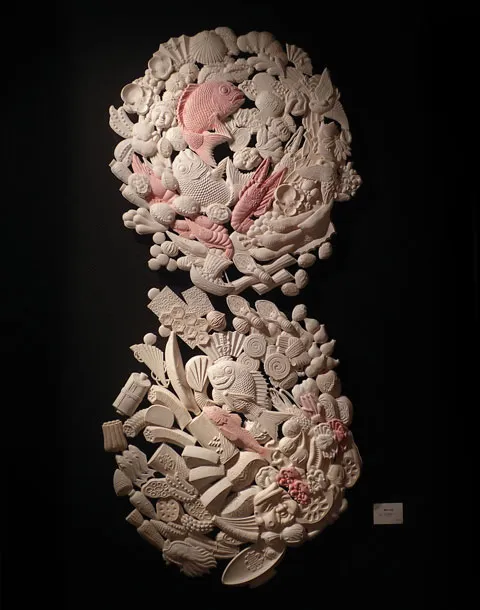 Tetsuya Nagata’s Osechi is a tribute to the traditional Japanese food prepared during the New Year.
 Left: Hanging inside an Andaz Tokyo hotel elevator is Nagata’s Where the Mantis Dwells. Right: Nagata’s works have deep philosophical symbolism.
 Nagata’s work Spreading Out into the Great Sea is located inside an elevator of the luxury hotel Andaz Tokyo Toranomon Hills.
 Top: The Blessed Flow of the Treasure Chest. Bottom: Watching a Sublime Waterfall with the Dancing Lotus.
 Nagata’s work Dancing in the Sun (Left) and a wooden Wagashi mould (Right).
 Nagata’s Seashore with the Inflowing Tide.